
Who was Frank Morris?
Hear Frank Morris's story
Chapter 1 of The Alcatraz Escape · the full story is in the app
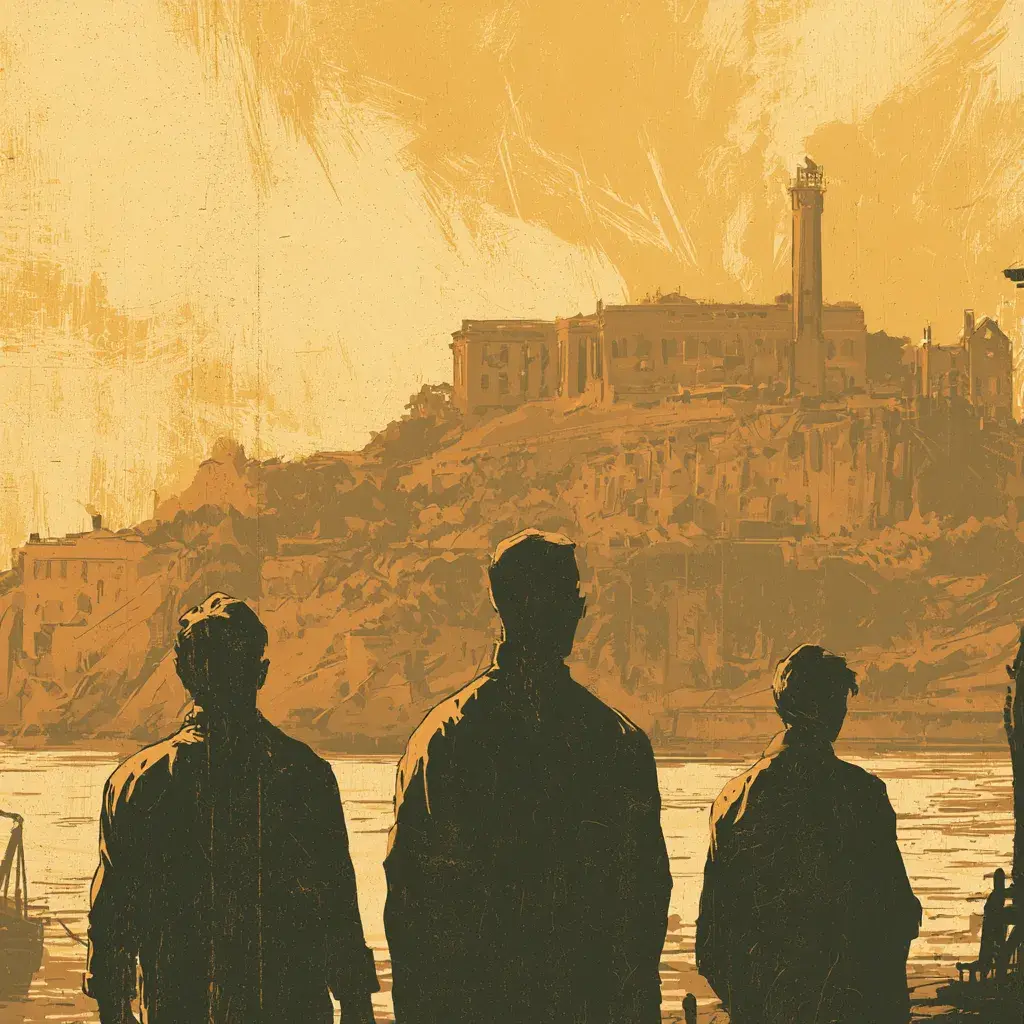
Frank Lee Morris (September 1, 1926 - disappeared June 11, 1962) was an American criminal born in Washington, D.C., known for orchestrating the 1962 escape from Alcatraz Federal Penitentiary alongside brothers John and Clarence Anglin. With a reported IQ of 133, Morris planned the breakout using tools and ventilation ducts, departing the island by raft. He was never definitively found; the FBI concluded in 1979 that he likely drowned, though his fate remains officially unresolved.
American bank robber who escaped Alcatraz in 1962 and was never found.
Don't stop at the facts — continue Frank Morris's story in free narrated chapters on Chunks.
See how Chunks works → Download on iOS
 Download on Android
Quick facts
- Born
- 1 September 1926
- Birthplace
- Washington, D.C.
- Died
- 11 June 1962
- Nationality
- United States
- Occupation
- Criminal
Frank Morris: key facts
- Frank Lee Morris was born on September 1, 1926, in Washington, D.C., to a mother named Clara.
- Morris was orphaned at age 11 and spent the rest of his childhood moving through foster homes.
- He had an IQ of 133, placing him in the top 2 percent of the general population by that measure.
- In April 1955 Morris escaped from Louisiana State Penitentiary with fellow inmate William Martin, but was later recaptured during a burglary in Kansas City, Missouri.
- Morris arrived at Alcatraz Federal Penitentiary on January 18, 1960, as inmate AZ1441.
- On the night of June 11, 1962, Morris escaped Alcatraz alongside brothers John and Clarence Anglin by crawling through a ventilation duct and launching an improvised raft into San Francisco Bay.
- In 1979 the FBI closed its file on Morris's case, concluding he most likely drowned while attempting to cross San Francisco Bay, though no body was ever found.
A Childhood Without Roots
Frank Lee Morris was born on September 1, 1926, in Washington, D.C., to a woman named Clara, who had run away from home in her youth and refused to settle down. Clara gave him the surname of a civil engineer she claimed to have married, though he was not actually Morris's father. Unable or unwilling to raise him herself, she placed him in a foster home and then an orphanage, visiting him only twice a week. The relationship between mother and son was never close; Clara was prone to uncontrolled rages and offered him little real attention.
Those who knew him as a boy described Morris as affable and quiet, yet by age six he was already stealing small change from a teacher's desk and rifling through other children's lunch boxes, behavior that tended to follow his mother's visits. He later told people that his parents had died in 1937, though this appears to have been a story he told rather than the truth. He was orphaned in a more official sense at age eleven and spent the remainder of his childhood cycling through foster homes, with no stable family base.
Morris's criminal record began early. He was convicted of his first offense at thirteen, and by his late teens had accumulated arrests covering narcotics possession and armed robbery. He was later arrested in Miami Beach, Florida, on charges of grand larceny, auto theft, and armed robbery. Despite this trajectory, he was an unusually intelligent man, testing in the top two percent of the general population with an IQ of 133.
Prison Record and a First Escape
Morris served time in Florida and Georgia before being sent to the Louisiana State Penitentiary, where he received a ten-year sentence for robbery and marijuana possession. In April 1955, he broke out of that institution alongside fellow inmate William Martin. The two men hitchhiked away from the prison, caught a ride with an African American farmer, and were dropped off near an oil refinery outside Baton Rouge, Louisiana.
Morris and Martin spent several months at large in New Orleans, during which they scouted a bank in the nearby town of Slidell for a potential robbery, before heading north to Kansas City, Missouri. There, about a year after his escape, Morris was caught committing a burglary alongside a third accomplice, Earl Branci. This recapture ultimately led to his transfer to the federal prison system's most secure facility.
Morris arrived at Alcatraz Federal Penitentiary on January 18, 1960, and was assigned inmate number AZ1441. He was placed in Cell No. 138 on the outside B Block, next door to Allen West. It was at Alcatraz that his path crossed with brothers John and Clarence Anglin, with some accounts suggesting Morris had already known John Anglin from an earlier stretch at Atlanta Penitentiary.
Planning the Breakout
Accounts differ on who first conceived the escape that would make Morris famous. One version credits Morris with devising the scheme after a fellow inmate in the brush shop told him about a ventilation fan motor removed from a shaft years earlier and never replaced, sarcastically suggesting he simply ask a guard for the key. In this telling, Morris waited for West to be released from solitary confinement in early 1962 before bringing West and the Anglin brothers into the plan. West himself later claimed the idea was his, inspired while painting the prison roof in 1961, and said he had pitched it to the Anglins first. Prison officials were skeptical of West's version given his reputation, and tended to credit Morris as the driving force, though at least one former inmate later claimed John Anglin had been the true mastermind.
Whatever its origin, the escape took roughly six months of secretive preparation. The four men enlarged ventilation ducts beneath their sink basins using discarded saw blades, mess-hall spoons, and a drill improvised from a vacuum cleaner motor, concealing their progress with painted cardboard and covering the noise using Morris's accordion. Once the openings were large enough, they slipped into an unguarded utility corridor behind their cells and climbed to a disused top level of the cellblock, turning it into a hidden workshop.
In this workshop the men built equipment for their crossing of San Francisco Bay: life preservers sewn from more than fifty stolen raincoats, following a design Morris found in a March 1962 issue of Popular Mechanics, and a roughly six-by-fourteen-foot rubber raft with hand-stitched seams sealed using plastic cement and steam-pipe heat. Morris also drew on other magazine articles, including one on resin casting and another on bay channel buoys from a May 1962 issue of Sports Illustrated, apparently to help plan navigation. To mask their nightly absences from their cells, and eventually their disappearance entirely, the men sculpted convincing dummy heads from soap, toothpaste, concrete dust, and toilet paper, finished with paint and real hair swept from the barbershop floor.
The Night of June 11, 1962
After lights-out, Morris and the Anglin brothers set their dummy heads in their bunks and left their cells for the final time, while West discovered that cement he had used to reinforce his own vent had hardened and trapped his grille in place, leaving him behind. The three others climbed the ventilation shaft to the roof, and guards heard a crash but never investigated it. They slid down a kitchen vent pipe roughly fifty feet to the ground, scaled two twelve-foot barbed-wire fences, and reached a blind spot near the island's power plant, where they inflated their raft using a modified concertina as a bellows. Around 10 p.m., they launched into the bay and vanished from history.
The escape went undiscovered until the next morning, when guards found the dummy heads in the beds. A ten-day land, sea, and air search followed, turning up a paddle near Angel Island, a plastic-wrapped wallet belonging to Anglin family contacts, and two life vests recovered from the bay and a nearby beach in the following days. Nothing else connected to the three men was ever found, and no raft was conclusively recovered despite later disputed reports of one spotted on Angel Island.
An Open Case
The FBI's working theory held that Morris and the Anglins drowned attempting to reach the mainland, reasoning that men who left behind prized personal effects would only have done so if death were imminent. Even so, investigators also operated on the possibility the men survived, since no bodies ever surfaced. The Bureau formally closed its file in December 1979 after seventeen years, concluding the three most likely drowned in the bay's cold currents while trying to reach Angel Island, though the case was handed to the U.S. Marshals Service, which kept it open.
Over the decades that followed, numerous claimed sightings, letters, and deathbed confessions surfaced, none definitively verified. Hoax calls and a mocking postcard reached authorities within days of the escape. Later developments included disputed reports of a stolen car matching descriptions near the bay, a 2014 ocean-current study suggesting survival was plausible if the men left at the right time, and a 2015 documentary featuring photographs a family friend claimed showed the Anglin brothers alive in Brazil in 1975, though experts disagreed on their authenticity and Morris himself was never identified in any comparable image. No evidence has ever conclusively placed Morris anywhere after that June night in 1962, and his case remained part of an active federal warrant for decades afterward.
Frank Morris: timeline
- 1926Born in Washington, D.C., to a mother named Clara who was not married to the man she named as his father.
- 1930sOrphaned at age 11 after his parents reportedly died, spending the rest of his childhood moving through foster homes.
- 1930s-40sBegan a long criminal record, committing his first offense at age 13 and later facing charges including narcotics possession and armed robbery.
- 1950sArrested in Miami Beach, Florida, for grand larceny, auto theft and armed robbery, and later served time in Florida and Georgia.
- 1950sSentenced to ten years at Louisiana State Penitentiary for robbery and marijuana possession.
- 1955-04Escaped from Louisiana State Penitentiary with fellow inmate William Martin, later spending months in New Orleans and scouting a bank in Slidell.
- 1956Recaptured in Kansas City, Missouri, while committing a burglary with a third accomplice, Earl Branci.
- 1960-01-18Transferred to Alcatraz Federal Penitentiary as inmate AZ1441.
- 1960-01-30Placed in Cell No. 138 on outside B Block at Alcatraz, next to cellmate Allen West.
- 1961-62Spent roughly six months with John and Clarence Anglin and Allen West secretly widening ventilation ducts and building escape gear from stolen and improvised materials.
- 1962-06-11Disappeared from Alcatraz alongside John and Clarence Anglin, leaving a dummy head in his bunk and departing the island on a handmade raft.
- 1979FBI closed its investigation, concluding Morris most likely drowned in San Francisco Bay, though his body was never recovered.
Listen: stories featuring Frank Morris
Narrated chapters from the Chunks Microlearning app. Read a preview here, or listen to the full story in the app.
Continue Frank Morris's story
You've read the summary — hear the full story as narrated 5-minute chapters on Chunks, alongside 200+ figures and events from history, philosophy and science. Free to start on iOS and Android.