
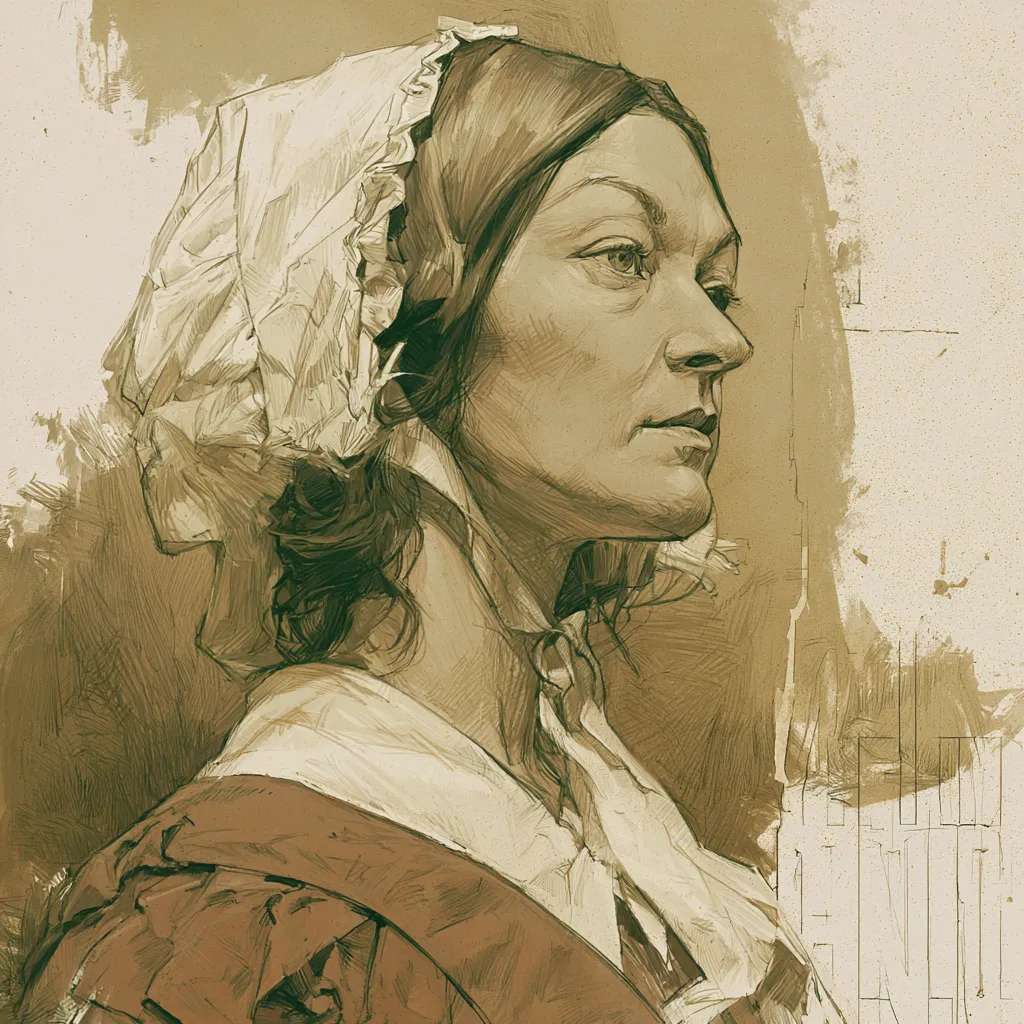
Who was Florence Nightingale?
Florence Nightingale (12 May 1820 – 13 August 1910) was a British nurse, statistician and social reformer who founded modern nursing. She led a team of nurses at the Barrack Hospital in Scutari during the Crimean War, where soldiers' letters home earned her the name "the Lady with the Lamp". Her later work proved that most military deaths came from preventable disease, not battlefield wounds.
British nurse and social reformer who revolutionized hospital sanitation during the Crimean War and established modern nursing as a respected profession.
Don't stop at the facts — continue Florence Nightingale's story in free narrated chapters on Chunks.
Or get it straight away:
 Download on iOS
 Download on Android
Quick facts
- Born
- 12 May 1820
- Birthplace
- Florence, Grand Duchy of Tuscany (modern Italy)
- Died
- 13 August 1910 (aged 90)
- Place of death
- Mayfair, London, England
- Nationality
- British
- Occupation
- Nurse, statistician, social reformer, writer
- Known for
- Founding modern nursing; pioneering the use of statistics in public health
Florence Nightingale: key facts
- Named after Florence, the Italian city where she was born to wealthy English parents travelling in Europe.
- Arrived at the Barrack Hospital in Scutari (modern Üsküdar, Istanbul) in November 1854 with 38 volunteer nurses.
- Popularised the polar area diagram — a circular chart form still used today — to show that disease, not combat, was killing British soldiers.
- Elected the first woman member of the Royal Statistical Society in 1859.
- Opened the Nightingale Training School for Nurses at St Thomas' Hospital, London, in 1860 — the first secular nursing school of its kind.
- In 1907 became the first woman to receive the Order of Merit.
- International Nurses Day is held on 12 May every year to mark her birthday.
Early life and the decision to nurse
Florence Nightingale was born in Florence on 12 May 1820, the younger daughter of William and Frances Nightingale, a wealthy English couple then on an extended European tour. She grew up between the family's two houses — Embley Park in Hampshire and Lea Hurst in Derbyshire — and was given an unusually rigorous education by her father, including mathematics, Greek, Latin, history and philosophy.
In 1837, aged 16, she recorded what she described as a call from God to serve others. Nursing at the time was not a respectable profession for a woman of her class; hospital nurses were largely untrained and the work carried a poor reputation. Her family resisted for years. She eventually trained at the Institution of Deaconesses at Kaiserswerth in Germany in 1851, and in 1853 took an unpaid post running the Institute for the Care of Sick Gentlewomen on Upper Harley Street in London.
The Crimean War and Scutari
Reports in The Times about the neglect of wounded British soldiers in the Crimean War caused public outrage in 1854. Sidney Herbert, the Secretary at War and a personal friend, asked Nightingale to lead a party of nurses to the military hospitals at Scutari, across the Bosphorus from Constantinople. She arrived in November 1854 with 38 volunteers.
The Barrack Hospital was overcrowded and filthy. Its water supply was contaminated, its sewers were blocked, and there was almost no ventilation, bedding, soap or basic equipment. Nightingale organised supplies, laundry, food and record-keeping, and made night rounds carrying a lamp — the detail that gave her the popular name "the Lady with the Lamp", first reported in The Times and later fixed in the public imagination by Longfellow's 1857 poem "Santa Filomena".
Nightingale's own account of what happened next is more honest than the legend. Death rates at Scutari stayed catastrophically high through the winter of 1854–55 and only fell after a government Sanitary Commission arrived in March 1855 and flushed the sewers and improved ventilation. Studying the figures afterwards, she concluded that the hospital's own insanitary conditions had killed far more men than their wounds had. That conclusion, not the lamp, shaped the rest of her life's work.
Statistics as an instrument of reform
Back in England, Nightingale turned to data. Working with the statistician William Farr, she analysed mortality in the British Army and presented the results in her 1858 report on the health and administration of the army — a document dense with tables and charts aimed squarely at ministers and generals who would never read a statistical paper.
Her best-known device is the polar area diagram, a circular chart in which each wedge's area represents deaths in a given month, shaded to separate deaths from preventable disease, from wounds, and from other causes. The visual argument was impossible to miss: the preventable-disease wedges dwarfed the rest. It is one of the earliest examples of data visualisation used deliberately to change government policy.
In 1859 she became the first woman elected to the Royal Statistical Society, and she was later made an honorary member of the American Statistical Association.
Nursing as a trained profession
In 1859 Nightingale published Notes on Nursing: What It Is, and What It Is Not, a short and famously blunt book written for ordinary readers as much as for nurses. Its themes — fresh air, clean water, light, warmth, diet and careful observation of the patient — followed directly from what she had seen at Scutari.
The Nightingale Fund, raised by public subscription in recognition of her Crimean work, paid for the Nightingale Training School for Nurses, which opened at St Thomas' Hospital in London in 1860. It established nursing as a trained, salaried and respectable profession with its own standards, and its graduates carried the model to hospitals across Britain and abroad.
From around 1857 Nightingale was largely confined to her home by chronic illness, often attributed to an infection contracted in Crimea. She nevertheless spent the next fifty years writing reports, briefing officials and corresponding relentlessly on hospital design, army health and sanitary reform in India. She died in her sleep in London on 13 August 1910, aged 90.
Florence Nightingale: timeline
- 1820Born on 12 May in Florence, Italy.
- 1837Records a calling to serve others, aged 16.
- 1851Trains at the Institution of Deaconesses, Kaiserswerth, Germany.
- 1853Becomes superintendent of the Institute for the Care of Sick Gentlewomen, London.
- 1854Arrives at the Barrack Hospital, Scutari, with 38 nurses during the Crimean War.
- 1855A government Sanitary Commission overhauls the hospital's sewers and ventilation; mortality falls sharply.
- 1858Publishes her army health report with its polar area diagrams.
- 1859Elected the first woman member of the Royal Statistical Society.
- 1859Publishes Notes on Nursing.
- 1860The Nightingale Training School for Nurses opens at St Thomas' Hospital, London.
- 1883Awarded the Royal Red Cross by Queen Victoria.
- 1907Becomes the first woman awarded the Order of Merit.
- 1910Dies on 13 August in Mayfair, London, aged 90.
Listen: stories featuring Florence Nightingale
Narrated chapters from the Chunks Microlearning app. Read a preview here, or listen to the full story in the app.

Frequently asked questions about Florence Nightingale
What is Florence Nightingale most famous for?
Florence Nightingale is most famous for founding modern nursing. She led the nursing effort at the Barrack Hospital in Scutari during the Crimean War, established the first secular nursing school at St Thomas' Hospital in London in 1860, and used statistics to prove that preventable disease — not battlefield wounds — was the main cause of death among British soldiers.
When was Florence Nightingale born and when did she die?
She was born on 12 May 1820 in Florence, Italy, and died on 13 August 1910 in Mayfair, London, at the age of 90.
Why was Florence Nightingale called the Lady with the Lamp?
The name came from her night rounds at the Barrack Hospital in Scutari, where she walked the wards carrying a lamp after the medical officers had retired. It was reported in The Times in 1854 and made permanent by Henry Wadsworth Longfellow's 1857 poem "Santa Filomena".
Was Florence Nightingale a statistician?
Yes. She was a serious and influential statistician who used mortality data to argue for sanitary reform in the British Army, popularised the polar area diagram as a way of presenting that data to politicians, and in 1859 became the first woman elected to the Royal Statistical Society.
Why is International Nurses Day on 12 May?
12 May is Florence Nightingale's birthday. The International Council of Nurses has marked the date as International Nurses Day since 1974 in recognition of her role in establishing nursing as a trained profession.
Continue Florence Nightingale's story
You've read the summary — hear the full story as narrated 5-minute chapters on Chunks, alongside 200+ figures and events from history, philosophy and science. Free to start on iOS and Android.