
Who was Fidel Castro?
Hear Fidel Castro's story
Chapter 1 of The Cuban Missile Crisis · the full story is in the app
Fidel Castro (13 August 1926 - 25 November 2016) was a Cuban revolutionary and politician who led Cuba from 1959 to 2011, serving as prime minister, then president, and as first secretary of the Communist Party. Born in Biran, he overthrew Fulgencio Batista in the Cuban Revolution, built a one-party socialist state allied with the Soviet Union, and triggered the 1962 Cuban Missile Crisis. He died in Havana.
Cuban revolutionary leader whose alliance with the Soviet Union led to the placement of nuclear missiles on the island, triggering the 1962 Cuban Missile Crisis. He ruled Cuba as a communist state for nearly five decades.
Don't stop at the facts — continue Fidel Castro's story in free narrated chapters on Chunks.
See how Chunks works → Download on iOS
 Download on Android
Quick facts
- Born
- 13 August 1926
- Birthplace
- Birán
- Died
- 25 November 2016
- Place of death
- Havana
- Nationality
- Cuba
- Occupation
- Politician, lawyer, partisan
Fidel Castro: key facts
- Fidel Castro was born on 13 August 1926 at his father's farm in Birán, Cuba, the son of a Spanish migrant farmer.
- Castro studied law at the University of Havana before leading a failed attack on the Moncada Barracks in 1953, for which he was imprisoned.
- In Mexico he co-founded the 26th of July Movement with his brother Raul Castro and Ernesto Che Guevara to overthrow President Fulgencio Batista.
- After Batista's overthrow in 1959, Castro became Cuba's prime minister, a post he held until 1976, then served as president from 1976 to 2008.
- He aligned Cuba with the Soviet Union, allowing the placement of Soviet nuclear missiles that triggered the 1962 Cuban Missile Crisis.
- Castro led the Non-Aligned Movement from 1979 to 1983 and sent Cuban troops to support allies in conflicts including the Angolan Civil War.
- He transferred power to his brother Raul Castro in 2006 and formally stepped down as president in 2008, dying in Havana on 25 November 2016 at age 90.
A Wealthy Farmer's Son Turned Radical Student
Fidel Alejandro Castro Ruz was born out of wedlock on 13 August 1926 at his father's farm in Birán, Cuba. His father, Ángel Castro y Argiz, was a Spanish immigrant farmer from Galicia, and his mother, Lina Ruz González, had originally been the household's servant before becoming Ángel's mistress and later his second wife. Sent away at age six to live with a teacher in Santiago de Cuba, Fidel was baptized into the Catholic Church at eight, which allowed him to attend Catholic schools, eventually studying at the Jesuit-run El Colegio de Belén in Havana.
In 1945 Castro began a law degree at the University of Havana, a campus notorious for its violent student gang politics. He became consumed by anti-imperialist ideas, opposed United States intervention in the Caribbean, and ran unsuccessfully for a student federation presidency. He grew critical of President Ramón Grau's corrupt government and in 1947 joined the newly formed Party of the Cuban People, led by Eduardo Chibás, remaining loyal to the party even after its electoral defeat.
Castro's political education extended beyond Cuba. In 1947 he joined a planned but aborted expedition to overthrow the Dominican Republic's Rafael Trujillo. In 1948 he traveled to Bogotá, Colombia, where the assassination of a leftist leader sparked citywide riots; Castro joined the uprising by seizing weapons from a police station, though investigators later cleared him of any killings. Back in Cuba, he married Mirta Díaz Balart, had a son named Fidelito, and drifted further left, concluding that Cuba's problems stemmed from capitalism itself rather than merely corrupt individuals. He completed his law degree in 1950 and opened a practice serving poor clients, though it proved financially unviable.
Armed Rebellion, Imprisonment, and Exile
General Fulgencio Batista seized power in a 1952 coup, cancelling scheduled elections in which Castro had been a congressional candidate. Convinced that legal opposition was futile, Castro built a clandestine organization known as "The Movement," recruiting over a thousand members and stockpiling weapons. On 26 July 1953 he led roughly 165 fighters in an assault on the Moncada Barracks near Santiago, intending to spark a nationwide uprising. The attack failed disastrously; many rebels were killed outright or captured and tortured, with 22 executed without trial. Castro escaped into the mountains but was soon captured.
At his trial, Castro acted as his own defense lawyer, delivering a lengthy speech later published as History Will Absolve Me, in which he argued Batista's government was the true lawbreaker for having seized power unconstitutionally. Sentenced to 15 years, he served his time in relatively comfortable conditions on the Isla de Pinos, reading widely in Marx, Lenin, and Martí, until a 1955 amnesty secured his release.
Forced into exile after further unrest, Castro went to Mexico, where he organized the 26th of July Movement with his brother Raúl and the Argentine revolutionary Ernesto "Che" Guevara, training under veteran guerrilla fighter Alberto Bayo. In November 1956 Castro and 81 armed companions sailed for Cuba aboard the overcrowded yacht Granma. The crossing went badly wrong, arriving days late and missing a planned coordinated uprising. After landing, government forces killed or captured most of the group, leaving only about nineteen survivors, including the Castro brothers and Guevara, to retreat into the Sierra Maestra mountains and begin a guerrilla campaign.
Guerrilla Victory and the Birth of a New Government
From their mountain base, Castro's small guerrilla band gradually expanded through raids on army outposts, gaining recruits, arms, and the attention of international media, notably a sympathetic New York Times profile. Despite being vastly outnumbered, the rebels repelled a major 1958 army offensive and went on the counterattack, cutting the island in two. As Batista's support collapsed both domestically and among US backers, he fled into exile on 31 December 1958 with a vast personal fortune. Castro's forces entered Havana shortly after, and he arrived in the capital on 9 January 1959 to mass celebration.
A moderate lawyer, Manuel Urrutia, was installed as provisional president, though Castro held real power from the outset and was formally sworn in as prime minister in February 1959. His government executed hundreds of Batista-era officials following hasty trials, redistributed land under agrarian reform laws, and began nationalizing industries, moves popular with the poor but alarming to the propertied classes, foreign investors, and the United States.
Tensions escalated quickly. After Cuba's government seized foreign-owned oil refineries and other US assets, Washington imposed a trade embargo. Castro suppressed opposition media, formed neighborhood surveillance committees called Committees for the Defense of the Revolution, and built a militia force, while increasingly aligning Cuba with the Soviet Union. He initially denied being a communist to the press even as he quietly brought Marxists into senior government positions.
Bay of Pigs, Nuclear Missiles, and Formal Communism
In April 1961, CIA-backed Cuban exiles invaded at the Bay of Pigs, hoping to topple Castro's government. Cuban forces defeated the invasion within days, and Castro publicly declared for the first time that Cuba's revolution was socialist. Later that year he openly proclaimed himself a Marxist-Leninist, and by 1965 the merged revolutionary factions had become the Cuban Communist Party, with Castro as its first secretary.
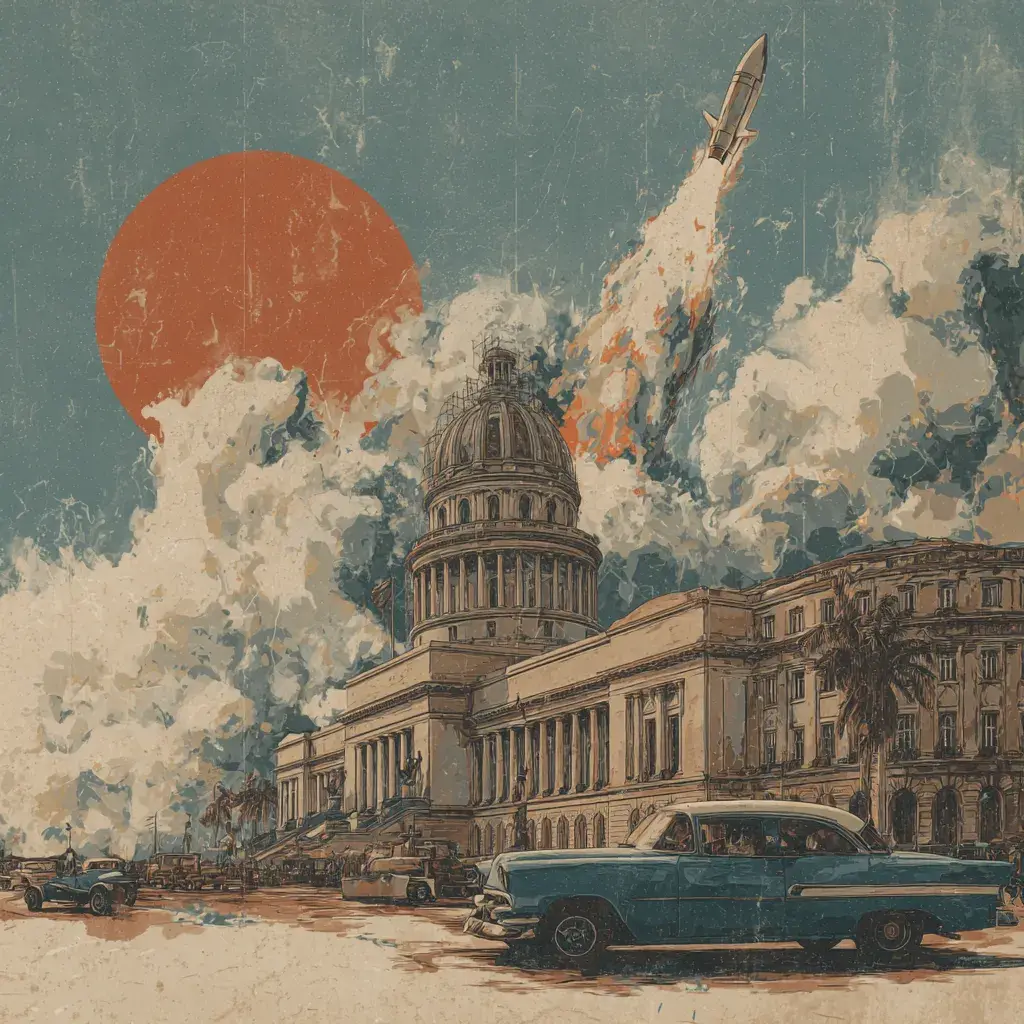
Seeking to offset American nuclear superiority and protect Cuba from invasion, Castro agreed to let the Soviet Union station nuclear missiles on the island. American reconnaissance discovered the missiles in October 1962, triggering the Cuban Missile Crisis. Washington imposed a naval quarantine, and after tense negotiations Soviet premier Nikita Khrushchev agreed to withdraw the missiles in exchange for an American pledge not to invade Cuba, a deal reached without Castro's direct involvement that left him feeling betrayed.
Throughout the 1960s Castro consolidated one-party rule, nationalized remaining private enterprise, and built an extensive system of free healthcare and education alongside continued repression of dissidents, independent press, and perceived social deviance, including the persecution of gay men. He also positioned Cuba as a champion of revolutionary movements abroad, hosting and arming leftist guerrillas from across Latin America and Africa, even as this strained relations with an increasingly cautious Soviet leadership under Leonid Brezhnev.
Exporting Revolution, Economic Collapse, and Retirement
Castro dispatched Cuban troops and advisers to conflicts across the developing world, including Algeria's Sand War, the Angolan Civil War, the Ogaden War in support of Ethiopia, and the Yom Kippur War, while backing the Sandinistas in Nicaragua and Marxist movements in Chile and Grenada. These campaigns, combined with his leadership of the Non-Aligned Movement from 1979 to 1983, raised Cuba's international profile far beyond what its size would suggest, even as critics noted the human cost of these foreign deployments.
The 1991 collapse of the Soviet Union cut off the subsidies that had propped up Cuba's economy, plunging the country into the severe shortages of what Castro termed the "Special Period." Rationing, blackouts, and food scarcity became widespread, prompting cautious market reforms such as legalizing small private enterprises and the US dollar, alongside a growing tourism industry. Despite the hardship, Castro's government survived the wave of communist collapses that swept Eastern Europe, later finding new allies in Latin America's "Pink Tide," particularly Hugo Chávez's Venezuela, with whom Cuba formed the Bolivarian Alternative for the Americas.
Declining health forced Castro to hand presidential duties to his brother Raúl in July 2006, a transfer made permanent in February 2008. In retirement he remained a public commentator on world affairs, writing newspaper columns and occasionally meeting foreign leaders, while acknowledging past injustices such as the persecution of gay men. He died in Havana on 25 November 2016 at the age of 90; his ashes were carried in a funeral procession retracing his 1959 victory route before being entombed in Santiago de Cuba.
Fidel Castro: timeline
- 1926Born at his father's farm in Birán, Cuba, the son of a Spanish migrant farmer.
- 1945-50Studied law at the University of Havana, becoming involved in student activism and anti-imperialist politics.
- 1953Led a failed attack on the Moncada Barracks aiming to overthrow President Fulgencio Batista, resulting in his imprisonment.
- 1955Released from prison under amnesty and soon after went into exile in Mexico, where he formed the 26th of July Movement with Raúl Castro and Che Guevara.
- 1956-58Led a guerrilla war from the Sierra Maestra mountains against Batista's forces after landing in Cuba aboard the Granma.
- 1959Became prime minister of Cuba after Batista fled the country, consolidating power and beginning sweeping nationalizations.
- 1961Declared Cuba a socialist state after Cuban forces defeated a CIA-backed exile invasion at the Bay of Pigs.
- 1962Agreed to allow Soviet nuclear missiles on Cuban soil, precipitating the Cuban Missile Crisis with the United States.
- 1976Became president of Cuba under a new constitution, while remaining first secretary of the Communist Party.
- 1975-88Sent Cuban troops to support Marxist allies in conflicts including the Angolan Civil War and the Ogaden War.
- 2006Fell seriously ill and transferred presidential duties to his brother Raúl Castro.
- 2016Died in Havana at the age of 90.
Listen: stories featuring Fidel Castro
Narrated chapters from the Chunks Microlearning app. Read a preview here, or listen to the full story in the app.
Frequently asked questions about Fidel Castro
Who was Fidel Castro?
Fidel Castro was a Cuban revolutionary who overthrew the government of Fulgencio Batista in 1959 and ruled Cuba as a communist state until 2008. He aligned Cuba closely with the Soviet Union during the Cold War.
What was Castro's role in the Cuban Missile Crisis?
Castro agreed to allow the Soviet Union to place nuclear missiles in Cuba as a deterrent against a feared US invasion. This decision triggered a tense standoff between the United States and Soviet Union in October 1962.
How long did Fidel Castro lead Cuba?
Castro led Cuba for nearly 49 years, from 1959 until he handed power to his brother Raul Castro in 2008 due to failing health. He remained a prominent political figure until his death in 2016.
Continue Fidel Castro's story
You've read the summary — hear the full story as narrated 5-minute chapters on Chunks, alongside 200+ figures and events from history, philosophy and science. Free to start on iOS and Android.