Who was Constantine XI Palaiologos?
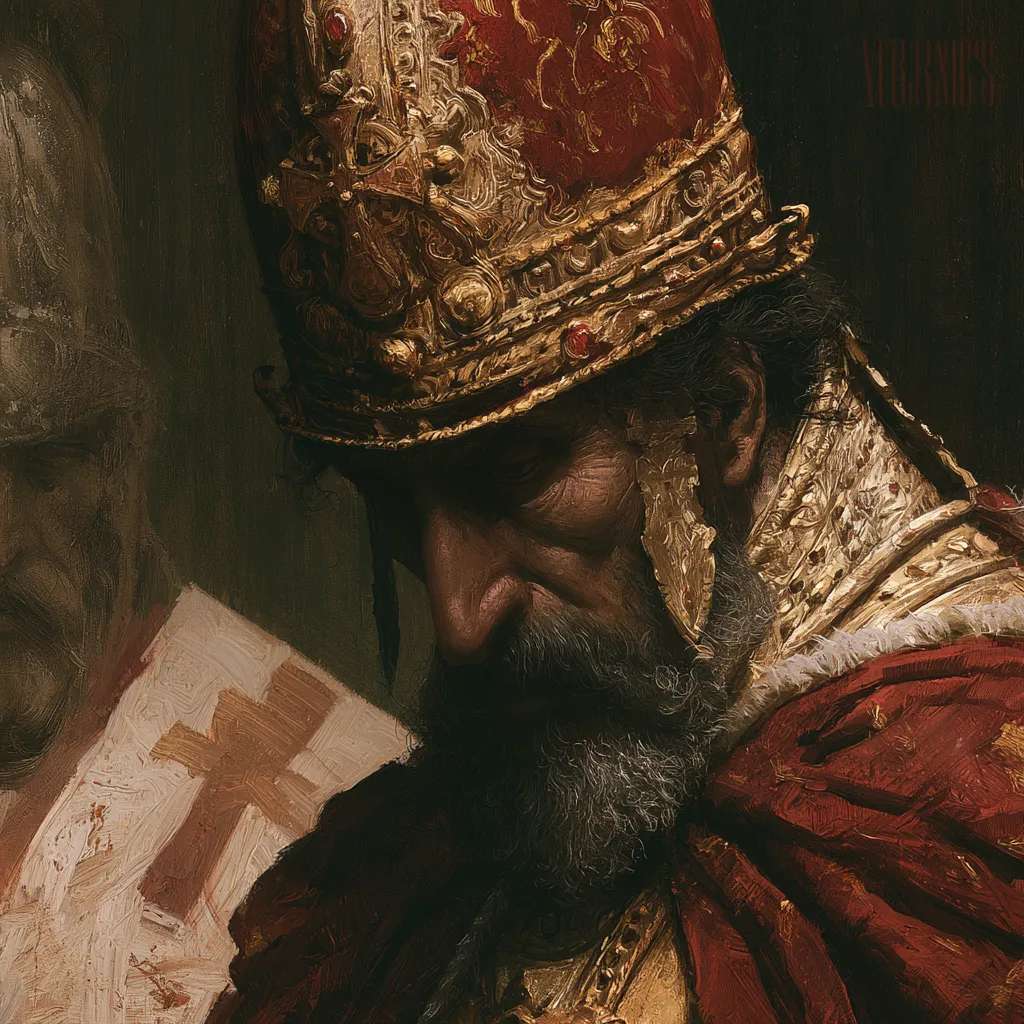
Constantine XI Palaiologos (8 February 1404 – 29 May 1453) was the last Byzantine emperor, who ruled from 1449 until his death defending Constantinople against the Ottoman siege. When Sultan Mehmed II's army of up to 80,000 men stormed the city, Constantine refused to flee, dying in battle. His death ended the Eastern Roman Empire, which had endured for over a thousand years.
The last Byzantine Emperor who died defending Constantinople during the Ottoman siege in 1453. His death marked the end of the thousand-year Byzantine Empire and the fall of one of history's greatest cities.
Don't stop at the facts — continue Constantine XI Palaiologos's story in free narrated chapters on Chunks.
Or get it straight away:
 Download on iOS
 Download on Android
Quick facts
- Born
- 8 February 1404
- Birthplace
- Constantinople
- Died
- 29 May 1453
- Place of death
- Constantinople
- Nationality
- Byzantine Empire
Constantine XI Palaiologos: key facts
- Constantine XI Palaiologos was born on 8 February 1404 in Constantinople and died on 29 May 1453, the day the city fell to Ottoman forces under Sultan Mehmed II.
- Constantine was the fourth son of Emperor Manuel II Palaiologos and Serbian noblewoman Helena Dragaš, from whom he inherited the surname Dragases.
- Before becoming emperor, Constantine ruled the Morea (Peloponnese) as Despot from 1428, extending Byzantine control across nearly the entire peninsula for the first time since the Fourth Crusade over two centuries earlier.
- Constantine was proclaimed emperor on 6 January 1449 in a small ceremony at Mystras rather than being crowned in Constantinople's Hagia Sophia, partly to avoid inflaming anti-unionist sentiment in the capital.
- When Sultan Mehmed II besieged Constantinople in April 1453 with an army estimated at up to 80,000 men, the city's defenders numbered fewer than 8,500, yet Constantine refused to abandon or surrender the city.
- No verified eyewitness account of Constantine's death survived, though the majority of contemporary Christian and Muslim sources agree he died fighting in battle rather than fleeing.
- Greek folklore later held that Constantine had not died but was turned to marble by an angel and hidden beneath Constantinople's Golden Gate, awaiting divine resurrection to reclaim the city — a legend known as the Marble Emperor.
A Prince of a Shrinking Empire
Constantine Dragases Palaiologos was born on 8 February 1404 in Constantinople, the fourth son of Emperor Manuel II Palaiologos and Helena Dragaš, a Serbian noblewoman and daughter of the ruler Konstantin Dejanović. The surname Dragases came directly from his mother's family, and Constantine used it alongside Palaiologos throughout his life. He was considered Porphyrogennetos, meaning born in the purple, a distinction reserved for sons born to a reigning emperor within the imperial palace.
The empire into which Constantine was born had contracted dramatically from its ancient extent. The Ottoman Turks had seized vast territories across Anatolia, Bulgaria, Macedonia, Serbia, and Thessaly over the course of the 14th century. By the time of Constantine's birth, Byzantium amounted to little more than Constantinople itself, the Peloponnese peninsula known as the Morea, and a scattering of Aegean islands, all while paying tribute to the Ottomans. Constantine's older brothers were assigned provinces to govern as despots, but the younger sons, Constantine among them, remained in Constantinople because there was simply not enough territory left to give them.
Soldier and Administrator in the Morea
Constantine's political career began in earnest after the failed Ottoman siege of Constantinople in 1422, when his brother John VIII trusted him enough to leave him as regent while travelling west to seek military allies. Constantine used that time to negotiate a peace treaty with the Ottoman sultan Murad II, demonstrating the combination of military confidence and practical diplomacy that would define his career. John appointed him Despot of the Morea in 1427 and he married Theodora, niece of Carlo I Tocco of Epirus, the following year, with her dowry including the town of Glarentza.
In the Morea, Constantine worked alongside his brothers Theodore and Thomas to bring nearly the entire Peloponnese under Byzantine control for the first time since the Fourth Crusade of 1204. His most celebrated early feat was the capture of Patras in 1429. After a siege of nearly two months, the city's defenders agreed to surrender if the Archbishop who held it did not return with reinforcements by the end of May. He did not return, and Constantine received the keys to the city on 4 June 1429, ending 225 years of foreign rule there. Constantine and Thomas also restored the ancient Hexamilion wall across the isthmus of the Peloponnese, completing the project by March 1444, as a defence against Ottoman incursions from the north.
Between 1444 and 1446, Constantine launched an ambitious campaign northward into central Greece and Thessaly, briefly capturing Athens and Thebes and raiding as far as the Pindus mountains. The offensive was ultimately crushed when Murad II marched south with an army of perhaps 60,000 men in 1446. The Ottomans destroyed the Hexamilion wall with cannon fire by 10 December, routed the defenders, and ravaged the Morea. Constantine and Thomas were forced to acknowledge Murad as their overlord, pay tribute, and swear never to rebuild the wall.
Accession as Emperor Without a Crown
John VIII Palaiologos died childless on 31 October 1448, and Constantine was the acknowledged favourite successor, supported by both his mother Helena Dragaš and his brother Thomas. Helena acted as regent to prevent their brother Demetrios, who had Ottoman backing and opposed the church union John had pursued, from seizing the throne before Constantine could arrive from the Morea. Murad II was informed and accepted the appointment on 6 December 1448. On 6 January 1449, in a small ceremony at Mystras, Constantine was proclaimed Emperor of the Romans and arrived in Constantinople on 12 March 1449.
The circumstances of his proclamation were unusual. No formal coronation took place in the Hagia Sophia, as was traditional. Both Constantine and the Patriarch of Constantinople, Gregory III Mammas, were supporters of the union between the Greek Orthodox and Catholic churches that had been declared at the Council of Florence in 1439. A public coronation by Gregory risked provoking the many Byzantines who fiercely opposed that union. Constantine took the position that his proclamation at Mystras had given him full imperial authority and referred to himself in his earliest surviving imperial document as 'Constantine Palaiologos in Christ true Emperor and Autocrat of the Romans.'
The Siege and the Final Stand
The new sultan Mehmed II began constructing the Rumelihisarı fortress on the Bosphorus in the spring of 1452, giving him control over sea traffic into Constantinople. Constantine protested, searched desperately for western military allies, and sent urgent appeals to Pope Nicholas V, Venice, Alfonso V of Aragon and Naples, and John Hunyadi of Hungary. The responses were almost uniformly inadequate. The most significant practical reinforcement arrived in January 1453 when the Genoese soldier Giovanni Giustiniani landed with 700 men and was appointed by Constantine as the commander of the land walls.
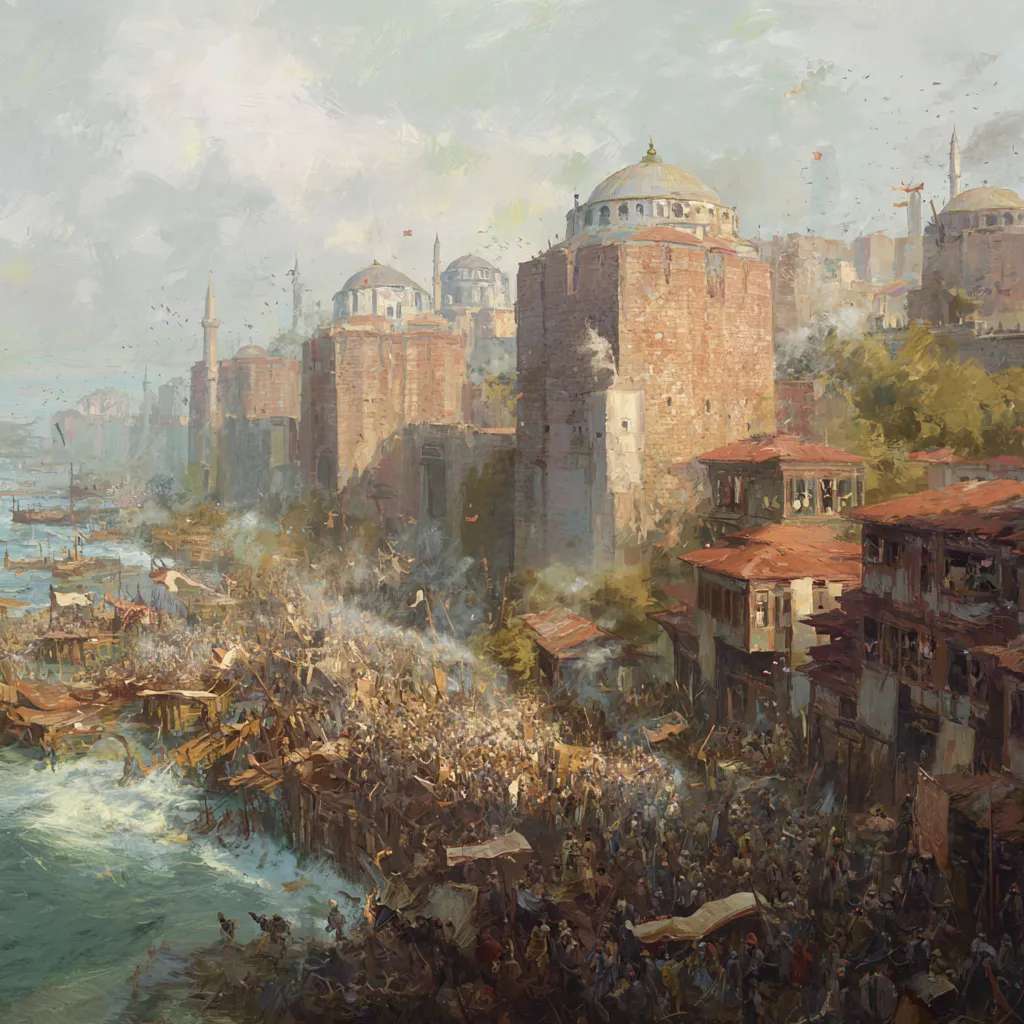
On 5 April 1453, Mehmed arrived outside the walls at the head of an army that may have numbered as many as 80,000 men. The defenders, by most estimates, totalled between 6,000 and 8,500. Bombardment of the walls began on 6 April. Constantine blocked the Ottoman fleet from entering the Golden Horn with a heavy chain stretched across its mouth. When Mehmed had his ships dragged overland on tracks across the hill behind Galata on 23 April, bypassing the chain entirely, the position of the defenders became increasingly desperate. Constantine rejected every suggestion that he flee and establish a government in exile. When Mehmed offered to spare the city's population in exchange for surrender, Constantine's recorded reply was that the city's people had resolved to die of their own free will.
In the early hours of 29 May 1453, the Ottomans launched their final assault. Giustiniani was mortally wounded after hours of fighting and was carried to the harbour, his departure causing the Genoese troops to waver. Ottoman soldiers entered through the Kerkoporta gate, which had been left unlocked, raised their flag above the walls, and broke the defence. Constantine died that day. No eyewitness account of his death survived, and accounts differ: the Greek historian Michael Critobulus wrote that the emperor died fighting, while other sources describe him being trampled in the crush or decapitated. Ottoman accounts consistently state that he was beheaded. His last reported words before the final charge were 'the city is fallen and I am still alive.'
The Marble Emperor and the Weight of His Name
Constantine's death ended an institution that traced its origin to Constantine the Great's foundation of Constantinople in 330 and the line of Roman emperors begun by Augustus roughly 1,480 years earlier. The symmetry was not lost on later commentators: the city founded by a Constantine had fallen under another Constantine, just as Old Rome had been founded by a Romulus and lost under Romulus Augustulus. In the Orthodox world, Constantine came to be regarded as a martyr, with his death in battle seen as erasing the stigma of his support for church union with Rome.
A legend that emerged among Greeks in the late 15th century held that Constantine had not died but had been transformed into marble by an angel at the moment of his death and hidden beneath the Golden Gate of Constantinople. There he waits for a divine signal to awaken, reclaim his sword, and drive the Turks from the city as far as their legendary homeland. This figure, known as the Marble Emperor, endured in Greek popular imagination well into the 19th and 20th centuries and was revived politically when the Greek King George I named his heir Constantine in 1868, with many Greeks hailing the new king as Constantine XII rather than Constantine I when he took the throne, seeing in him the fulfillment of the old prophecy.
Constantine XI Palaiologos: timeline
- 1404Born in Constantinople as the fourth son of Emperor Manuel II Palaiologos and Helena Dragaš, a Serbian noblewoman.
- 1423–1424Served as regent of Constantinople while his brother John VIII traveled to Western Europe seeking military aid against the Ottomans.
- 1428Proclaimed Despot of the Morea and married Theodora Tocco, whose dowry included the town of Glarentza, consolidating Byzantine control over the Peloponnese.
- 1444Led a military campaign into central Greece, capturing Athens and Thebes and raiding as far north as the Pindus mountains in Thessaly.
- 1446Suffered a catastrophic defeat when Murad II's army, using cannons, demolished the rebuilt Hexamilion wall and devastated the Morea, forcing Constantine to accept Ottoman suzerainty.
- 1449Proclaimed Emperor of the Romans at Mystras in a small ceremony, becoming the last reigning Byzantine emperor without ever receiving a formal coronation in Constantinople.
- 1452Mehmed II completed the Rumelihisarı fortress on the Bosphorus, effectively blockading Constantinople by sea and land, as Constantine urgently sought western military aid.
- 1453Mehmed II arrived outside Constantinople with an army estimated at up to 80,000 men and began bombarding the city's walls, while Constantine's defenders numbered fewer than 8,500.
- 1453Four western ships carrying soldiers, weapons, and supplies broke through the Ottoman blockade, briefly raising morale among Constantinople's defenders.
- 1453Died fighting as Ottoman forces broke through Constantinople's walls, ending the Byzantine Empire and the line of Roman emperors stretching back 1,480 years to Augustus.
Listen: stories featuring Constantine XI Palaiologos
Narrated chapters from the Chunks Microlearning app. Read a preview here, or listen to the full story in the app.
Continue Constantine XI Palaiologos's story
You've read the summary — hear the full story as narrated 5-minute chapters on Chunks, alongside 200+ figures and events from history, philosophy and science. Free to start on iOS and Android.