
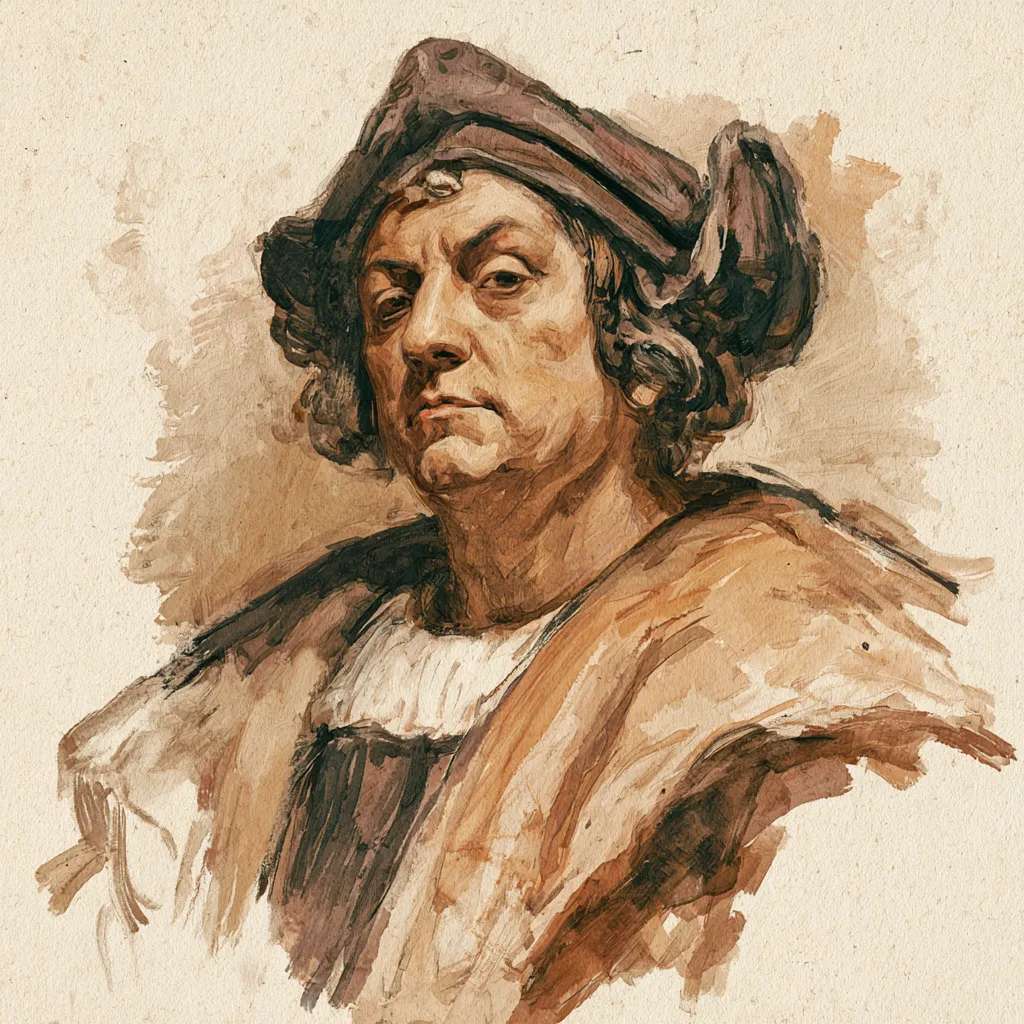
Who was Christopher Columbus?
Christopher Columbus (c. 1451 – 20 May 1506) was a Genoese navigator who, sailing for the Crown of Castile, made four voyages across the Atlantic between 1492 and 1504. He was seeking a western sea route to Asia and never accepted that he had not found one. His landfall in the Bahamas on 12 October 1492 began sustained contact between Europe and the Americas — and the conquest and enslavement that followed it.
Italian explorer whose 1492 voyage to the Americas initiated widespread European colonization and forever changed the course of world history. His expeditions connected two worlds and sparked centuries of exploration.
Don't stop at the facts — continue Christopher Columbus's story in free narrated chapters on Chunks.
Or get it straight away:
 Download on iOS
 Download on Android
Quick facts
- Born
- c. 1451 (before 31 October)
- Birthplace
- Republic of Genoa (modern Italy)
- Died
- 20 May 1506
- Place of death
- Valladolid, Crown of Castile (modern Spain)
- Nationality
- Genoese; sailed in the service of Castile
- Occupation
- Navigator, explorer, colonial governor
- Known for
- Four transatlantic voyages that opened sustained European contact with the Americas
Christopher Columbus: key facts
- Known as Cristoforo Colombo in Italian and Cristóbal Colón in Spanish.
- His proposal was rejected repeatedly — by Portugal, and initially by Castile — because expert advisers correctly judged his distance estimates to be far too short.
- Sailed from Palos de la Frontera on 3 August 1492 with three ships: the carrack Santa María and the caravels Niña and Pinta.
- Made landfall on 12 October 1492 on a Bahamian island the Lucayan people called Guanahaní, which he renamed San Salvador.
- Made four voyages in total, in 1492, 1493, 1498 and 1502.
- Arrested in 1500 by the royal commissioner Francisco de Bobadilla over his governance of Hispaniola and shipped back to Spain in chains.
- Never set foot on the mainland of North America, and died still convinced he had reached the outskirts of Asia.
Who was Christopher Columbus?
Christopher Columbus was born in the Republic of Genoa, most likely in the city itself, some time before 31 October 1451. He went to sea young, worked the Mediterranean and Atlantic trade routes, and by the 1480s was living in Portugal, then the leading European centre of oceanic navigation.
There he developed the plan that would occupy the rest of his life: reaching Asia by sailing west rather than around Africa. The idea rested on two serious errors. Columbus underestimated the circumference of the Earth and overestimated how far Asia extended eastward, which together put Japan roughly where the Caribbean actually is.
The flat Earth myth
The popular story that Columbus had to convince a flat-Earth establishment is not true. That the Earth is a sphere had been standard knowledge among educated Europeans since antiquity, and Eratosthenes had estimated its circumference with reasonable accuracy in the third century BC.
The experts who rejected Columbus's proposal — first in Portugal under John II, then in Castile — did so because they thought his numbers were wrong. They were right. An unbroken ocean of the size Columbus imagined would have been survivable; the real distance to Asia would have killed his crews. What saved the expedition was an unknown landmass in the way.
The four voyages
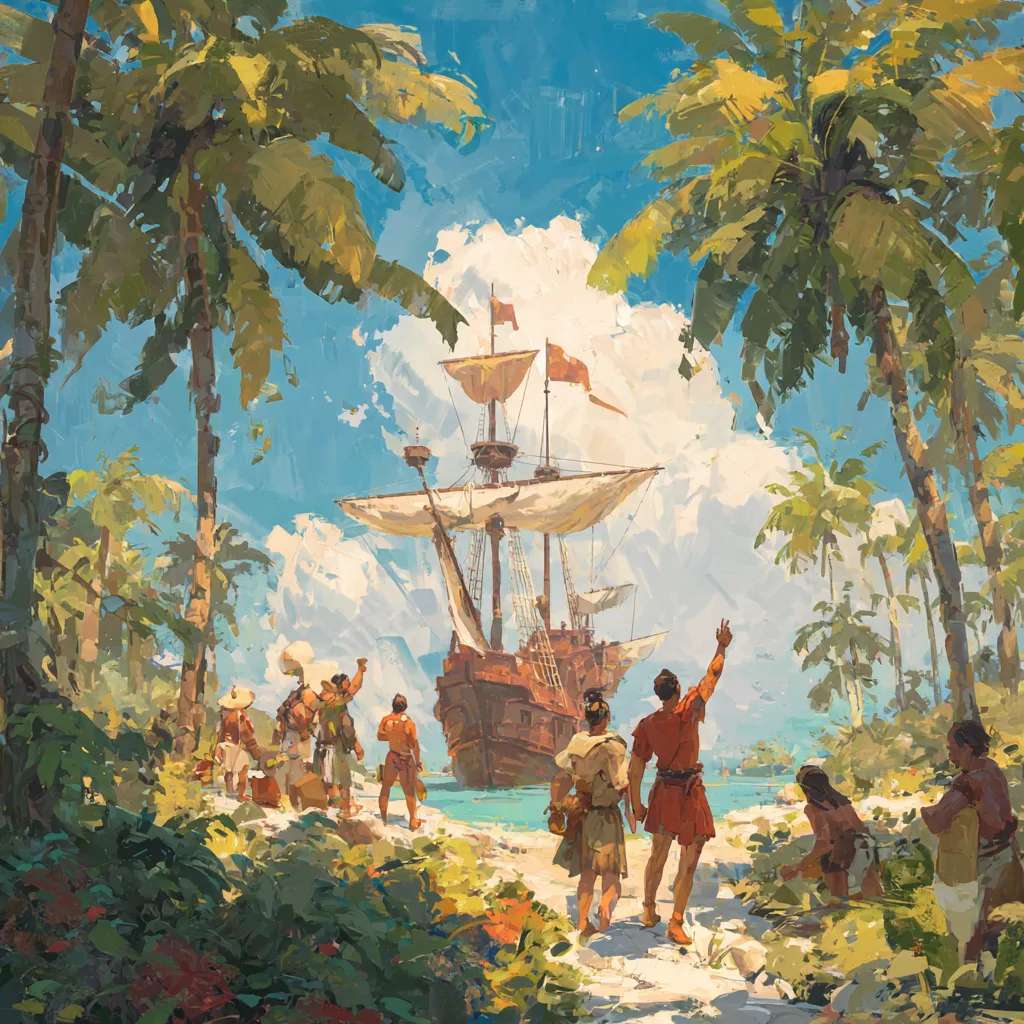
After years of lobbying, Isabella I of Castile and Ferdinand II of Aragon agreed terms in April 1492, shortly after the fall of Granada. Columbus sailed from Palos de la Frontera on 3 August with three ships and around 90 men, stopped in the Canary Islands, and struck west. Land was sighted in the early hours of 12 October. He went on to explore the coasts of Cuba and Hispaniola; the Santa María ran aground on Christmas Day and its timbers were used to build a small settlement, La Navidad.
The second voyage in 1493 was a very different undertaking — seventeen ships and around 1,200 men, sent to colonise. La Navidad was found destroyed and its garrison dead. On the third voyage in 1498 Columbus reached the Paria Peninsula on the South American mainland, in modern Venezuela, and recognised that the volume of fresh water pouring out of the Orinoco meant a continent lay behind it.
The fourth voyage of 1502–04 explored the Central American coast in search of a strait through to the Indian Ocean. It ended badly: worm-eaten ships, a mutiny, and a year marooned on Jamaica before rescue arrived.
Governor, prisoner, and contested legacy
Columbus's contract had made him governor of the lands he found, and he proved a disastrous administrator. Complaints about brutality and mismanagement on Hispaniola reached the Crown, and in 1500 the royal commissioner Francisco de Bobadilla arrested Columbus and his brothers and sent them back to Spain in chains. They were released, but he never recovered the governorship.
He died in Valladolid on 20 May 1506, wealthy but embittered, still maintaining that the lands he had reached were part of Asia. The continents were named instead after Amerigo Vespucci, who argued they were a new world.
His legacy is genuinely contested rather than fashionably so. The voyages triggered the Columbian Exchange — the transfer of crops, animals, people and diseases between hemispheres that reshaped diets and populations worldwide. They also began the conquest, forced labour and epidemic disease that destroyed the Taíno population of the Caribbean within a few decades. Any honest account of Columbus has to hold both.
Christopher Columbus: timeline
- c. 1451Born in the Republic of Genoa.
- 1470s–80sSails Mediterranean and Atlantic trade routes; settles in Portugal and develops his westward plan.
- 1485His proposal is rejected by John II of Portugal.
- 1492Isabella and Ferdinand agree terms; sails 3 August, makes landfall 12 October at Guanahaní (San Salvador).
- 1493Second voyage — seventeen ships sent to colonise Hispaniola.
- 1498Third voyage reaches the South American mainland at the Paria Peninsula.
- 1500Arrested by Francisco de Bobadilla and returned to Spain in chains; later freed but stripped of the governorship.
- 1502–04Fourth voyage explores Central America; ends with a year marooned on Jamaica.
- 1506Dies on 20 May in Valladolid, Spain.
Listen: stories featuring Christopher Columbus
Narrated chapters from the Chunks Microlearning app. Read a preview here, or listen to the full story in the app.
Frequently asked questions about Christopher Columbus
What is Christopher Columbus famous for?
Columbus is famous for the four voyages he made across the Atlantic between 1492 and 1504 for the Crown of Castile. His 1492 landfall in the Bahamas began sustained contact between Europe and the Americas, which reshaped both hemispheres — through the exchange of crops, animals and people, and through the conquest, enslavement and epidemic disease that followed.
Did Christopher Columbus discover America?
No. The Americas had been populated for thousands of years, and Norse sailors led by Leif Erikson had reached Newfoundland around the year 1000. Columbus also never landed on the mainland of North America. What his voyages did was begin permanent, sustained contact between Europe and the Americas.
Did people think the Earth was flat before Columbus?
No. Educated Europeans had accepted that the Earth is a sphere since antiquity. The scholars who rejected Columbus's plan objected to his distance calculations, not to the shape of the planet — and they were correct that he had badly underestimated the size of the Earth.
How many voyages did Columbus make?
Four: in 1492, 1493, 1498 and 1502. The first was a small expedition of three ships, the second a large colonising fleet, the third reached the South American mainland, and the fourth ended with a year stranded on Jamaica.
Why is Columbus a controversial figure?
Because of what he did as governor and what his voyages set in motion. He was arrested in 1500 over his brutal administration of Hispaniola, he took Indigenous people as slaves, and the colonisation that followed destroyed the Taíno population of the Caribbean through forced labour and introduced disease.
Continue Christopher Columbus's story
You've read the summary — hear the full story as narrated 5-minute chapters on Chunks, alongside 200+ figures and events from history, philosophy and science. Free to start on iOS and Android.