
In the late 15th century, Europe buzzed with curiosity and ambition. Maps were incomplete, and many believed the world ended just beyond the horizon. Among the dreamers was Christopher Columbus, an Italian navigator with bold aspirations. He was captivated by stories of gold, spices, and fabled lands to the west. However, reaching Asia by sailing westward was a radical idea. Most thought the oceans were too vast and dangerous. Columbus, undeterred, poured over charts and accounts from earlier travelers. He became convinced he could reach Asia faster by heading west, not east. He spent years seeking support for his voyage, visiting the courts of Portugal, England, and France. Rejection after rejection followed, but Columbus’s determination never wavered. Finally, in Spain, he found royal patrons who saw potential in his vision. Queen Isabella and King Ferdinand, eager for new trade routes and glory, offered Columbus three ships and a crew. The stage was set for a journey that would reshape not just Europe, but the entire world.
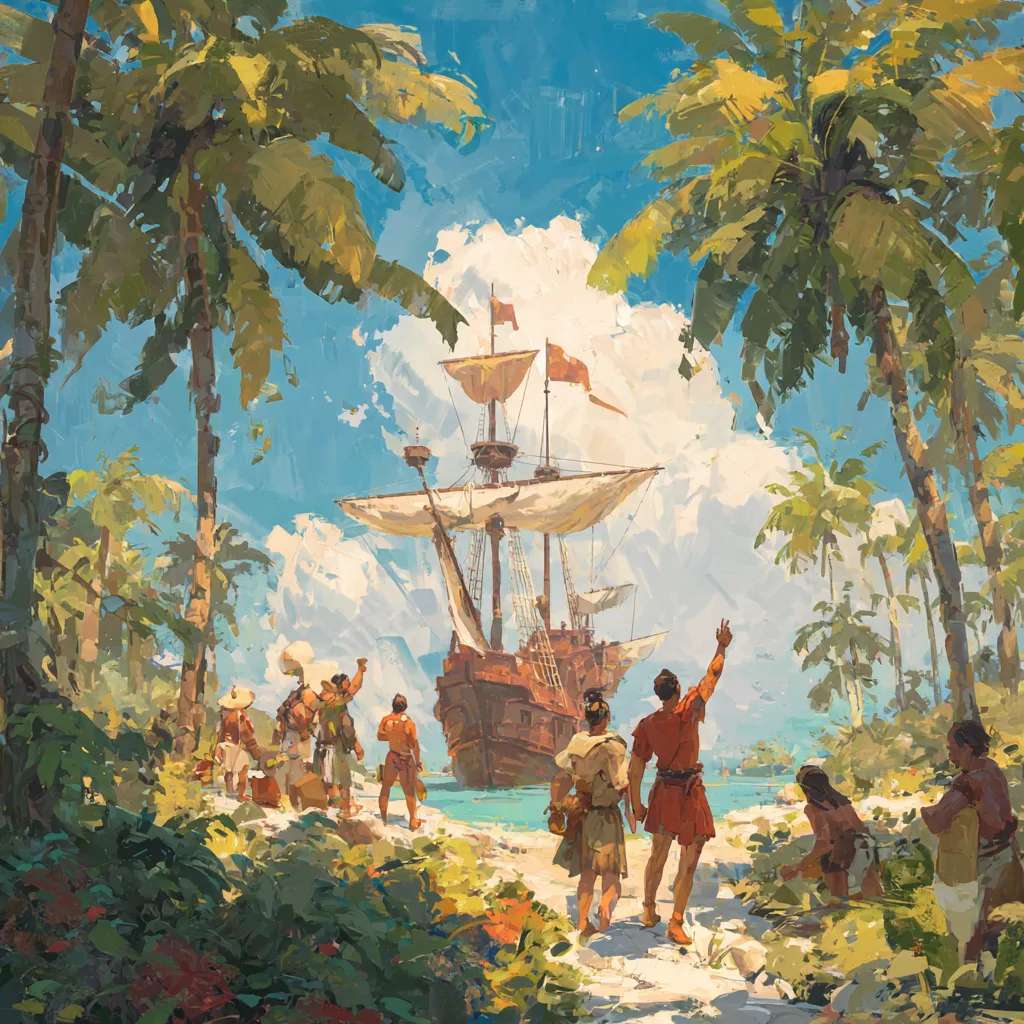
Christopher Columbus
Journey with Columbus as he sails into the unknown and changes the course of history in the discovery of the Americas.
A World of Curiosity
Frequently Asked Questions
What motivated Christopher Columbus to sail west across the Atlantic Ocean?
Columbus believed he could reach Asia by sailing west, which would provide a shorter trade route to obtain valuable spices and goods. He was convinced the Earth was smaller than it actually was and that the Atlantic Ocean was much narrower. His goal was to find a western passage to the Indies and establish profitable trading relationships.
How many voyages did Christopher Columbus make to the Americas?
Columbus made four voyages to the Americas between 1492 and 1504. His first voyage in 1492 led to his initial landing in the Caribbean islands. The subsequent three voyages allowed him to explore more Caribbean islands and parts of Central and South America, though he never realized he had reached a continent previously unknown to Europeans.
What happened when Columbus first encountered indigenous peoples in the Americas?
Columbus first met the Taíno people in the Caribbean islands, whom he called 'Indians' because he believed he had reached the Indies. The initial encounters were generally peaceful, with exchanges of gifts and goods. However, Columbus noted their potential value as servants and converts to Christianity, setting the stage for future colonization and exploitation of indigenous populations.
Learn more
To continue the story, download the Chunks Microlearning app
 Download on iOS
 Download on Android