
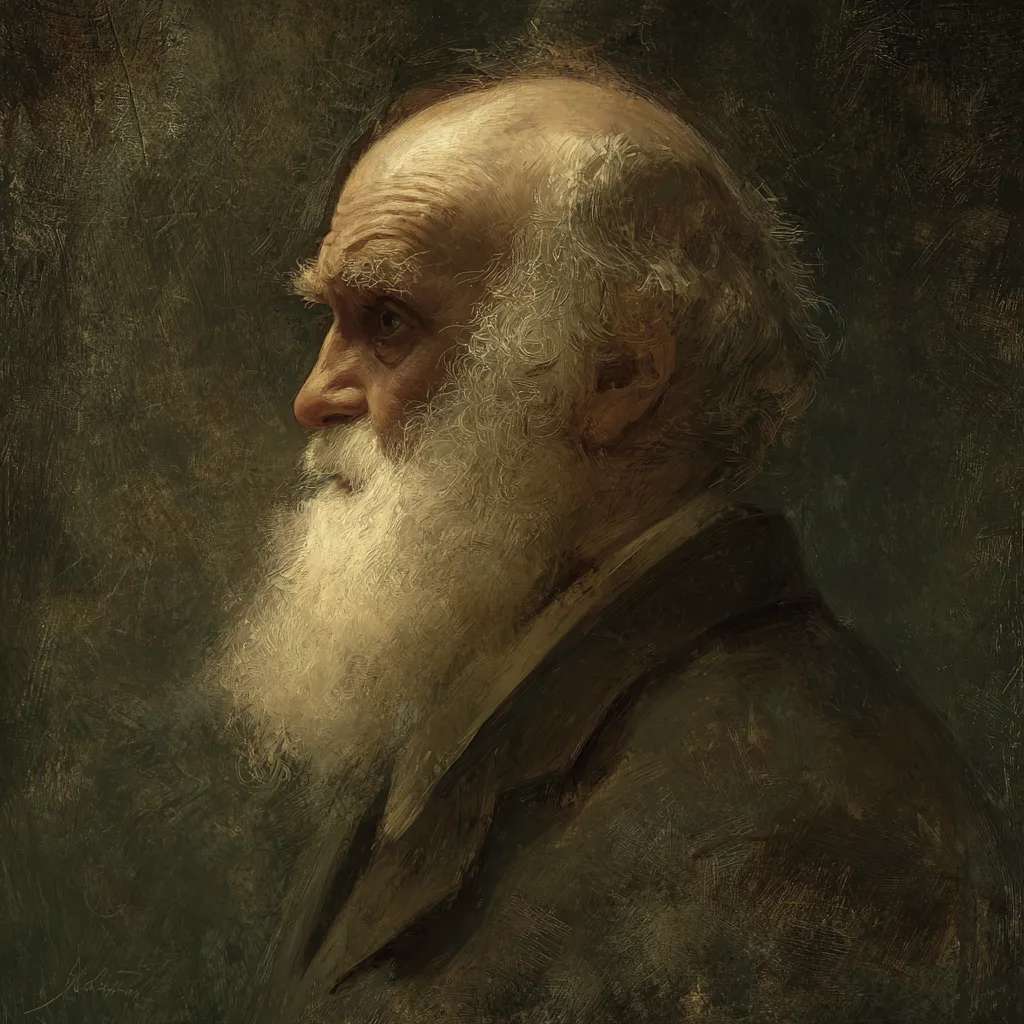
Who was Charles Darwin?
Charles Darwin (12 February 1809 – 19 April 1882) was an English naturalist, geologist, and biologist who proposed that all species of life descended from common ancestors through a process he called natural selection. His five-year voyage on HMS Beagle shaped his observations, and his 1859 book On the Origin of Species established evolution as the dominant explanation for the diversity of life.
British naturalist who developed the theory of evolution through natural selection, fundamentally changing our understanding of life on Earth. His voyage on the HMS Beagle and subsequent work 'On the Origin of Species' revolutionized biology and science.
Don't stop at the facts — continue Charles Darwin's story in free narrated chapters on Chunks.
 Download on iOS
 Download on Android
Quick facts
- Born
- 12 February 1809
- Died
- 19 April 1882
- Place of death
- Down House
- Nationality
- United Kingdom of Great Britain and Ireland
- Occupation
- Geologist, explorer, travel writer
Charles Darwin: key facts
- Charles Darwin was born on 12 February 1809 at The Mount in Shrewsbury, Shropshire, the fifth of six children of physician Robert Darwin and Susannah Darwin.
- Darwin's five-year voyage aboard HMS Beagle from 1831 to 1836 established him as an eminent geologist and provided the observations that shaped his theory of natural selection.
- In 1838, after reading Malthus's Essay on the Principle of Population, Darwin devised the core mechanism of his theory: favourable variations help organisms survive and reproduce, passing those traits to offspring.
- On the Origin of Species, published on 22 November 1859, sold out its entire first stock of 1,250 copies on its first day of sale to booksellers and presented Darwin's full case for evolution by natural selection.
- When Alfred Russel Wallace independently described natural selection in 1858, Darwin and Wallace made a joint presentation of their theories to the Linnean Society of London on 1 July 1858.
- Darwin died at Down House on 19 April 1882, aged 73, and was buried in Westminster Abbey near John Herschel and Isaac Newton.
- Darwin won the Royal Society's Royal Medal in 1853 for his work on barnacles and coral reefs, and later received the Copley Medal, Britain's highest scientific honour, in 1864.
A Wealthy Family, A Neglected Medical Degree, and a Taste for Beetles
Charles Robert Darwin was born on 12 February 1809 at The Mount, his family's home in Shrewsbury, Shropshire. He was the fifth of six children of Robert Darwin, a wealthy doctor and financier, and Susannah Darwin, née Wedgwood. Both sides of the family carried intellectual weight: his grandfather Erasmus Darwin had written speculatively about gradual creation and common descent, while his other grandfather, Josiah Wedgwood, was a prominent abolitionist. Darwin's mother died when he was eight, and from September 1818 he boarded at the nearby Anglican Shrewsbury School.
At sixteen, Darwin accompanied his brother Erasmus to the University of Edinburgh Medical School. He found lectures dull and surgical operations deeply upsetting, so he drifted toward natural history instead, assisting Robert Edmond Grant in dissecting marine invertebrates and presenting his own small discovery — that black spores found in oyster shells were the eggs of a skate leech — to the student Plinian Society in March 1827. His father, frustrated by this neglect of medicine, sent him to Christ's College, Cambridge in January 1828 to study toward a Bachelor of Arts degree, hoping he might eventually become a country parson.
At Cambridge, a chance encounter with his cousin William Darwin Fox drew Darwin into beetle collecting, which he pursued with obsessive energy, even managing to get some finds published. Through that hobby he fell into the orbit of botany professor John Stevens Henslow, who became a close mentor. Darwin passed his final exams in January 1831, coming tenth out of 178 candidates for the ordinary degree. He stayed on through the summer, reading John Herschel on scientific reasoning and Alexander von Humboldt on tropical travels, and joined Adam Sedgwick on a geology field trip to Wales.
From Finches to Natural Selection: Building the Theory in London and Kent
Darwin arrived back in England on 2 October 1836 and quickly discovered he was already something of a celebrity; extracts from his letters to Henslow had been circulated among scientific societies. The ornithologist John Gould examined the Galápagos birds Darwin had brought back and announced that what Darwin had taken for a mixture of blackbirds, grosbeaks, and finches were in fact twelve distinct species of finches. Gould also confirmed that the Galápagos mockingbirds were separate species, not mere varieties. By mid-1837, Darwin was quietly speculating in his notebooks about whether one species could transform into another.
The crucial intellectual leap came in late September 1838 when Darwin read the sixth edition of Thomas Malthus's essay on population. Malthus argued that human populations grow geometrically while food supply does not, producing inevitable competition for survival. Darwin immediately connected this to the struggle he had observed among wild plants and animals. Favourable variations would help individuals survive and reproduce; unfavourable ones would be lost. The result, over enough time, would be the formation of new species. He later recalled in his autobiography that it was here he finally had a theory 'by which to work.'
Darwin confided these ideas to very few people. He wrote a brief sketch of the theory in 1842, expanded it to a 230-page essay by 1844, and told the botanist Joseph Dalton Hooker that year that sharing his views felt 'like confessing a murder.' Meanwhile he buried himself in other work: writing up his geological findings, editing the multi-volume Zoology of the Beagle voyage, and spending eight years on a definitive study of barnacles that earned him the Royal Society's Royal Medal in 1853. The family had moved to Down House in rural Kent in September 1842, giving him the quiet he needed for sustained research.
On the Origin of Species: Publication, Priority, and Public Uproar
Darwin was still expanding his notes into a large book on natural selection when, on 18 June 1858, he received an essay from the naturalist Alfred Russel Wallace working in Borneo, which independently described the same mechanism. On the advice of Charles Lyell and Joseph Hooker, a joint presentation of both men's ideas was read to the Linnean Society of London on 1 July 1858. Darwin did not attend: his infant son had died of scarlet fever two days earlier. Darwin then spent thirteen months condensing his 'big book' into what he called an abstract. On the Origin of Species went on sale on 22 November 1859; all 1,250 copies were oversubscribed before they reached the public.
The book argued through detailed observation and inference that all species descended from common ancestors through a process Darwin called natural selection, drawing an explicit analogy with the artificial selection that farmers and pigeon breeders had long practised. Darwin avoided direct discussion of human origins, though he included homologies between humans and other mammals and hinted that 'light will be thrown on the origin of man and his history.' The scientific community's response was rapid: Thomas Henry Huxley reportedly said 'How extremely stupid not to have thought of that,' and became one of Darwin's most combative public defenders. The most famous public confrontation came at the 1860 Oxford debate, where Bishop Samuel Wilberforce argued against Darwin's explanation of species change and Huxley rebutted him sharply.
By the end of the 1860s, most scientists accepted that evolution had occurred, though fewer agreed that natural selection was its primary engine. Darwin continued writing. In 1871 he published The Descent of Man, and Selection in Relation to Sex, explicitly tracing human origins from earlier animals and introducing sexual selection to explain features such as the peacock's plumage. The following year, The Expression of the Emotions in Man and Animals — one of the first books to be illustrated with photographs — extended his argument into human psychology. A broad scientific consensus that natural selection was the central mechanism of evolution did not emerge until the modern evolutionary synthesis of the 1930s to 1950s.
Death at Down House and a Burial Among Scientists
Darwin spent the final decades of his life largely at Down House, continuing to work through repeated bouts of illness whose cause was never established. He produced books on insectivorous plants, climbing plants, cross- and self-fertilisation in plants, and the movement of plant forms. His very last book, published in 1881, examined how earthworms shape soil — a subject that had first caught his attention back in 1837 when his uncle pointed out a patch of ground where cinders had sunk beneath loam.
In 1882, Darwin was diagnosed with a condition then called angina pectoris, understood to involve disease of the heart. He died at Down House on 19 April 1882, aged 73. His last recorded words were addressed to his wife Emma and to his children, telling Emma she had been a good wife and urging the children to remember how good they had been to him. He had expected to be buried in the local churchyard at Downe, but colleagues petitioned successfully for a state honour. William Spottiswoode, President of the Royal Society, arranged for Darwin to be buried in Westminster Abbey, close to John Herschel and Isaac Newton. Thousands attended the funeral on 26 April 1882.
Charles Darwin: timeline
- 1809Born at The Mount in Shrewsbury, Shropshire, the fifth of six children of wealthy doctor and financier Robert Darwin and Susannah Darwin.
- 1831–1836Sailed on HMS Beagle on a five-year surveying voyage, making geological observations and natural history collections that would shape his thinking on evolution.
- 1838After reading Malthus's essay on population, he devised his theory of natural selection, recognising that favourable variations help organisms survive and reproduce.
- 1839Married his cousin Emma Wedgwood and published his Journal of the Beagle voyage, winning fame as a popular author and travel writer.
- 1842Published The Structure and Distribution of Coral Reefs, his first major scientific book, presenting his theory of atoll formation and establishing his reputation as a geologist.
- 1853Awarded the Royal Society's Royal Medal, recognition largely driven by his exhaustive eight-year study of barnacles alongside his earlier coral reef work.
- 1858A paper by Alfred Russel Wallace describing natural selection prompted a joint presentation of both men's theories to the Linnean Society of London on 1 July.
- 1859On the Origin of Species went on sale, presenting compelling evidence for evolution by natural selection and immediately selling out its entire first print run of 1,250 copies.
- 1871Published The Descent of Man, and Selection in Relation to Sex, explicitly arguing that humans are animals and introducing sexual selection as a major evolutionary mechanism.
- 1872Published The Expression of the Emotions in Man and Animals, one of the first books to feature printed photographs, exploring the evolutionary continuity of human and animal behaviour.
- 1881Published his final book, The Formation of Vegetable Mould, through the Actions of Worms, completing a lifetime of wide-ranging scientific inquiry.
- 1882Died at Down House aged 73 and, following petitioning by colleagues, was buried in Westminster Abbey close to John Herschel and Isaac Newton.
Listen: stories featuring Charles Darwin
Narrated chapters from the Chunks Microlearning app. Read a preview here, or listen to the full story in the app.
Continue Charles Darwin's story
You've read the summary — hear the full story as narrated 5-minute chapters on Chunks, alongside 200+ figures and events from history, philosophy and science. Free to start on iOS and Android.