
Charles Darwin was born in 1809 in Shrewsbury, England, to a prosperous family. From a young age, his fascination with the natural world was apparent. He eagerly collected beetles and examined rocks, preferring outdoor adventures to formal lessons. Although he began studying medicine at Edinburgh like his father, Darwin soon found the operating room unbearable. He then switched to theology at Cambridge University, but academic pursuits again took a backseat to his true interests in natural history and geology. At Cambridge, his passion found encouragement in the mentorship of Professor John Henslow, who recognized Darwin’s keen observational skills. When a position for a naturalist opened on the HMS Beagle’s expedition, Henslow recommended Darwin. In 1831, at just twenty-two, Darwin embarked as the ship’s naturalist on a five-year journey to survey distant coasts. This decision would not only shape his destiny, but also change how humanity understood life itself.
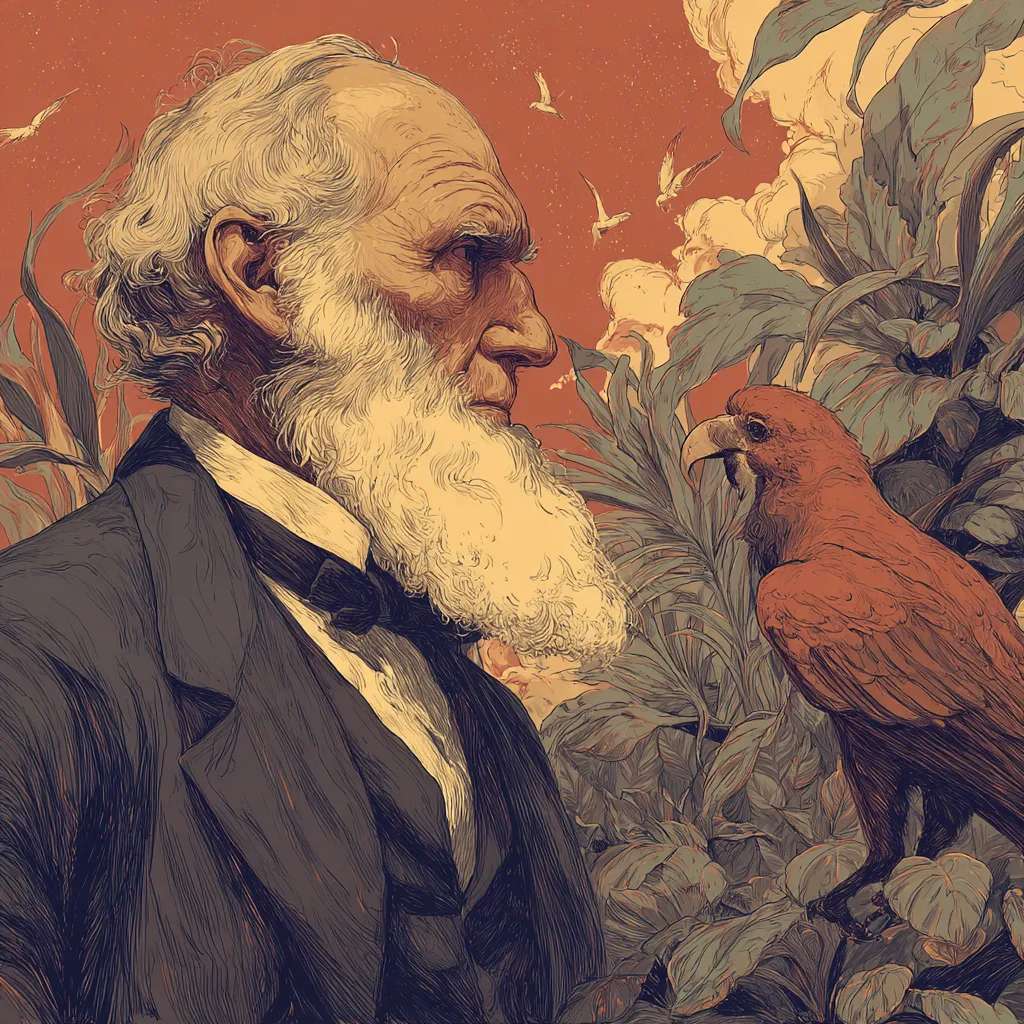
Charles Darwin and the Origin of Species
How Darwin’s voyage and ideas forever changed our understanding of life.
A Naturalist in the Making
Frequently Asked Questions
What was Charles Darwin's voyage on the Beagle and why was it important?
Darwin's voyage on HMS Beagle from 1831 to 1836 was a scientific expedition around the world that served as the foundation for his theory of evolution. During this five-year journey, Darwin collected specimens, made geological observations, and studied the unique wildlife of places like the Galápagos Islands. The voyage provided him with crucial evidence about how species adapt to different environments and change over time.
Why did Darwin delay publishing his theory of evolution for so long?
Darwin spent over 20 years developing and refining his theory after returning from the Beagle voyage because he knew it would be controversial and challenge religious beliefs of the time. He wanted to gather overwhelming evidence and present a compelling case. Darwin was finally prompted to publish when Alfred Russel Wallace independently developed a similar theory, leading to their joint presentation in 1858.
How did On the Origin of Species change scientific understanding?
Published in 1859, On the Origin of Species revolutionized biology by providing a scientific explanation for the diversity of life through natural selection. The book showed that all species descended from common ancestors and evolved over millions of years. This fundamentally changed how scientists understood life on Earth and laid the foundation for modern evolutionary biology.
Learn more
To continue the story, download the Chunks Microlearning app
 Download on iOS
 Download on Android