
Who is Arjuna?
Hear Arjuna's story
Chapter 1 of The Bhagavad Gita · the full story is in the app
Arjuna is a central hero of the ancient Hindu epic Mahabharata, the third of the five Pandava brothers and son of Kunti and the god Indra. Renowned as a peerless archer trained under Drona, he won Draupadi's hand in her swayamvara and later married Ulupi, Chitrangada, and Subhadra. Guided by his charioteer Krishna, his crisis before the Kurukshetra War prompted the teachings of the Bhagavad Gita, and he later slew Bhishma and Karna in battle.
Warrior prince of the Mahabharata whose doubts on the battlefield open the Bhagavad Gita.
Don't stop at the facts — continue Arjuna's story in free narrated chapters on Chunks.
See how Chunks works → Download on iOS
 Download on Android
Quick facts
- Role
- Hero of the Mahabharata
Arjuna: key facts
- Arjuna is the third of the five Pandava brothers in the Mahabharata and is considered the son of the god Indra and queen Kunti, conceived through a sacred mantra rather than ordinary union with Pandu.
- Arjuna trained in archery and warfare under the sage-warrior Drona, who declared him his favourite pupil and famously said no other archer in the world would match him.
- Arjuna won princess Draupadi's hand by succeeding in her svayamvara archery contest, but she ultimately married all five Pandava brothers after Kunti's unwitting instruction to share what was won.
- During a period of exile, Arjuna married the Naga princess Ulupi, Manipura's princess Chitrangada, and Krishna's sister Subhadra, fathering sons including Iravan, Babhruvahana, and Abhimanyu.
- Arjuna and Krishna together burned the Khandava Forest, helping the fire god Agni consume it despite opposition from Indra and other gods, and in reward Arjuna received the celestial bow Gandiva.
- On the eve of the Kurukshetra War, Arjuna's moral crisis over fighting his own kin led Krishna, his charioteer, to deliver the teachings later recorded as the Bhagavad Gita.
- In the Kurukshetra War, Arjuna killed major warriors including Bhishma, Bhagadatta, Jayadratha, and his own half-brother Karna, whom he had vowed to kill after Karna insulted Draupadi.
A Son of Indra Born to Kunti and Pandu
Arjuna was the third of the five Pandava brothers, sons of King Pandu of the Kuru dynasty, though none of the brothers were conceived by Pandu directly. A curse had left Pandu unable to father children without dying from the act, so his wife Kunti used a mantra granted to her by the sage Durvasa during her maidenhood, which allowed her to invoke gods to father children on Pandu's behalf. Arjuna's elder brothers Yudhishthira and Bhima had already been born through the gods Dharma and Vayu before Kunti invoked Indra, king of the gods, who fathered Arjuna. His birth was marked by an unusually large gathering of sages and celestial beings, a divine voice foretelling his future heroism, and the sound of drums as flowers fell from the sky, all signaling his exceptional destiny among the brothers.
Arjuna was born under the lunar constellation Phalguna and spent his early childhood in the forest of Shatashringa with his brothers, raised under the care of resident sages after Pandu chose a life of asceticism. Following the deaths of Pandu and his second wife Madri, Kunti brought all five boys to Hastinapura, the Kuru capital, to be raised among their cousins, the Kauravas.
Training Under Drona and the Rise of a Rival
In Hastinapura, Arjuna's early instruction in archery came from Kripacharya under the supervision of the patriarch Bhishma, before the warrior-sage Drona was brought in to train the princes more fully. When Drona first met his pupils and asked for a future favor in return for his teaching, Arjuna was the only one who agreed immediately, a gesture that won him Drona's particular favor. He went on to become Drona's most devoted and gifted student, proving his focus in a famous test where, asked what he saw while aiming at a bird in a tree, he replied that he saw only its head rather than the bird or the surrounding branches that other princes described.
Drona rewarded Arjuna's quick reflexes after a staged crocodile attack with the celestial weapon Brahmashira, declaring that no archer in the world would equal him. At a public exhibition of the princes' skills, Arjuna displayed mastery over fire, wind, water, and rain using divine weapons, and it was at this event that Karna first challenged him, setting the two on a path of rivalry that would run throughout the epic and that was only later revealed to be a conflict between half-brothers. As payment for his education, Drona asked his students to defeat his rival King Drupada of Panchala, a task credited chiefly to Arjuna, who alone among the pupils had pledged in advance to deliver it.
Winning Draupadi and Four Marriages
Living in hiding after escaping an assassination attempt by the Kauravas, Arjuna and his brothers traveled to Panchala, where King Drupada had designed a svayamvara contest specifically to secure Arjuna as a son-in-law after being impressed by him in battle. Still disguised, Arjuna completed the archery trial that every other suitor, including Duryodhana and Karna, had failed, striking the target with five arrows. A misunderstanding at home led Kunti to unknowingly instruct her sons to share what Arjuna had won, and after the sage Vyasa revealed that the Pandavas were partial incarnations of five Indras destined to share one wife, Draupadi became the common wife of all five brothers, marrying Arjuna on the third day of the ceremonies. Despite this shared marriage, textual references suggest Draupadi held particular affection for Arjuna, and he fathered a son with her named Shrutakriti or Shrutakarman in different sources.
A fraternal agreement regarding privacy with Draupadi led Arjuna into a period of exile after he broke it unintentionally while retrieving weapons to help a Brahmin. During this journey he was pulled underwater by the Naga woman Ulupi, who declared she would rather die than be refused, and Arjuna, honoring his duty to protect those in distress, spent a night with her; she later bore him a son, Iravat. Continuing south, he married Chitrangada, the princess of Manipura, under an agreement that their son Babhruvahana would remain there to inherit the throne. Finally, in Dvaraka, Arjuna fell for Subhadra, sister of his close friend Krishna, and abducted her with Krishna's encouragement after Krishna argued a svayamvara would be too uncertain; the marriage was settled peacefully after Krishna defended Arjuna's conduct to the Vrishni clan. Subhadra later bore Arjuna's son Abhimanyu.
The Khandava Forest and the Years of Exile
Arjuna and Krishna, by this time close companions known together as the two Krishnas, agreed to help the fire god Agni, disguised as a Brahmin, consume the Khandava Forest after Agni's repeated attempts had been thwarted by Indra's rains. In exchange, Arjuna received the celestial bow Gandiva, inexhaustible quivers, a divine chariot, and celestial horses. During the burning, Arjuna and Krishna killed nearly every fleeing creature in the forest and even repelled Indra and other gods who intervened, after which a mysterious voice revealed that Arjuna and Krishna were incarnations of the divine pair Nara and Narayana.
Arjuna's vow to kill Karna originated during a rigged dice game in which Yudhishthira gambled away the Pandavas' kingdom and Draupadi herself, who was then publicly humiliated and called unchaste by Karna. This led to a twelve-year exile for the brothers. During this period, Arjuna traveled to the Himalayas seeking celestial weapons and undertook a penance that led to a fight with a hunter who was secretly the god Shiva; after hours of combat in which Arjuna could not overcome him, Shiva revealed himself, pleased, and granted Arjuna the Pashupatastra. Arjuna also visited Indra's heaven, where he rebuffed the apsara Urvashi's advances by calling her mother, since she had once been the wife of an ancestor of the Kuru line, and her resulting curse that he become a eunuch was shortened to one year at Indra's request. In the final year of exile, Arjuna lived at the Matsya kingdom disguised as Brihannala, a eunuch teacher of dance and music to princess Uttara, and used this period to single-handedly defeat the Kaurava army, including Bhishma, Drona, and Karna, before his identity was revealed.
The Bhagavad Gita and the Kurukshetra War
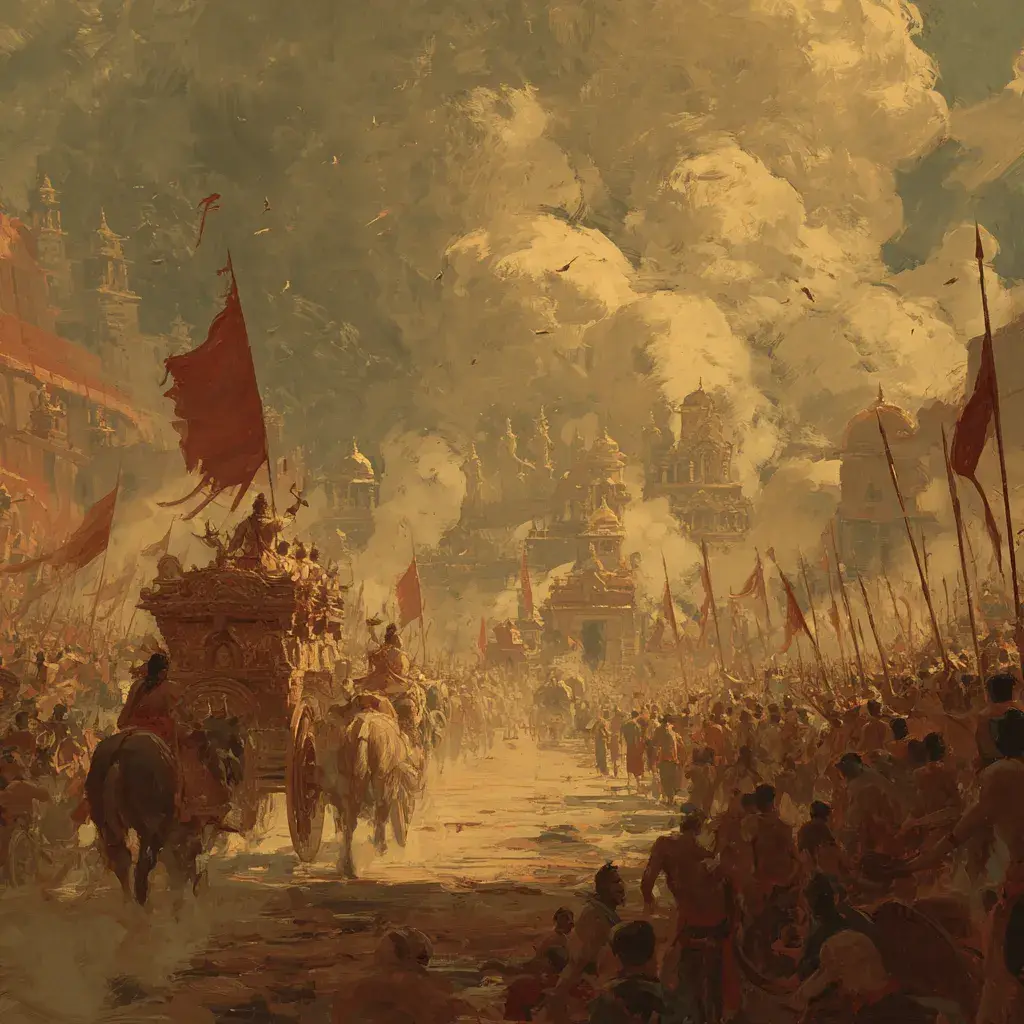
Before the Kurukshetra War began, Arjuna was overcome by despair at the prospect of killing his own relatives and teachers arrayed on the opposing side, and he dropped his weapons in the midst of the battlefield. His charioteer Krishna responded with the teachings later recorded as the Bhagavad Gita, addressing Arjuna's duty as a warrior and the nature of action and liberation; the dialogue ends with Arjuna resolved and ready to fight.
Across the eighteen days of war, Arjuna proved decisive. He killed Bhishma on the tenth day while sharing a chariot with Shikhandi, since Bhishma would not fight Shikhandi directly. He killed the king Bhagadatta along with his elephant on the twelfth day. After his son Abhimanyu was killed unfairly by multiple warriors on the thirteenth day, Arjuna vowed to kill Jayadratha, who had blocked the other Pandavas from reaching Abhimanyu, by the next sunset or die by his own hand, and he fulfilled this vow by beheading Jayadratha on the fourteenth day after cutting through seven divisions of the Kaurava army. He also killed King Sudakshina of the Kambojas and King Susharma of Trigarta. His long-anticipated duel with Karna came on the seventeenth day, ending in Karna's death by Arjuna's arrow.
Final Years and Death in the Himalayas
After the war, Yudhishthira made Arjuna his prime minister, and Arjuna later followed the sacrificial horse of his brother's Ashvamedha ritual into Manipura, where he unknowingly fought his own son Babhruvahana, who wounded him fatally in battle. Chitrangada revealed their relationship, and Ulupi, Arjuna's other wife, restored him to life using a celestial gem.
Following Krishna's death, Arjuna led the surviving people of Dvaraka toward Indraprastha but chose not to fight off bandits who attacked them along the way, recognizing the changing of the age. On the advice of the sage Vyasa, Arjuna and his brothers eventually gave up their throne to Parikshit, Abhimanyu's son, and set out with Draupadi on a final pilgrimage to the Himalayas, where Arjuna died along with his brothers and wife. The Kuru line continued afterward through Parikshit.
Arjuna: timeline
- Legendary eraBorn to Kunti through invocation of the god Indra, marked at birth by celestial omens and prophecies of future greatness.
- ChildhoodRaised alongside his brothers and Kaurava cousins in Hastinapura, trained first by Kripacharya and then by the warrior-sage Drona, becoming his most favored pupil.
- YouthFulfilled his teacher's fee by helping defeat King Drupada of Panchala, fulfilling his earlier pledge to Drona.
- YouthWon Draupadi's hand by succeeding in her svayamvara archery contest, after which she became the shared wife of all five Pandava brothers.
- Period of wandering exileAfter breaking a fraternal agreement over Draupadi, undertook a pilgrimage during which he married Ulupi, Chitrangada, and Subhadra, fathering Iravan, Babhruvahana, and Abhimanyu.
- Period of wandering exileJoined Krishna in burning the Khandava Forest, an act that won him the celestial bow Gandiva and a divine chariot.
- After the dice gameVowed to kill Karna after Draupadi's humiliation in a rigged dice game that stripped the Pandavas of their kingdom and sent them into twelve years of exile.
- Exile in the forestPerformed penance to obtain the Pashupatastra from Shiva and later traveled to Indra's heaven to gather further divine weapons.
- Thirteenth year of exileLived disguised as the eunuch dance teacher Brihannala at King Virata's court and single-handedly defeated the attacking Kaurava army.
- Eve of the Kurukshetra WarOvercome by doubt at facing kinsmen and teachers in battle, received Krishna's counsel in the Bhagavad Gita and witnessed his cosmic form.
- Kurukshetra WarKilled major warriors including Bhishma, Jayadratha, and his previously unknown elder half-brother Karna.
- After the warAssisted Yudhishthira's Ashvamedha campaign, was slain in battle by his own son Babhruvahana, and was revived through Ulupi's intervention.
- Final yearsAfter Krishna's death and the fall of the Yadavas, set out with his brothers and Draupadi on a final pilgrimage to the Himalayas, where he died.
Listen: stories featuring Arjuna
Narrated chapters from the Chunks Microlearning app. Read a preview here, or listen to the full story in the app.
Continue Arjuna's story
You've read the summary — hear the myth of Arjuna as narrated 5-minute chapters on Chunks, alongside 200+ figures and events from history, myth, philosophy and science. Free to start on iOS and Android.