
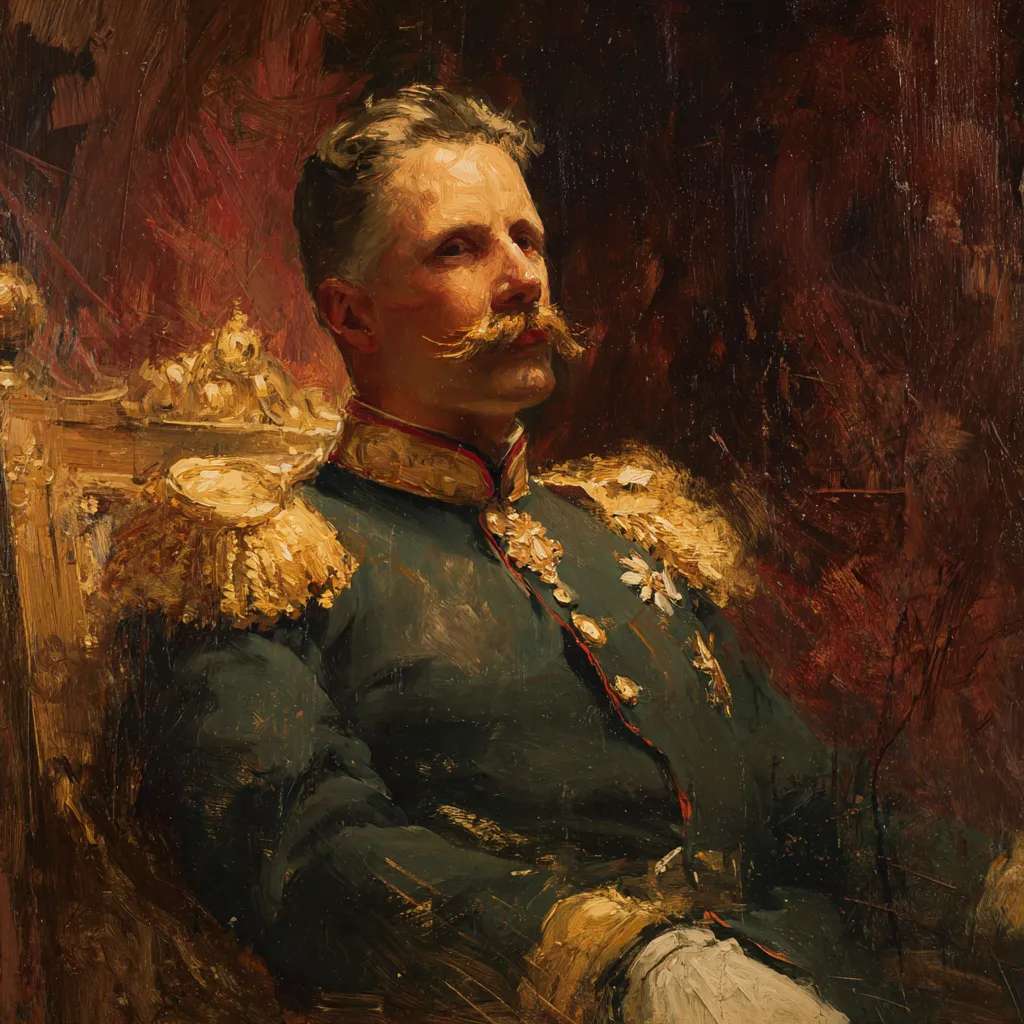
Who was Archduke Franz Ferdinand?
Archduke Franz Ferdinand (18 December 1863 – 28 June 1914) was the heir presumptive to the Austro-Hungarian throne whose assassination in Sarajevo by 19-year-old Gavrilo Princip triggered the July Crisis and ultimately World War I. Appointed inspector general of the Austro-Hungarian Armed Forces in 1913, he had significant military influence, and his morganatic marriage to Sophie Chotek in 1900 required him to renounce his descendants' succession rights.
Heir to the Austro-Hungarian throne whose assassination in Sarajevo on June 28, 1914, triggered a series of events that led to World War I. His death became the catalyst for the most devastating conflict the world had yet seen.
Don't stop at the facts — continue Archduke Franz Ferdinand's story in free narrated chapters on Chunks.
 Download on iOS
 Download on Android
Quick facts
- Born
- 18 December 1863
- Birthplace
- Graz
- Died
- 28 June 1914
- Place of death
- Sarajevo
- Nationality
- Austrian Empire, Cisleithania
- Occupation
- Politician
Archduke Franz Ferdinand: key facts
- Franz Ferdinand was born on 18 December 1863 in Graz, then part of the Austrian Empire, as the eldest son of Archduke Karl Ludwig of Austria.
- Franz Ferdinand became heir presumptive to the Austro-Hungarian throne in 1896 following the 1889 suicide of Crown Prince Rudolf and the 1896 death of his father Karl Ludwig from typhoid fever.
- In 1913, Franz Ferdinand was appointed inspector general of all Austro-Hungarian armed forces, a position that included presumed command in wartime.
- Franz Ferdinand married Countess Sophie Chotek on 1 July 1900 in a morganatic marriage, meaning their descendants held no succession rights to the throne.
- On 28 June 1914, Franz Ferdinand and his wife Sophie were shot and killed in Sarajevo by 19-year-old Gavrilo Princip, a member of the Young Bosnia movement.
- Princip used a pocket-sized FN Model 1910 pistol chambered for the .380 ACP cartridge, first shooting Sophie in the abdomen and then Franz Ferdinand in the neck.
- The assassination triggered the July Crisis and Austria-Hungary's declaration of war against Serbia, setting off a chain of events that started World War I within four weeks of Franz Ferdinand's death.
From Habsburg Sideline to Heir Presumptive
Franz Ferdinand was born on 18 December 1863 in Graz, then part of the Austrian Empire, the eldest son of Archduke Karl Ludwig, who was himself a younger brother of Emperor Franz Joseph I. His early place in the line of succession was distant enough that he seemed unlikely ever to inherit the throne. That changed in stages. In 1875, at the age of eleven, his cousin Francis V, Duke of Modena, died and named Franz Ferdinand his heir on condition that the boy add 'Este' to his name — an inheritance that made Franz Ferdinand one of the wealthiest men in Austria.
The path to the throne opened through a sequence of deaths. In 1889, Crown Prince Rudolf, the emperor's only son, shot himself at his hunting lodge in Mayerling, leaving Karl Ludwig first in line. When Karl Ludwig died of typhoid fever in 1896, Franz Ferdinand stepped into the position of heir presumptive. He was not the most obvious candidate for such a role — he had not been groomed from birth for it — but the logic of dynastic succession left no alternative.
A Military Career Built on Rank Rather Than Battle
Like most males in the ruling Habsburg line, Franz Ferdinand entered the Austro-Hungarian Army young and rose quickly. He was a lieutenant at fourteen, a captain at twenty-two, a colonel at twenty-seven, and a major general at thirty-one. He briefly commanded the primarily Hungarian 9th Hussar Regiment, though he never received formal staff training. In 1898, the emperor granted him a special commission to examine all aspects of the military, and agencies were ordered to open their records to him.
His influence extended well beyond whatever post he formally held. He maintained a military chancery, headed by Alexander Brosch von Aarenau and eventually staffed by sixteen people, which processed documents on military affairs and allowed him to shape decisions without holding a specific command. In 1907 he secured the retirement of the emperor's favored Chief of the General Staff, Friedrich von Beck-Rzikowsky, and personally selected Franz Conrad von Hötzendorf as the replacement. By 1913, as heir to the aging emperor, he was appointed inspector general of all Austro-Hungarian armed forces — a position that would have carried presumed command authority in wartime.
A Morganatic Marriage That Divided the Imperial Court
In 1894, Franz Ferdinand met Countess Sophie Chotek, who was serving as a lady-in-waiting at the household of Archduke Friedrich. The two kept their relationship secret for years, partly because Habsburg rules required that members of the imperial family marry into one of the reigning or formerly reigning dynasties of Europe — a standard the Chotek family did not meet. Franz Ferdinand refused to consider anyone else. Emperor Franz Joseph eventually agreed in 1899, but only on strict terms: the marriage would be morganatic, their children would have no claim to the throne, and Sophie would not share her husband's rank, title, or precedence.
The wedding took place on 1 July 1900 in Bohemia. Franz Joseph did not attend, nor did Franz Ferdinand's brothers or any other archduke. Sophie was given the title Princess of Hohenberg, later elevated in 1909 to Duchess of Hohenberg, but she was still required at court functions to yield precedence to all archduchesses, meaning she and her husband were often physically separated in public ceremonies. The couple had three surviving children: Princess Sophie, Maximilian, and Prince Ernst, as well as a stillborn son in 1908.
The Assassination in Sarajevo and Its Consequences
On the morning of 28 June 1914, Franz Ferdinand and Sophie traveled through Sarajevo, the capital of the Austro-Hungarian province of Bosnia and Herzegovina. A group of assassins organized by the Black Hand had positioned themselves along the route. The first attempt, a grenade thrown by Nedeljko Čabrinović, missed the royal car and wounded passengers in the following vehicle. After a stop at the Governor's residence, the couple insisted on visiting the injured at the hospital. The drivers were not told the route had changed, and as the cars reversed and stalled on a side street, 19-year-old Gavrilo Princip, a member of Young Bosnia, was sitting at a nearby cafe. He crossed the street and fired twice with an FN Model 1910 pistol, hitting Sophie in the abdomen and Franz Ferdinand in the neck.
Franz Ferdinand remained conscious long enough to plead with his wife not to die, repeating the words 'It is nothing' as his own strength faded. Sophie died before reaching the hospital; Franz Ferdinand died within minutes of being shot. The assassination set off the July Crisis, in which Austria-Hungary issued an ultimatum to Serbia and then declared war, triggering the alliance system that pulled the major European powers into conflict within weeks. Franz Ferdinand and Sophie were buried together at Artstetten Castle in Austria. After his death, Archduke Karl became the new heir presumptive to the Austro-Hungarian throne.
Archduke Franz Ferdinand: timeline
- 1863Born in Graz, then part of the Austrian Empire, as the eldest son of Archduke Karl Ludwig of Austria and Princess Maria Annunziata of Bourbon-Two Sicilies.
- 1875Inherited the fortune and name of his cousin Francis V, Duke of Modena, adding 'Este' to his own name and becoming one of the wealthiest men in Austria.
- 1889Moved closer to the throne after Crown Prince Rudolf died by suicide at his hunting lodge in Mayerling, leaving Franz Ferdinand's father Karl Ludwig first in line.
- 1892-1893Circumnavigated the globe, traveling through India, Australia, the Pacific islands, Asia, and North America, attending the World's Columbian Exposition in Chicago.
- 1896Became heir presumptive to the Austro-Hungarian throne after his father Karl Ludwig died of typhoid fever.
- 1900Married Sophie Chotek in a morganatic ceremony at Reichstadt in Bohemia, renouncing succession rights for their descendants as required by Emperor Franz Joseph.
- 1907Secured the retirement of Friedrich von Beck-Rzikowsky as Chief of the General Staff and personally selected Franz Conrad von Hötzendorf as Beck's successor.
- 1913Appointed inspector general of all Austro-Hungarian armed forces, a position that included presumed command in wartime and was superior to any previously held by an archduke.
- 1914Assassinated alongside his wife Sophie in Sarajevo by 19-year-old Gavrilo Princip, a member of Young Bosnia, triggering the July Crisis and the outbreak of World War I.
Listen: stories featuring Archduke Franz Ferdinand
Narrated chapters from the Chunks Microlearning app. Read a preview here, or listen to the full story in the app.
Continue Archduke Franz Ferdinand's story
You've read the summary — hear the full story as narrated 5-minute chapters on Chunks, alongside 200+ figures and events from history, philosophy and science. Free to start on iOS and Android.