
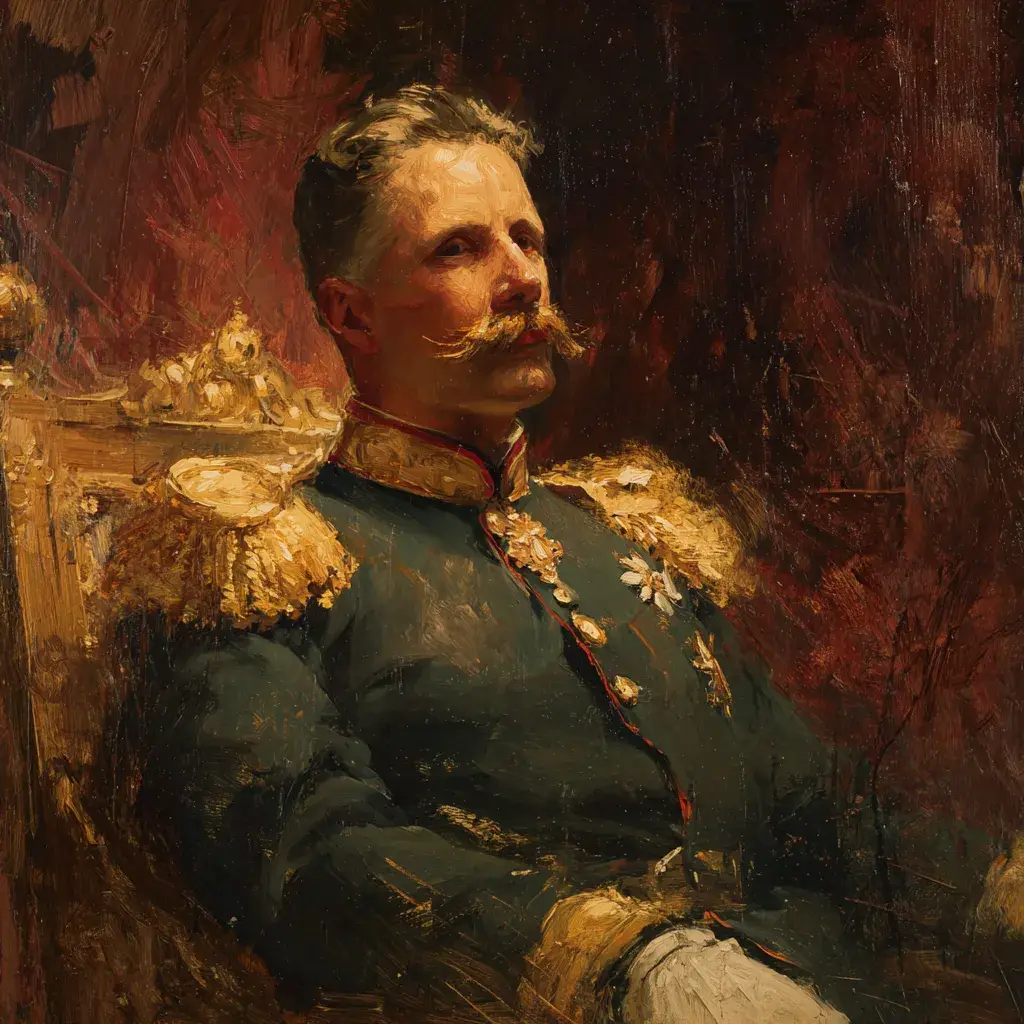
On June 28, 1914, Archduke Franz Ferdinand, heir to the Austro-Hungarian throne, arrived in Sarajevo with his wife, Sophie. The timing was deeply provocative. It was Vidovdan, a sacred day of Serbian national identity. The Archduke was in Bosnia, a territory annexed by Austria-Hungary, to inspect military maneuvers, a move local nationalists saw as an assertion of power. Despite warnings of unrest, security was dangerously light, with only 120 police officers assigned to guard the motorcade along its four-mile route. The couple traveled in an open-top luxury car, making them a conspicuous and vulnerable target for anyone wishing to make a violent statement against the empire they represented.
The Assassination of Archduke Franz Ferdinand
On June 28, 1914, a young nationalist's two gunshots in Sarajevo assassinated an Archduke and ignited the flames of World War One.
Chapter 1
A Provocative Visit
0:44
People in this story

Part of
Frequently Asked Questions
Why was Archduke Franz Ferdinand's visit to Sarajevo so controversial?
The visit was on June 28, a Serbian national holiday called Vidovdan, which was seen as a deliberate provocation. Furthermore, he was inspecting military forces in Bosnia and Herzegovina, a region with a large Serbian population that Austria-Hungary had recently annexed, inflaming nationalist sentiments.
Who were the assassins?
The assassins were members of 'Young Bosnia,' a revolutionary movement seeking to end Austro-Hungarian rule. The plot was supported by a Serbian secret society which provided weapons and training. Gavrilo Princip, the man who fired the fatal shots, was a 19-year-old member of this group.
How did this single assassination lead to a world war?
Austria-Hungary blamed Serbia for the attack. Backed by support from Germany, they issued an ultimatum with demands so harsh Serbia could not fully accept them. This refusal led to Austria-Hungary’s declaration of war on July 28, 1914, exactly one month after the assassination, which in turn activated a complex network of European military alliances.
Learn more
To continue the story, download the Chunks Microlearning app
Or get it straight away:
 Download on iOS
 Download on Android