
Who was Albert Einstein?
Hear Albert Einstein's story
Chapter 1 of Albert Einstein and Relativity · the full story is in the app
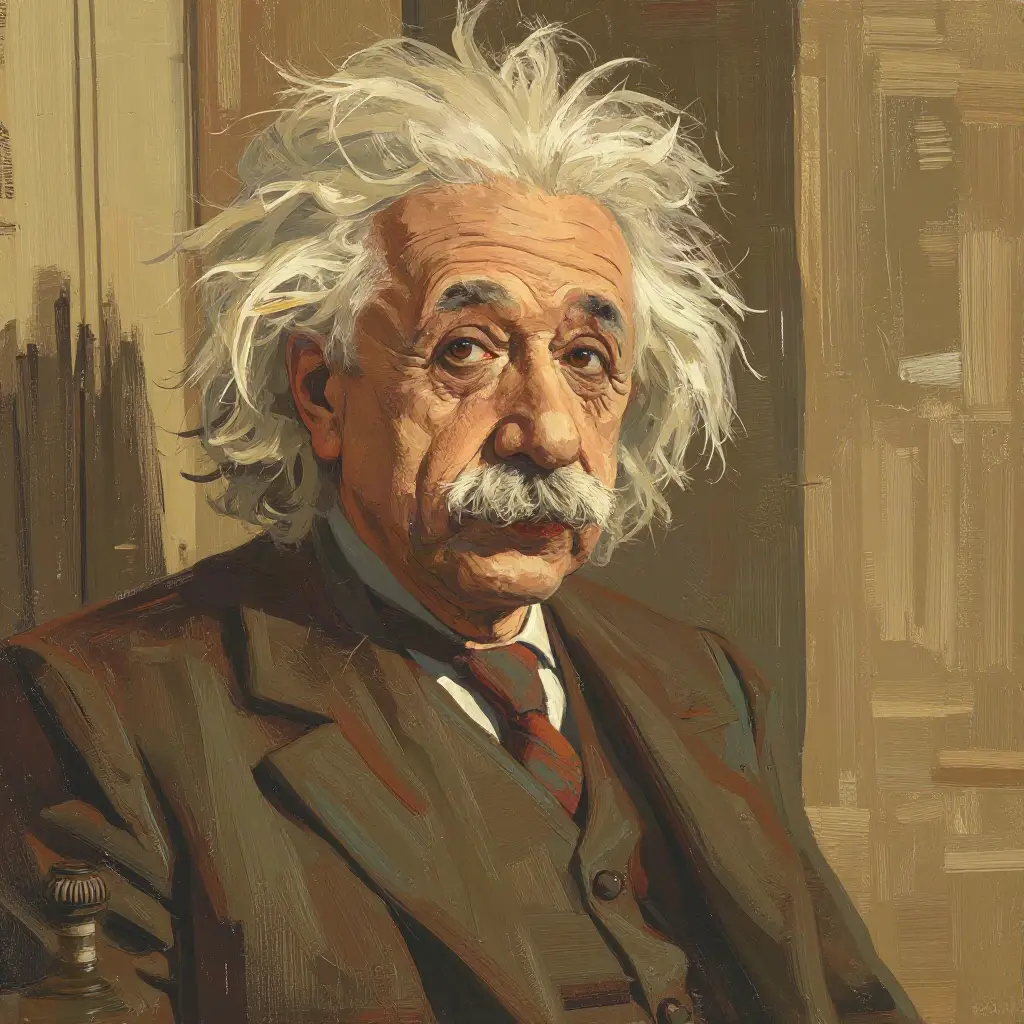
Albert Einstein (14 March 1879 - 18 April 1955) was a German-born theoretical physicist who developed the special and general theories of relativity, fundamentally changing scientific understanding of space, time, and gravitation. He also contributed to quantum theory and formulated the mass-energy equivalence formula E = mc2. Einstein received the 1921 Nobel Prize in Physics for explaining the photoelectric effect. He died in Princeton, United States, where he had settled after leaving Germany in 1933.
Albert Einstein was a theoretical physicist who developed the theory of relativity, revolutionizing understanding of space, time, and gravity. His work reshaped modern physics and earned him the 1921 Nobel Prize.
Don't stop at the facts — continue Albert Einstein's story in free narrated chapters on Chunks.
See how Chunks works → Download on iOS
 Download on Android
Quick facts
- Born
- 14 March 1879
- Birthplace
- Ulm
- Died
- 18 April 1955
- Place of death
- Princeton
- Nationality
- Kingdom of Württemberg, statelessness
- Occupation
- Theoretical physicist, philosopher of science, inventor
Albert Einstein: key facts
- Albert Einstein was born on 14 March 1879 in Ulm, then part of the Kingdom of Wurttemberg in the German Empire.
- He published four groundbreaking papers in 1905, his annus mirabilis, covering the photoelectric effect, Brownian motion, special relativity, and mass-energy equivalence.
- His formula E = mc2, derived from special relativity, is often called the world's most famous equation.
- He received the 1921 Nobel Prize in Physics, awarded in 1922, for his discovery of the law of the photoelectric effect.
- In 1915 he proposed the general theory of relativity, which extended his mechanics to incorporate gravitation and was confirmed by Arthur Eddington's 1919 eclipse observations.
- Einstein emigrated to the United States after Adolf Hitler rose to power in 1933 and became an American citizen in 1940.
- He died on 18 April 1955 in Princeton, New Jersey, after refusing surgery for a ruptured abdominal aortic aneurysm.
A Slow Talker from Ulm Who Loved a Compass
Albert Einstein was born on 14 March 1879 in Ulm, a subject of the Kingdom of Württemberg within the German Empire, to secular Ashkenazi Jewish parents Hermann and Pauline Einstein. His father and uncle ran a company manufacturing electrical equipment, first in Munich and later, after a failed business bid, in Italy. As a small child Einstein was slow to learn to talk, enough to worry his parents, but at age five a compass his father showed him left a lasting impression, sparking a fascination with the invisible forces of nature that he later described as the feeling that something deeply hidden lay behind things.
He attended a Catholic elementary school in Munich and then the Luitpold Gymnasium, where he chafed against rote learning and rigid discipline. Left behind in Munich to finish school while his family moved to Pavia, he left early and joined them in Italy. He taught himself algebra, calculus and Euclidean geometry starting around age twelve, worked out his own proof of the Pythagorean theorem before turning thirteen, and by fourteen had mastered integral and differential calculus on his own. A family tutor introduced him to Kant's philosophy at thirteen, which he grasped with unusual ease for his age.
In 1895, at sixteen, Einstein failed the general portion of the entrance exam for the federal polytechnic school in Zurich but excelled in physics and mathematics. He finished secondary school in Aarau, Switzerland, and in January 1896 renounced his Württemberg citizenship to avoid military conscription, leaving him stateless for several years. He enrolled in the polytechnic's teaching diploma program in mathematics and physics, where he met fellow student Mileva Marić, with whom he discussed physics extensively and later had a romantic relationship.
Patent Clerk, Unconventional Family Life
Einstein graduated from the polytechnic in 1900 and struggled to find teaching work. In 1902 he secured a position as a patent examiner in Bern, Switzerland, evaluating inventions such as a gravel sorter and an electric typewriter. He married Mileva Marić in January 1903; the couple had already had a daughter, Lieserl, born in 1902 before their marriage, whose fate remains uncertain, possibly given up for adoption or dead of scarlet fever in infancy. Sons Hans Albert and Eduard were born in 1904 and 1910. In Bern, Einstein also formed an informal discussion group with friends, the Olympia Academy, where they read philosophers including Hume, Mach and Poincaré.
Einstein's personal life grew complicated over the following decade. In 1912 he began a relationship with his cousin Elsa Löwenthal, and when Marić discovered his infidelity after the family moved to Berlin in 1914, she returned to Zurich with their sons. Einstein and Marić divorced in 1919, with Einstein agreeing to give her any Nobel Prize money he might win, a promise fulfilled two years later. He married Elsa the same year. Their son Eduard was later diagnosed with schizophrenia and spent much of his life institutionalized.
The 1905 Miracle Year and the Reordering of Physics
While still working at the patent office, Einstein published four papers in 1905 later celebrated as his annus mirabilis. One explained the photoelectric effect by proposing that light itself is composed of discrete particles, later called photons, work that would eventually underpin his Nobel Prize. Another explained Brownian motion as evidence that molecules exist. A third introduced the special theory of relativity, reconciling the laws of electricity and magnetism with mechanics and showing that moving clocks run slow and moving objects contract in their direction of motion. A fourth derived the equivalence of mass and energy, expressed in the formula E equals mc squared.
These papers did not bring immediate fame. Einstein continued at the patent office until 1908, when he took a junior post at the University of Bern, before a series of professorships in Zurich and Prague led to his appointment in Berlin in 1914, where Max Planck and Walther Nernst secured him a research position at the Prussian Academy of Sciences free of teaching duties. He became director of the Kaiser Wilhelm Institute for Physics in 1917. Between 1907 and 1915 he developed his general theory of relativity, reconceiving gravity not as a force but as the curvature of spacetime caused by mass, a project aided mathematically by his friend Marcel Grossmann.
Confirmation came in 1919, when astronomer Arthur Eddington observed starlight bending around the sun during a total eclipse, matching Einstein's predictions. The result was reported worldwide, including a famous Times of London headline declaring Newtonian ideas overturned, and it transformed Einstein almost overnight into a global celebrity, arguably the first scientist to achieve that kind of fame. In 1922 he received the 1921 Nobel Prize in Physics, awarded specifically for his explanation of the photoelectric effect rather than for relativity, which some physicists still regarded with caution.
World Travels and a Growing Public Voice
Through the 1920s Einstein became an international figure well beyond physics. He toured the United States in 1921, lectured across Asia in 1922 including Japan, Singapore and Ceylon, and spent twelve days in Mandatory Palestine, where he was welcomed with ceremony usually reserved for heads of state. He helped raise funds for the Hebrew University of Jerusalem, which opened in 1925, though he opposed the creation of an independent Jewish nation-state, favoring Jewish and Arab coexistence, a position he later revised as conditions changed. He served for a decade on the League of Nations' International Committee on Intellectual Cooperation.
Alongside relativity, Einstein made major contributions to quantum theory, including work with Indian physicist Satyendra Nath Bose that established Bose-Einstein statistics, and a 1917 paper introducing stimulated emission, the physical principle later used in lasers. Yet he grew increasingly uneasy with the quantum mechanics being developed by younger physicists in the 1920s, objecting to its reliance on fundamental randomness with the remark that God does not play dice. He spent much of his later career, largely without success, searching for a unified field theory that would merge gravitation and electromagnetism, a pursuit that left him somewhat isolated from mainstream physics.
Exile, the Bomb Letter, and Final Years in Princeton
Einstein was in the United States when Adolf Hitler became German chancellor in January 1933. With Nazi raids on his home in Berlin and his property in Germany confiscated, he renounced his German citizenship and did not return. Jewish scientists were being barred from university posts across Germany, and Einstein's own works were burned by the German Student Union that year; one magazine listed him as an enemy of the regime with a bounty on his head. He spent time in Belgium and England, where he met Winston Churchill and lobbied for Jewish scientists fleeing Germany to find refuge abroad, before accepting a position at the newly formed Institute for Advanced Study in Princeton, New Jersey, where he remained for the rest of his life.
In 1939, alerted by fellow physicists Leo Szilard and Eugene Wigner to the danger of Nazi Germany developing an atomic bomb, Einstein signed a letter to President Franklin Roosevelt urging the United States to pursue nuclear research, a letter credited with helping spur the Manhattan Project. He later called this one of the great regrets of his life, a pacifist's compromise made only because he feared what Germany might do first. Einstein became a United States citizen in 1940, joined the NAACP in Princeton, campaigned against racial discrimination, and was offered, and declined, the largely ceremonial presidency of Israel in 1952 following the death of Chaim Weizmann.
Einstein died in Princeton Hospital on 18 April 1955 after refusing surgery for a ruptured abdominal aortic aneurysm, saying he wished to go when he chose rather than prolong life artificially. He had continued working almost to the end, including on a speech for Israel's anniversary. His brain was removed during autopsy without family permission in hopes future science might learn what underlay his abilities, and his remains were cremated with his ashes scattered at an undisclosed site. He left his papers and intellectual legacy to the Hebrew University of Jerusalem, and in 1999 Time magazine named him Person of the Century.
Albert Einstein: timeline
- 1879Born in Ulm, in the Kingdom of Württemberg, to a secular Jewish family.
- 1896Renounced his Württemberg citizenship and enrolled in the mathematics and physics teaching program at the Zurich polytechnic school.
- 1900Graduated from the Zurich polytechnic certified to teach mathematics and physics.
- 1902Began working as an examiner at the Swiss Patent Office in Bern after struggling to find a teaching post.
- 1905Published four papers in one year covering the photoelectric effect, Brownian motion, special relativity, and mass-energy equivalence.
- 1914Moved to Berlin to join the Prussian Academy of Sciences and Humboldt University, later becoming Jewish and German citizen again.
- 1915Completed the general theory of relativity, extending his framework of mechanics to include gravitation.
- 1919Divorced Mileva Marić, married Elsa Löwenthal, and saw his gravitational light-bending prediction confirmed by Arthur Eddington's eclipse observations.
- 1922Received the 1921 Nobel Prize in Physics for his explanation of the photoelectric effect.
- 1933Renounced his German citizenship while in the United States, unable to return due to Nazi persecution, and settled at the Institute for Advanced Study in Princeton.
- 1939Co-signed a letter to President Franklin D. Roosevelt warning of possible German nuclear weapons research, spurring US atomic efforts.
- 1955Died in Princeton Hospital after refusing surgery for a ruptured abdominal aortic aneurysm.
Listen: stories featuring Albert Einstein
Narrated chapters from the Chunks Microlearning app. Read a preview here, or listen to the full story in the app.
Frequently asked questions about Albert Einstein
What did Albert Einstein's theory of relativity establish?
Einstein's theory of relativity established that the speed of light is constant for all observers, and that time and space are relative, changing depending on an observer's motion and gravity.
What prize did Einstein win and for what work?
Einstein won the 1921 Nobel Prize in Physics, awarded specifically for his explanation of the photoelectric effect rather than for relativity.
How did Einstein's ideas change physics?
Einstein's theories of special and general relativity replaced Newtonian assumptions about absolute space and time, providing the foundation for modern cosmology and technologies like GPS.
Continue Albert Einstein's story
You've read the summary — hear the full story as narrated 5-minute chapters on Chunks, alongside 200+ figures and events from history, philosophy and science. Free to start on iOS and Android.