
In 1905, Albert Einstein worked as a technical expert at the Swiss Patent Office. He wasn't a famous professor, but a 26-year-old clerk who pondered the nature of light and time. During long walks with his friend Michele Besso, he wrestled with a puzzle: what if the speed of light was constant for everyone, no matter how fast they were moving? He finally realized that for this to be true, the universal, steady flow of time must be a myth. In a paper titled 'On the Electrodynamics of Moving Bodies', he declared that light always travels at about 300,000 kilometers per second. This simple idea discarded the concept of absolute time and set the stage for a scientific revolution.
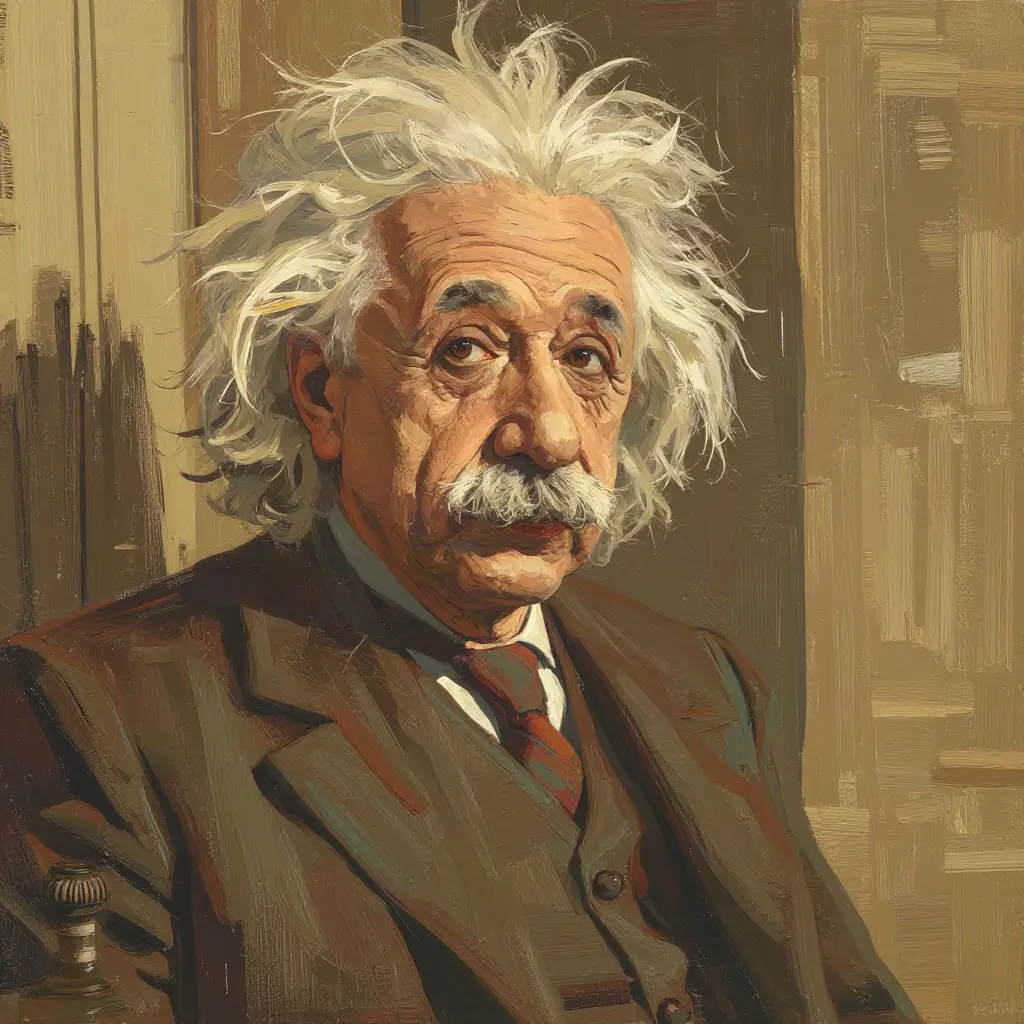
Albert Einstein and Relativity
Albert Einstein's theories of relativity state that the speed of light is constant, which means time and space are relative to the observer.
Chapter 1
The Patent Clerk's Revolution
0:48
Frequently Asked Questions
What is Special Relativity?
Special Relativity, published by Einstein in 1905, says the laws of physics and the speed of light are the same for all observers moving at a constant speed. This means that time can slow down (time dilation) and space can contract (length contraction) for an object the faster it moves relative to an observer.
What is General Relativity?
General Relativity, finalized in 1915, is Einstein's theory of gravity. It proposes that gravity is not a force, but a curve in the fabric of spacetime caused by massive objects. Planets orbit the Sun because they are following the curved path in spacetime created by the Sun's mass.
How does relativity affect GPS?
GPS satellites are affected by both theories. Their high speed makes their clocks tick slower by 7 microseconds per day (Special Relativity). However, being in weaker gravity makes their clocks tick faster by 45 microseconds per day (General Relativity). This net gain of 38 microseconds must be corrected for GPS to remain accurate.
To continue the story, download the Chunks Microlearning app
Or get it straight away:
 Download on iOS
 Download on Android