
In 37 BCE, as the Roman Republic tore itself apart, an 80-year-old scholar named Marcus Terentius Varro was finishing his final major work. A celebrated commander and polymath who claimed to have written nearly 500 books, Varro was now compiling a guide to farming called 'Res Rustica'. Buried within its practical advice on crops and livestock was a startling intuition, something far ahead of its time. He warned that farmers should not build their homes near swamps. This was common wisdom, but Varro's reason was not the usual fear of foul smells or 'bad air.' He believed the danger was something alive, invisible, and carried on the wind. What were these unseen things, and how could he possibly know about them?
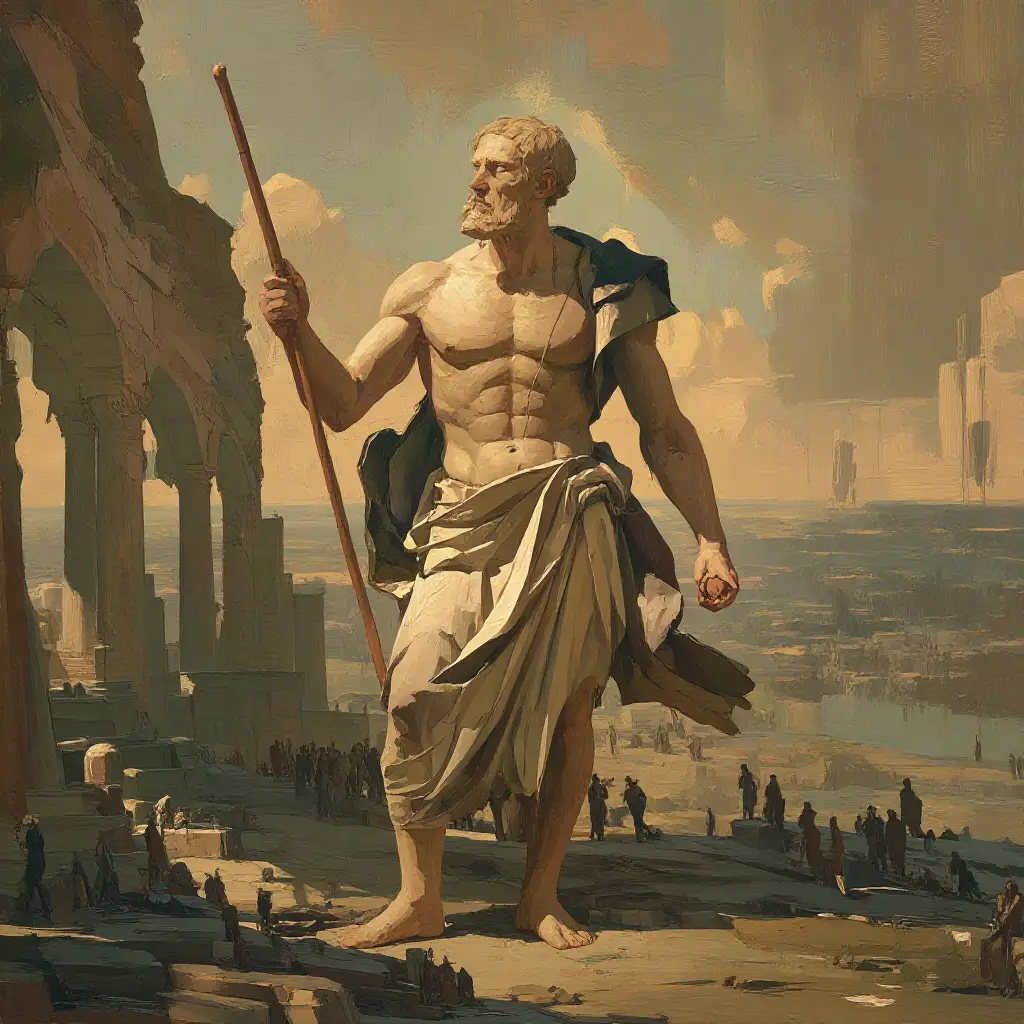
Varro's Ancient Germ Theory
Around 37 BCE the Roman scholar Varro wrote that tiny unseen creatures bred in swamps could cause disease, an idea that resembles modern germ theory.
Chapter 1
The Scholar and the Swamp
0:49
Frequently Asked Questions
What exactly did Varro warn about?
In his book on agriculture, Varro warned against building near swamps. He theorized that they bred 'certain minute creatures which cannot be seen by the eyes,' which floated in the air and entered the body through the mouth and nose to cause serious diseases. This was a biological explanation, unlike the era's focus on bad air.
Was Varro the first to discover germs?
No. Varro's idea was a remarkable intuition, not a scientific discovery. He had no microscope or way to prove his theory. The actual cause of 'swamp fever,' malaria, is a parasite spread by mosquitoes, not an airborne creature. His idea was a lucky guess that anticipated germ theory only loosely.
How did other Romans explain disease?
Roman medicine followed the Greek Hippocratic tradition, which sought natural causes. The dominant theories were miasma, the idea that disease came from polluted air or foul smells, and humoral theory, which blamed sickness on an imbalance of the body's four humors. They had already moved away from blaming gods for illness.
Learn more
To continue the story, download the Chunks Microlearning app
Or get it straight away:
 Download on iOS
 Download on Android