
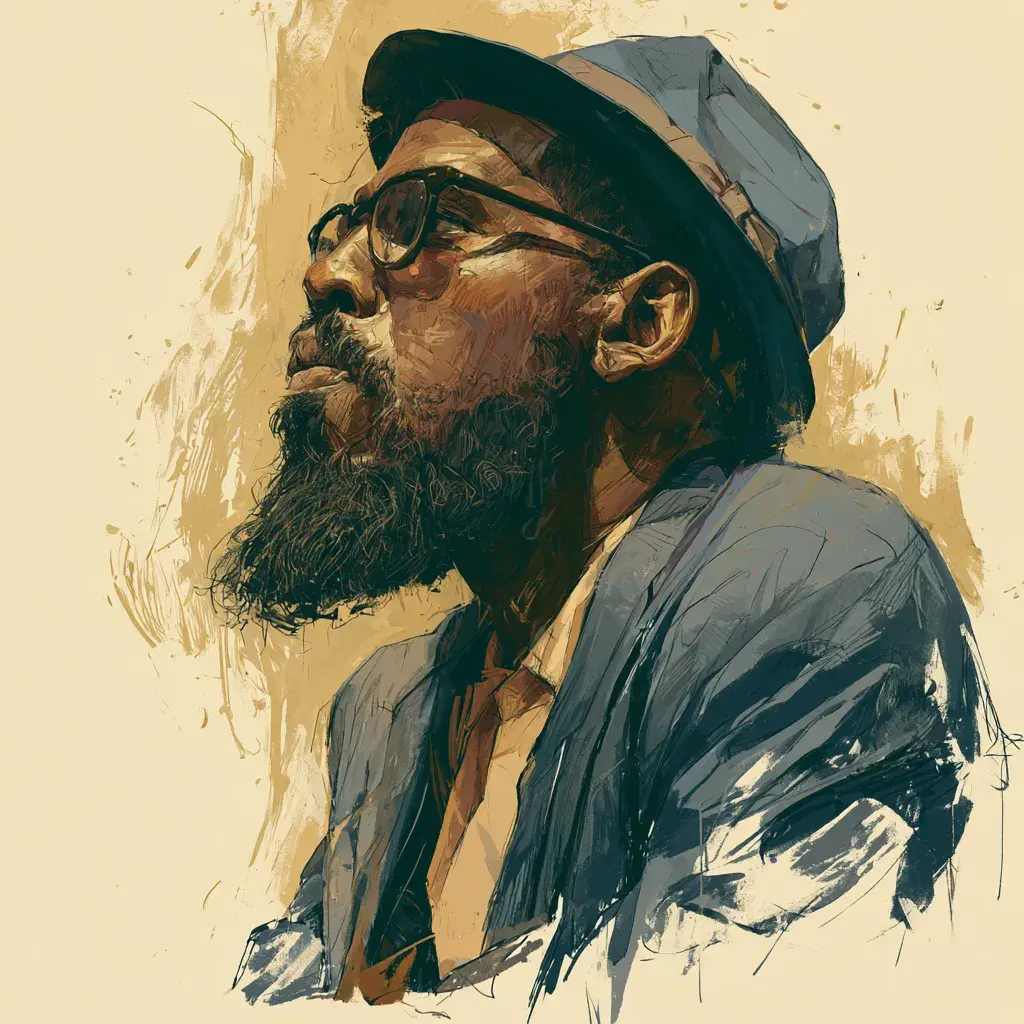
In the spring of 1941, the sound of jazz was changing in a Harlem club called Minton’s Playhouse. The house pianist was Thelonious Monk, hired for the house band by its leader, drummer Kenny Clarke. After hours, the club became a laboratory. Musicians like Charlie Parker and Dizzy Gillespie would join Monk for legendary jam sessions that often lasted until four in the morning. Monk’s focus on the ‘flatted fifth’ chord helped define the harmonic language of the new style known as bebop. While Clarke shifted the beat to the ride cymbal to free his left hand for more complex accents, Monk was building the foundations of a new musical language, one note at a time.
Thelonious Monk
The pianist whose percussive style changed jazz, and who was then banned from the NYC clubs where the revolution was happening.
Chapter 1
The House Pianist
0:47
People in this story
Part of
Frequently Asked Questions
What made Thelonious Monk's piano playing so different?
Monk used an unconventional technique with flat, stiff fingers, striking the keys with a percussive force. He deliberately used dissonant 'cluster' chords and made strategic use of silence, which many critics initially mistook for mistakes or 'wrong notes'.
What is Monk's most famous song?
His most famous composition is 'Round Midnight, copyrighted in 1943. It is the most-recorded jazz standard ever composed by a jazz musician. However, his own version was not recorded until 1947, years after it was popularized by others.
Why was Thelonious Monk unable to perform in New York for six years?
In 1951, police revoked Monk's 'cabaret card' after a narcotics arrest. Without this license, he was legally barred from performing in any NYC venue that served alcohol, effectively cutting him off from the city's nightclub circuit until 1957. He lost the card because he refused to testify against his friend, pianist Bud Powell.
To continue the story, download the Chunks Microlearning app
Or get it straight away:
 Download on iOS
 Download on Android