
In the Roaring Twenties, the American stock market seemed like a guaranteed path to riches. The Dow Jones Industrial Average had sextupled in value, fueled by a risky practice called 'buying on margin.' This allowed investors to borrow huge sums from brokers with a tiny down payment. For example, with just $100 in cash, someone could buy $1,000 worth of stock. The problem was leverage: if that stock's price fell by only 10%, the investor's entire $100 was wiped out instantly. Yet, the confidence was unshakable. The famous economist Irving Fisher declared that stock prices had reached a 'permanently high plateau.' For millions, the idea of a crash seemed impossible as the market climbed ever higher.
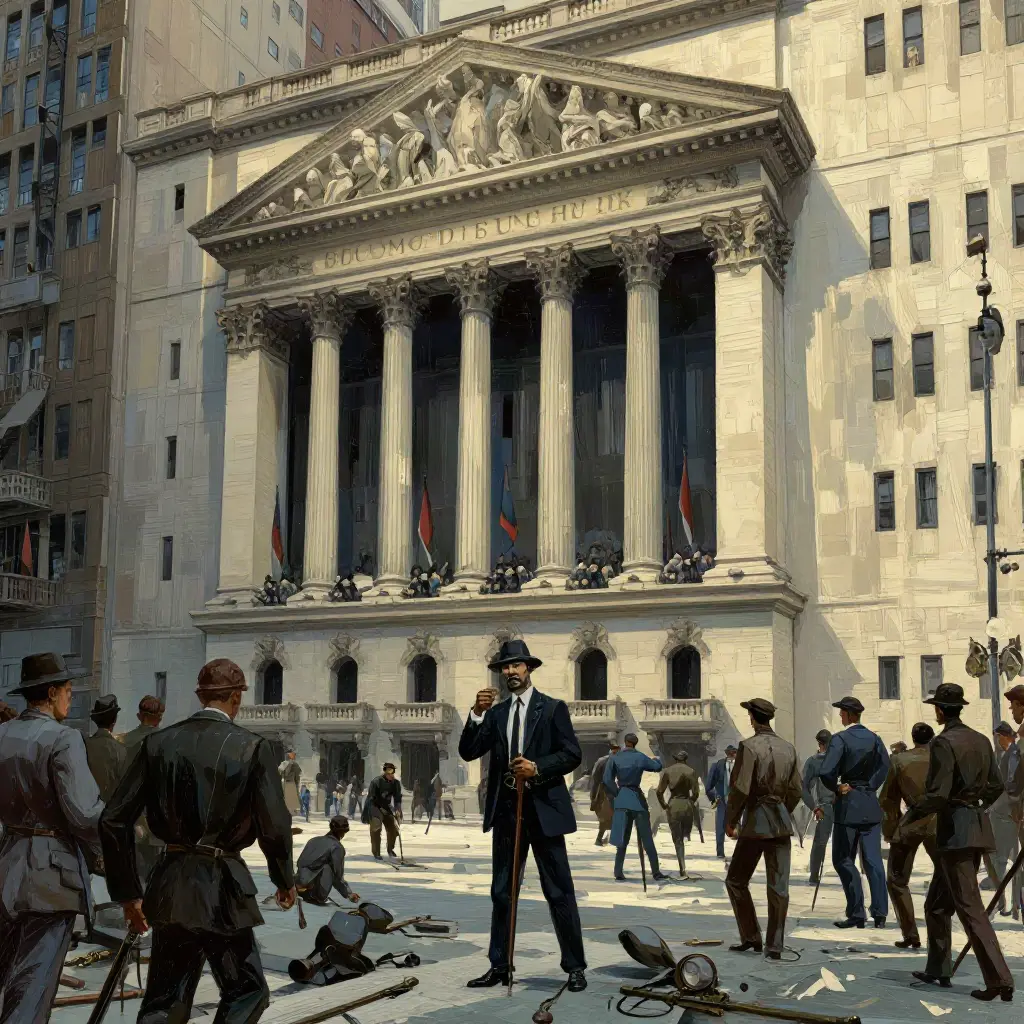
The Wall Street Crash of 1929
A stock boom sextupled the market on borrowed money before a record crash wiped out nearly a war's worth of wealth.
Chapter 1
The Permanently High Plateau
0:47
Part of
Frequently Asked Questions
What did 'buying on margin' mean in the 1920s?
It allowed investors to buy stocks by putting down a small fraction of the price, as little as 10%, and borrowing the rest from their broker. This magnified both gains and losses. A small drop in a stock's price could wipe out an investor's entire initial payment.
What were Black Thursday and Black Tuesday?
Black Thursday (Oct. 24, 1929) was the first day of major panic selling, which was temporarily halted by bankers. Black Tuesday (Oct. 29, 1929) was the most devastating day, when the market crashed catastrophically with a record 16.4 million shares traded, confirming the start of a major crisis.
What were the main consequences of the 1929 crash?
The crash destroyed public confidence, led to over 9,000 bank failures by 1933, and wiped out the savings of millions. It triggered the decade-long Great Depression and led to major financial reforms, including the creation of the Securities and Exchange Commission (SEC).
Learn more
To continue the story, download the Chunks Microlearning app
Or get it straight away:
 Download on iOS
 Download on Android