
At 5:12 AM on April 18, 1906, a faint tremor shook the coast of Northern California. This foreshock, lasting 20 to 25 seconds, was just a prelude. The main event was a magnitude 7.9 earthquake, its epicenter just 2 miles offshore. For 45 to 60 seconds, the ground convulsed violently. The San Andreas Fault tore open along a 296-mile stretch, a wound running down the state. In some places, the ground west of the fault lurched sideways by as much as 21 feet. High-intensity seismic waves traveled as far inland as central Nevada and north into Oregon. In San Francisco, the immediate consequence was catastrophic, but not from the shaking alone. Below the streets, the city’s veins snapped. Underground gas and water lines were completely fractured. As the shaking subsided and dust filled the morning air, fires began to spark across the ruined city. With the water mains broken, firefighters would find themselves holding useless hoses, watching as a new disaster began to unfold, a disaster they were powerless to stop. The earthquake was over, but the city's destruction had just begun.
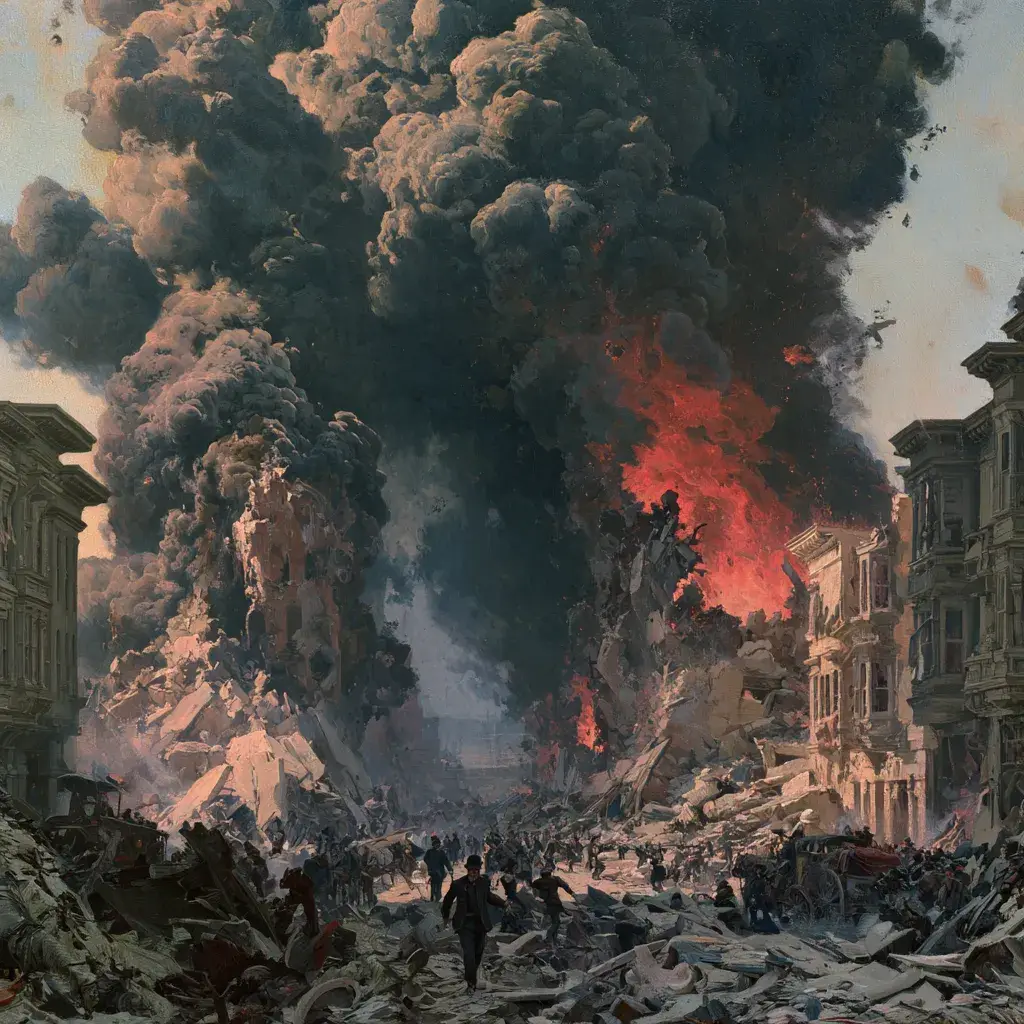
The San Francisco Earthquake
On April 18, 1906, a 7.9 magnitude quake tore open the San Andreas Fault, but it was the fire that followed that destroyed 80% of the city.
The Rip
Frequently Asked Questions
How powerful was the 1906 San Francisco earthquake?
The earthquake had a massive magnitude of 7.9. The mainshock caused violent ground shaking that lasted between 45 and 60 seconds, tearing open the ground along a 296-mile stretch of the San Andreas Fault.
What caused most of the destruction in the 1906 disaster?
While the initial earthquake was devastating, the subsequent firestorm caused the most damage. The quake fractured underground gas and water lines, leaving the city helpless as multiple fires combined and incinerated 490 city blocks, erasing over 80 percent of San Francisco's infrastructure.
What was the true death toll of the San Francisco earthquake?
For decades, the official death toll was a suspiciously low 478 people. This figure was a deliberate understatement by city leaders to protect real estate investments. Historical research later proved that at least 3,000 people died in the disaster, a number San Francisco officially recognized in 2005.
Learn more
To continue the story, download the Chunks Microlearning app
Or get it straight away:
 Download on iOS
 Download on Android