
In the spring of 1974, Hungarian architecture professor Ernő Rubik wanted to teach his students about 3D movement. Working in his mother’s apartment in Budapest, the 29-year-old built a prototype. He hand-carved 27 wooden blocks, connecting them first with elastic bands and paper clips. His goal was to create a structure whose individual parts could move without the whole thing falling apart. He marked the faces with different colors to track their movement. After twisting it a few times, he scrambled the colors, creating a vibrant, chaotic pattern. He then tried to return it to its original state, with each face a single, solid color. He quickly realized he had created something far more complex than a teaching tool.
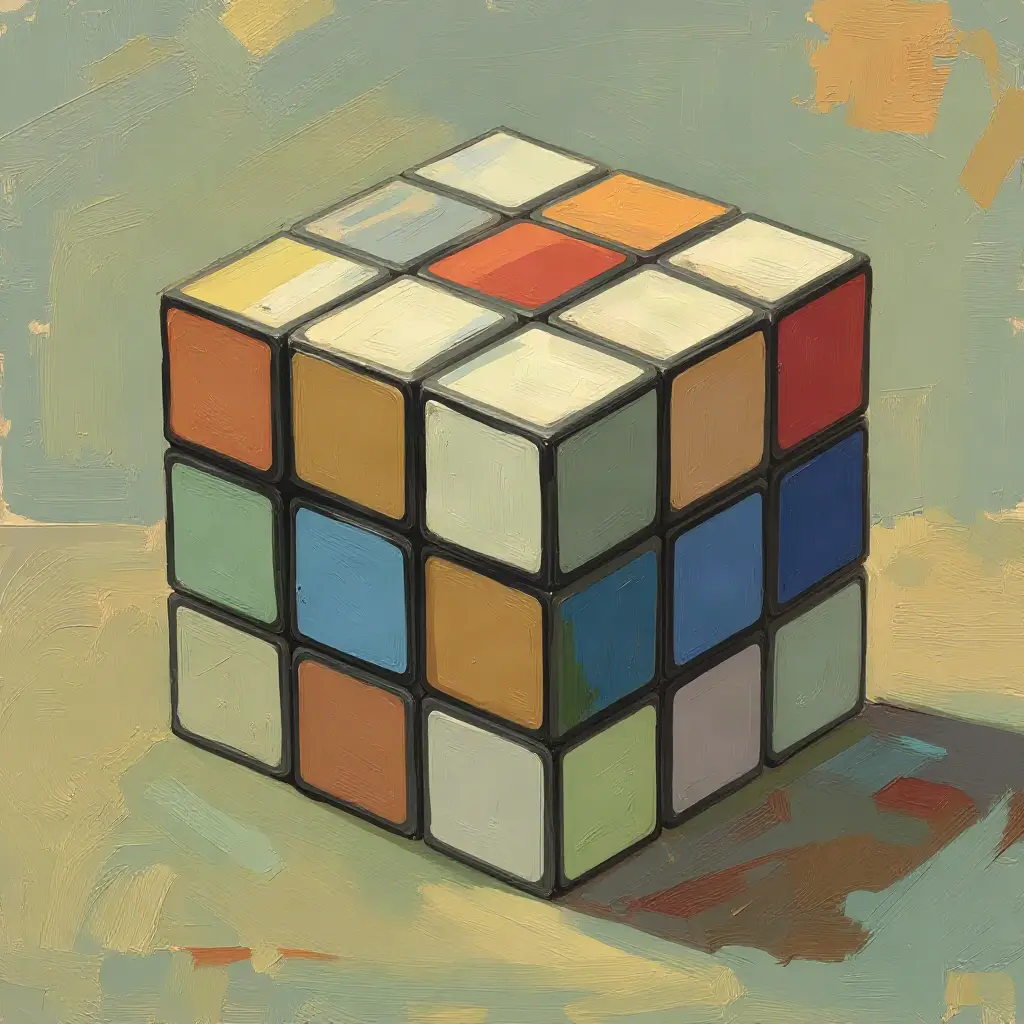
The Rubik's Cube
In 1974, a Hungarian professor made a puzzle he initially couldn't solve. This is the story of the Rubik's Cube.
Chapter 1
The Impossible Object
0:48
Part of
Frequently Asked Questions
Why did Ernő Rubik invent the cube?
Ernő Rubik, an architecture professor, created the cube in 1974 to help his students understand three-dimensional movement. He wanted a physical model whose parts could rotate without the entire structure falling apart.
How many possible combinations does a Rubik's Cube have?
A standard 3x3x3 Rubik's Cube has over 43 quintillion possible configurations. The exact number is 43,252,003,274,489,856,000.
What is the fastest a human has ever solved a Rubik's Cube?
The current world record for a single 3x3x3 solve is 2.51 seconds, set by Chinese speedcuber Xuanyi Geng in October 2026. This performance surpassed the previous mark of 2.76 seconds set by Teodor Zajder earlier that same year.
Learn more
To continue the story, download the Chunks Microlearning app
Or get it straight away:
 Download on iOS
 Download on Android