
Around 2580 BCE, the Pharaoh Khufu ordered the construction of his eternal tomb. His father, Sneferu, had already mastered pyramid building, and now Khufu intended to perfect it. He envisioned a monumental gateway to the afterlife, the centerpiece of a vast complex for himself and his queens. To his people, the project was known as 'Akhet Khufu', or 'Khufu’s Horizon'. The pharaoh was so central to the project that his name was found in red ochre graffiti scrawled by work crews, hidden deep inside the pyramid's chambers. The entire construction took between 20 and 30 years, and it stood as the tallest man-made structure on Earth for over three and a half millennia.
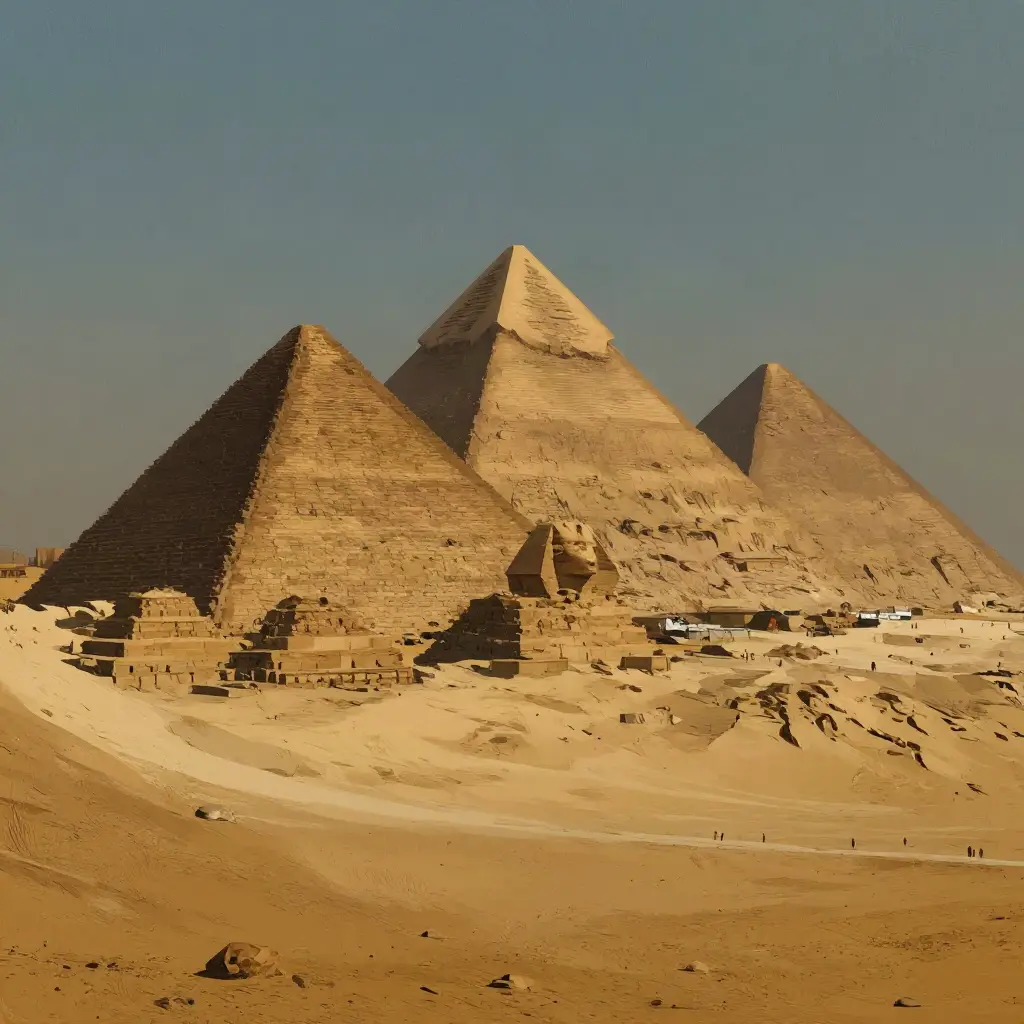
The Pyramids of Giza
How the Great Pyramid of Giza was built around 2580 BC: the architect, an inspector's surviving diary, and the paid workers' city beside it.
Chapter 1
Khufu's Horizon
0:46
Frequently Asked Questions
Were the pyramids built by slaves?
No. Archaeological evidence from a purpose-built settlement at Giza shows the builders were a well-provisioned and respected workforce of paid laborers. They had a high-protein diet of meat, lived in barracks, and received advanced medical care for their injuries.
How did the Egyptians move the giant stone blocks?
They pulled the multi-ton blocks on large wooden sledges. To make this easier, they poured a precise amount of water onto the sand directly in front of the sledge. This created a stiff surface that reduced friction and halved the force needed to pull the stones across the desert.
Is the Great Pyramid perfectly aligned?
It is a masterpiece of precision engineering, aligned almost perfectly to the four cardinal directions. The north-facing side deviates from true north by only 3 arcminutes, an error of about 0.05 degrees. This feat was likely achieved by tracking the rotation of specific stars.
Learn more
To continue the story, download the Chunks Microlearning app
Or get it straight away:
 Download on iOS
 Download on Android