
In September of 490 BC, a Persian fleet of roughly 600 ships put in on the sandy plain of Marathon, about 40 km northeast of Athens. Aboard were more than 20,000 infantry and cavalry under the Persian commanders Datis and Artaphernes. Beside them stood Hippias, the tyrant Athens had driven out years before, who had chosen this same beach for the landing because he remembered it from his own rule. Persia had come to punish Athens for backing the Ionian rebels against Persian authority, and Hippias hoped a Persian win would put him back on the throne he had lost. Athens had no standing army. When word of the landing reached the city, the Athenians had to scramble together citizen-soldiers, men pulled from farms and workshops, with no professional force to call on. The threat was not abstract. A force that size, landed so close to an undefended city, could reach Athens itself within days if nothing stopped it. The Athenian generals knew they could not face 20,000 Persian troops alone. They needed Sparta, the one Greek city whose soldiers might tip the balance, and they needed word to reach Sparta fast. Everything that followed, the desperate run south, the battle on the plain, and the myth born centuries later, started on that beach the moment the ships grounded and Hippias stepped onto sand he already knew.
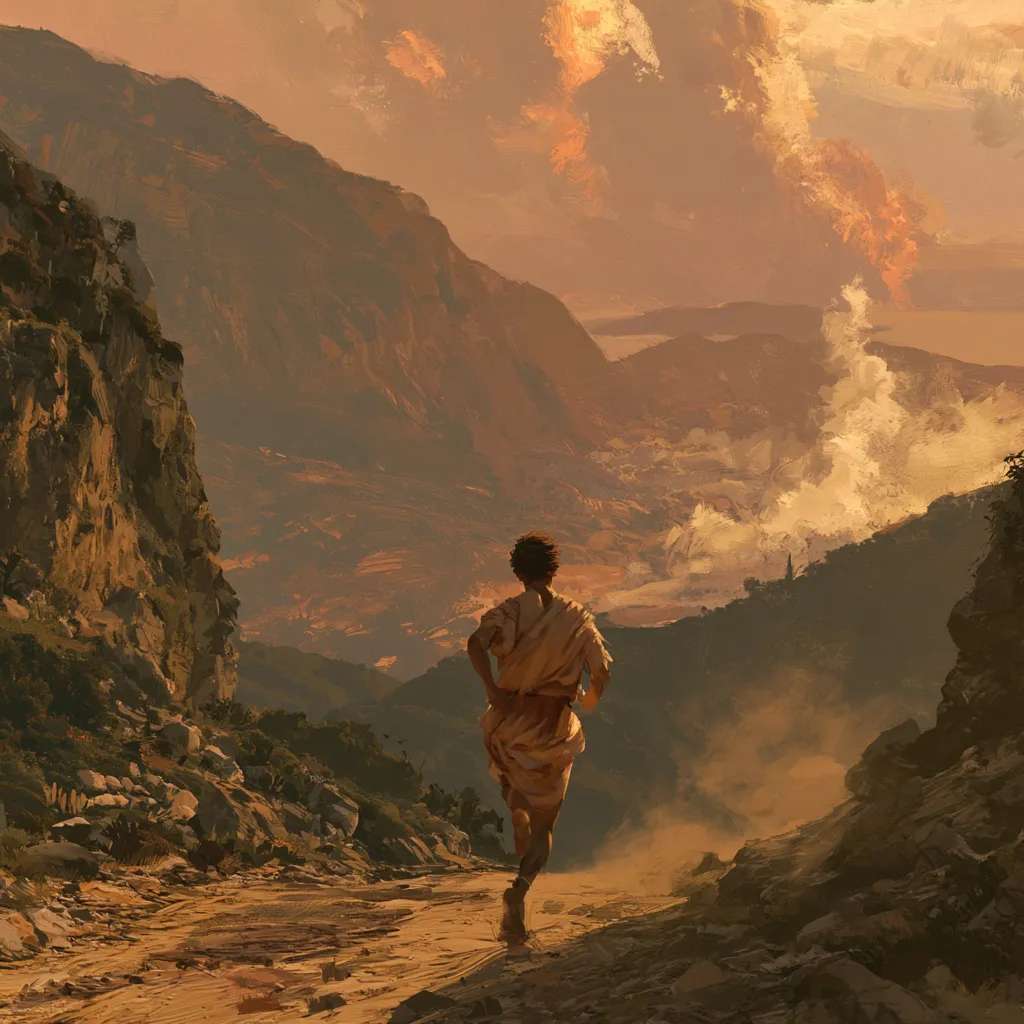
The Origin of the Marathon
A Greek herald ran 220-240 km to Sparta in 490 BC. A poem in 1879 turned him into a dying messenger.
The Fleet on the Beach
Frequently Asked Questions
Did Pheidippides really run from Marathon to Athens and die announcing victory?
No. Herodotus, writing about 50 years after the battle, only describes Pheidippides running from Athens to Sparta before the battle to ask for help. The dying victory messenger first appears centuries later in the writings of Plutarch and Lucian, and the two stories were fused into one legend much later.
Why did Sparta refuse to help Athens before the battle?
Spartan law forbade the army from marching out during the Carneia, a nine-day religious festival honoring Apollo Carneius. Spartan magistrates told Pheidippides they would come once the moon was full, and their army arrived at Marathon only after the fighting was over.
Why is the modern Olympic marathon about 40 km long?
French philologist Michel Bréal proposed the race for the 1896 Athens Olympics, and organizers laid out a course of roughly 40 km from the town of Marathon to the Panathenaic Stadium, retracing the route of the legendary victory run. The exact 42.195 km distance was standardized later.
Learn more
To continue the story, download the Chunks Microlearning app
Or get it straight away:
 Download on iOS
 Download on Android