
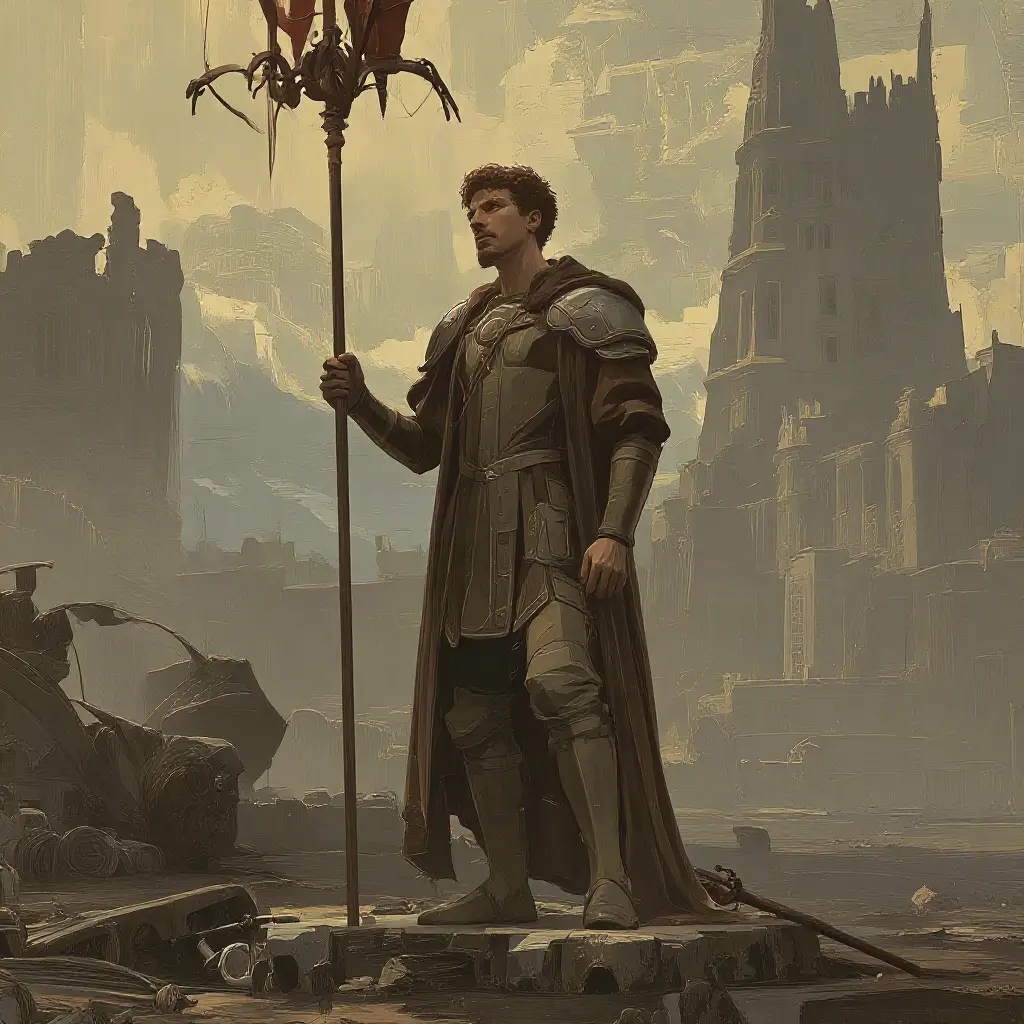
The legend of the Holy Grail begins not with a cup, but with a platter. Around 1190, French poet Chrétien de Troyes wrote 'Perceval', an unfinished story. In it, a young knight named Perceval visits the castle of the wounded Fisher King where he witnesses a strange procession. A young woman carries a 'graal', a wide, golden dish set with gems, holding a single communion wafer. It is carried alongside a mysterious bleeding lance. While Chrétien does not use the specific title ‘Holy Grail,’ his poem ends before Perceval can return to the castle to resolve the mystery. He left behind not a confirmed Christian relic, but a profound literary puzzle: what was the true nature of the grail?
The Legend of the Holy Grail
How the Holy Grail grew from a mysterious dish in Chrétien de Troyes's unfinished poem of about 1190 into the cup of the Last Supper, and why a chalice in Valencia is claimed to be it.
Chapter 1
A Mysterious Dish
0:48
Frequently Asked Questions
Was the Holy Grail originally a cup?
No. The first appearance of the 'graal' in literature, in Chrétien de Troyes's poem 'Perceval' around 1190, describes it as a wide, deep platter or serving dish. The writer Robert de Boron later reimagined it as the cup from the Last Supper about a decade later.
Who was the only knight to complete the Grail quest?
In the most famous versions of the legend, such as the 13th-century Vulgate Cycle, the only knight pure enough to fully achieve the quest is Sir Galahad. His spiritual perfection allowed him to gaze directly into the Grail, after which his soul was taken to heaven. Other great knights like Lancelot and Perceval were deemed too flawed for this ultimate vision.
Are there any real Holy Grails?
Several objects have been claimed to be the Grail, but none have verifiable proof. The most famous is the Holy Chalice of Valencia, an ancient agate cup whose age is consistent with the era of Christ. Another claimant, the Nanteos Cup, was found by modern analysis to be a common wooden bowl from the 14th century.
Learn more
To continue the story, download the Chunks Microlearning app
Or get it straight away:
 Download on iOS
 Download on Android