
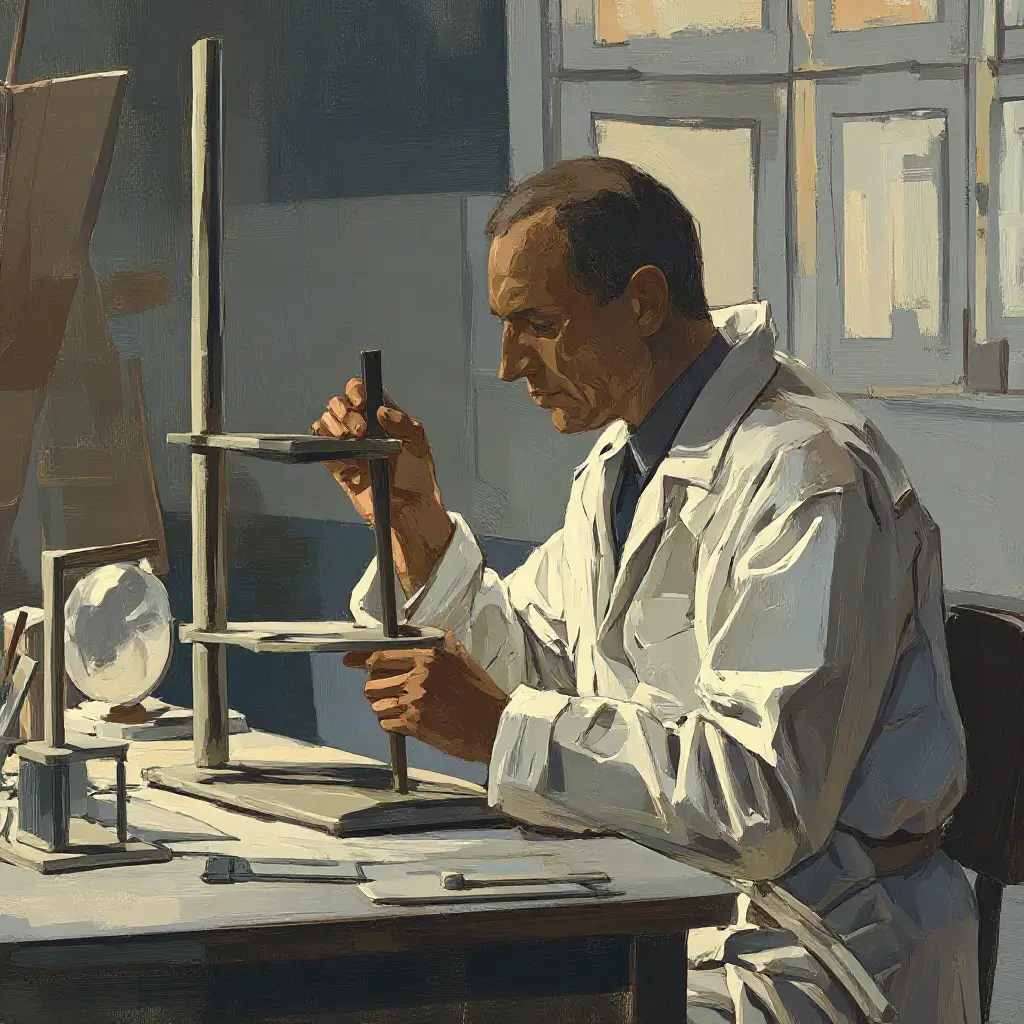
For centuries, a perfect murder weapon existed. Tasteless and untraceable, arsenic was known as the 'inheritance powder'. This changed because of a trial in 1832, when a man named John Bodle was acquitted of murdering his grandfather. The key evidence, a crude arsenic test, deteriorated before the jury could see it. A chemist at the Royal Arsenal, James Marsh, was infuriated. He resolved to create a better method. In 1836, he perfected a glass apparatus that could detect even a tiny amount of arsenic, as little as 0.02 milligrams. It produced a stable 'metallic mirror' as undeniable proof. Thanks to Marsh, poisoners could no longer rely on their weapon being invisible, and forensic toxicology was born. The test was famously used in 1840 to convict Marie Lafarge in France.
The History of Forensic Science
How forensic science learned to identify criminals, from the first reliable arsenic test and Bertillon's body measurements to fingerprinting, blood typing and Alec Jeffreys' discovery of DNA profiling.
The Inheritance Powder
Frequently Asked Questions
What was the first scientific test used to convict a poisoner?
The first reliable test was for arsenic, perfected by chemist James Marsh in 1836. Before his invention, arsenic was known as 'inheritance powder' because it was tasteless and previously untraceable. Marsh's device could detect as little as 0.02 milligrams of the poison.
How were fingerprints first used to solve a murder?
In June 1892, Argentine police official Juan Vucetich used a bloody thumbprint on a doorframe to solve a double murder. The print belonged to the mother, Francisca Rojas, who had accused a neighbor. After being confronted with the evidence, she confessed to the crime.
What case established DNA as the gold standard for forensic evidence?
The 1988 conviction of Colin Pitchfork for two murders in Leicestershire, UK, established DNA's role in the courtroom. DNA evidence was first used in the case to exonerate a suspect who had falsely confessed, and then to identify Pitchfork after a massive 'genetic dragnet' of 5,000 local men in 1987.
Learn more
To continue the story, download the Chunks Microlearning app
Or get it straight away:
 Download on iOS
 Download on Android