
In November 1801, the English polymath Thomas Young laid down a challenge to Isaac Newton's century-old theory of light. Newton believed light was made of tiny particles, or 'corpuscles'. But Young suspected it was a wave. In a darkened room, he used a pinhole in a shutter to create a single sunbeam, then split that beam with a thin paper strip just 0.85 millimetres wide. The result on the opposite wall was not a simple shadow, but a series of light and dark bands known as 'interference fringes'. It was the same crisscrossing pattern ripples make in a pond. Young used the spacing of these fringes to calculate the wavelengths of different colors of light for the first time, though his findings were initially rejected by a scientific community loyal to Newton.
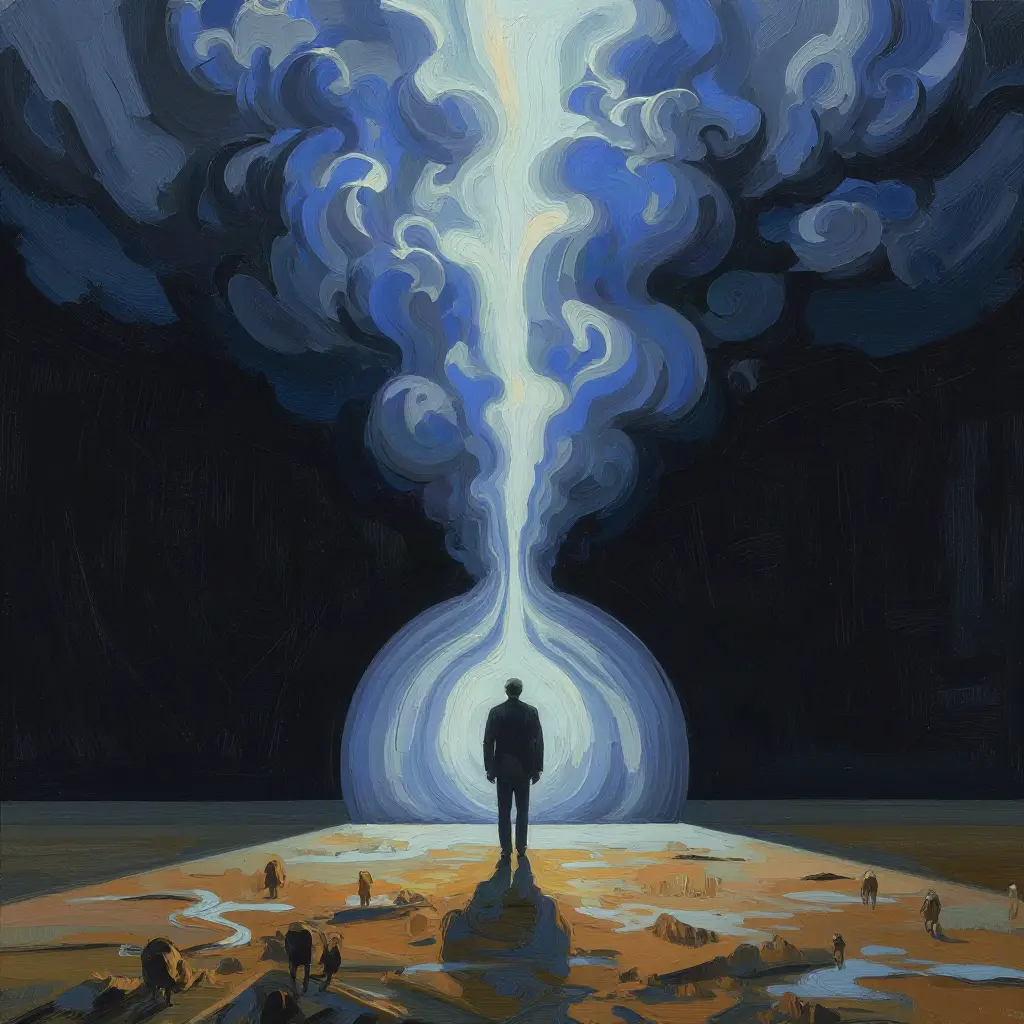
The Double-Slit Experiment
The quantum experiment where single particles pass through two slits at once, creating a wave pattern that vanishes when measured.
The Ripples of Light
Frequently Asked Questions
Why is the double-slit experiment so important?
It demonstrates the central mystery of quantum mechanics: wave-particle duality. It shows that particles like electrons can behave as both localized particles and spread-out waves simultaneously, defying classical intuition. The experiment reveals that the act of observation fundamentally changes the outcome.
What is the 'observer effect' in this experiment?
The observer effect is the finding that measuring which slit a particle goes through causes its wave-like behavior to disappear. The interference pattern vanishes and is replaced by two simple bands, as if solid objects were thrown through. This is caused by the physical interaction required for measurement, not by consciousness.
Does this effect only happen with light?
No, it was first shown with light, but has since been demonstrated with matter particles like electrons. Experiments have even shown the effect using massive molecules called 'Buckyballs', which are made of 60 carbon atoms. This proves that wave-particle duality is a fundamental property of matter, not just light.
Learn more
To continue the story, download the Chunks Microlearning app
Or get it straight away:
 Download on iOS
 Download on Android