
In 72 AD, the Roman Emperor Vespasian gave an order that would reshape Rome. On the site of a private lake built by his hated predecessor, Nero, he would construct a monumental stone amphitheater. This was a symbolic act, returning a piece of the city to its people. The project, originally named the Flavian Amphitheater, had a dark source of funding. An inscription confirms it was paid for 'Ex Manubiis,' or from the spoils of war. Specifically, it was financed by the plunder of the Temple in Jerusalem. To build it, tens of thousands of enslaved Jewish captives were brought to Rome, providing the manual labor for a structure that would stand for millennia. A concrete foundation 12 meters deep was laid to support its weight on the marshy ground.
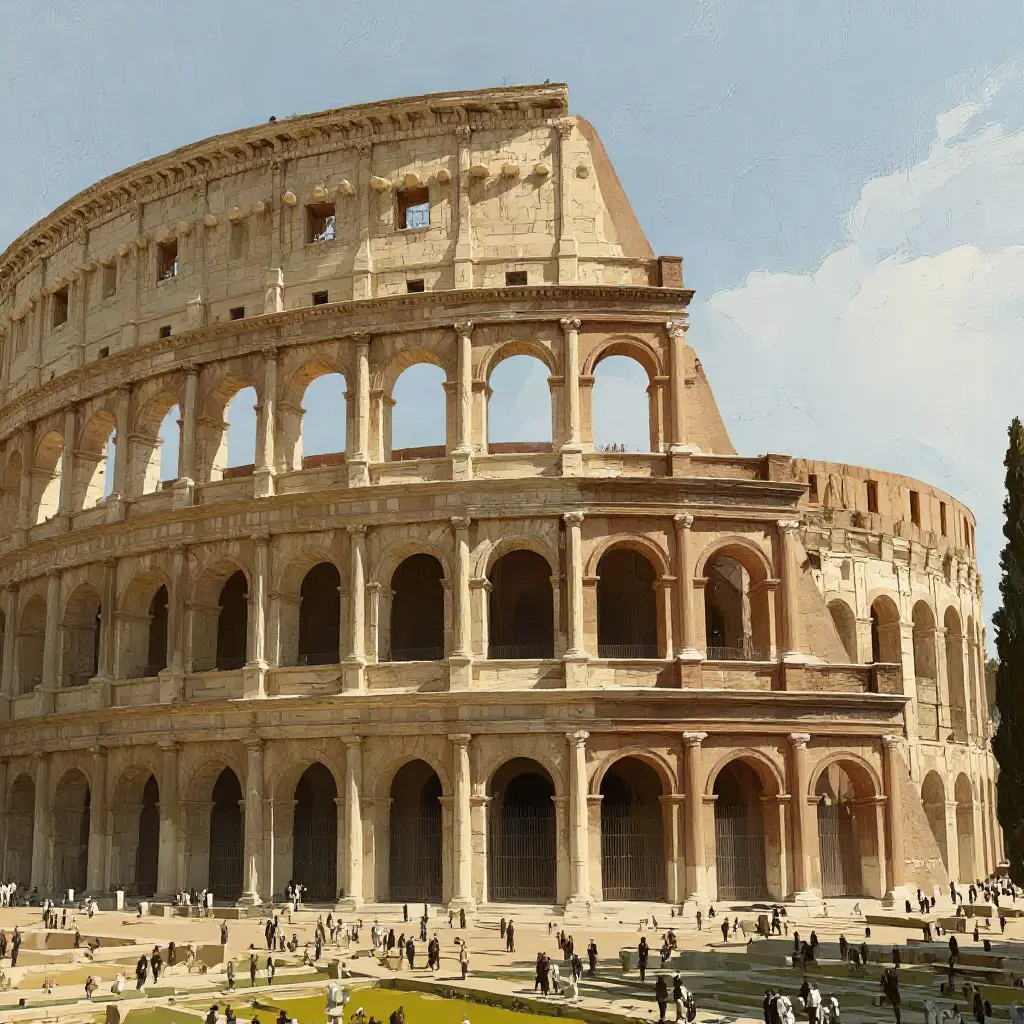
The Colosseum
Discover how the Colosseum was built with war spoils, engineered to empty in minutes, and what the thumbs-down gesture really meant.
The Emperor's Gift
Frequently Asked Questions
Who paid for the Colosseum?
Emperor Vespasian funded the construction using the spoils from the Roman-Jewish War. An inscription confirms it was financed by plunder from the Temple in Jerusalem. The project symbolically returned land to the public that the previous emperor, Nero, had used for a private lake.
Did gladiators always fight to the death?
No, this is a common myth. Gladiators were expensive assets, and about 90 percent of professional fights ended with both fighters surviving. Crowds would signal for mercy by tucking their thumb into a fist, which represented a sheathed sword.
Why is the Colosseum so damaged today?
After the fall of Rome, the Colosseum was used as a massive stone quarry. Earthquakes in 847 and 1349 AD caused major collapses, and builders recycled its stone for projects like St. Peter's Basilica. The looting only stopped when Pope Benedict XIV consecrated it as a sacred site in 1749.
Learn more
To continue the story, download the Chunks Microlearning app
Or get it straight away:
 Download on iOS
 Download on Android