
In June 1631, Shah Jahan was camped near Burhanpur, finishing a military campaign against the Deccan sultanates, when his wife Mumtaz Mahal went into labor with their fourteenth child. She was 38 years old and had already borne thirteen children before this one. The labor stretched on for many hours, and on 17 June 1631 she died in the camp. Word reached Shah Jahan inside his own tents, in the middle of a war he had come south to win. Court chroniclers, who normally filled their pages with troop movements and sieges, turned instead to describing an emperor undone. Within weeks his hair had turned white. He withdrew from the business of the court into seclusion, refusing the company of ministers and generals for nearly a year. When he finally reappeared, he had a permanent stoop in his back, and the only person who could draw him out of his rooms was his eldest daughter, Jahanara Begum. She became his closest companion in the months that followed, managing what he could not. The men around him had watched him plan campaigns and command armies without visible strain. None of them had recorded him like this before. It was this grief, catalogued in such unusual detail by the men who wrote his court's history, that turned into the decision to build something permanent for the woman he had lost in a military camp far from home.
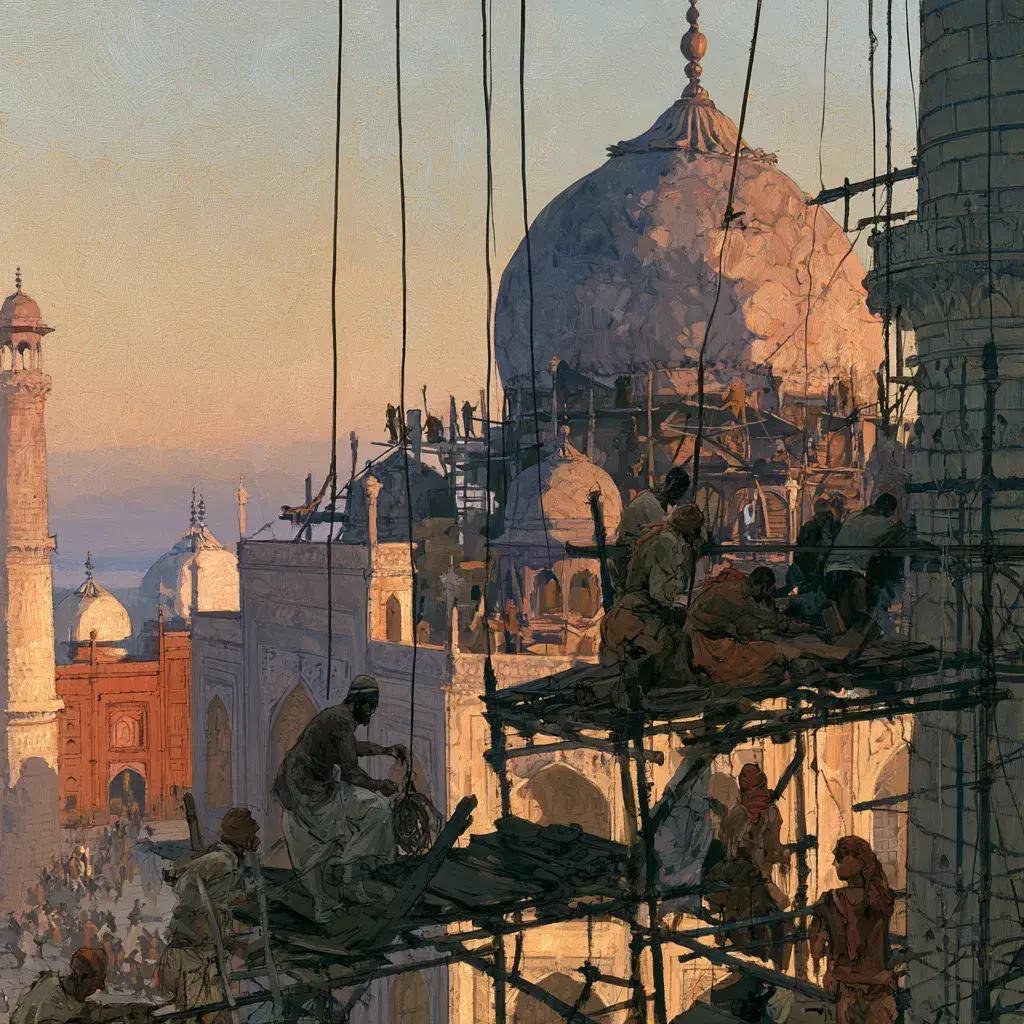
The Building of the Taj Mahal
Grief over Mumtaz Mahal's 1631 death drove Shah Jahan to build the Taj Mahal; he died imprisoned in sight of it.
A Death at Burhanpur
Frequently Asked Questions
Why did Shah Jahan build the Taj Mahal?
His wife Mumtaz Mahal died in 1631 in a military camp near Burhanpur while giving birth to their fourteenth child. Her death sent Shah Jahan into deep grief, and he had a mausoleum and funerary garden built in Agra to hold her remains permanently.
How did engineers stop the Taj Mahal from sinking into the riverbank?
Builders sank a network of deep wells below the water table on the Yamuna's south bank and packed each one with stone rubble and mortar. Masonry piers and arches connected the wells into a single raised platform, lifting the mausoleum above seasonal river floods.
Is it true that Shah Jahan cut off the hands of the Taj Mahal's craftsmen?
No contemporary chronicler or European traveler recorded any such mutilation, and historians have found no evidence for it. Many of the same master craftsmen are recorded working on later Mughal building projects after the Taj Mahal was finished.
Learn more
To continue the story, download the Chunks Microlearning app
Or get it straight away:
 Download on iOS
 Download on Android