
The storm god Susanoo-no-Mikoto was born from the nose of the creator god Izanagi. But his behavior was far from divine. After a series of destructive rampages against his sister, the sun goddess Amaterasu, he committed a final, horrific act. He flayed a piebald horse and threw its carcass into his sister's sacred weaving hall. The terror of the act caused one of Amaterasu’s weavers to die and drove the sun goddess herself into a dark cave, plunging the world into blackness. As punishment, the other gods plucked out Susanoo's beard and fingernails before banishing him from the Plain of High Heaven. Forced to pay a fine of a thousand tables of offerings, he was cast out, eventually landing at Tori-kami on the upper reaches of the Hii River.
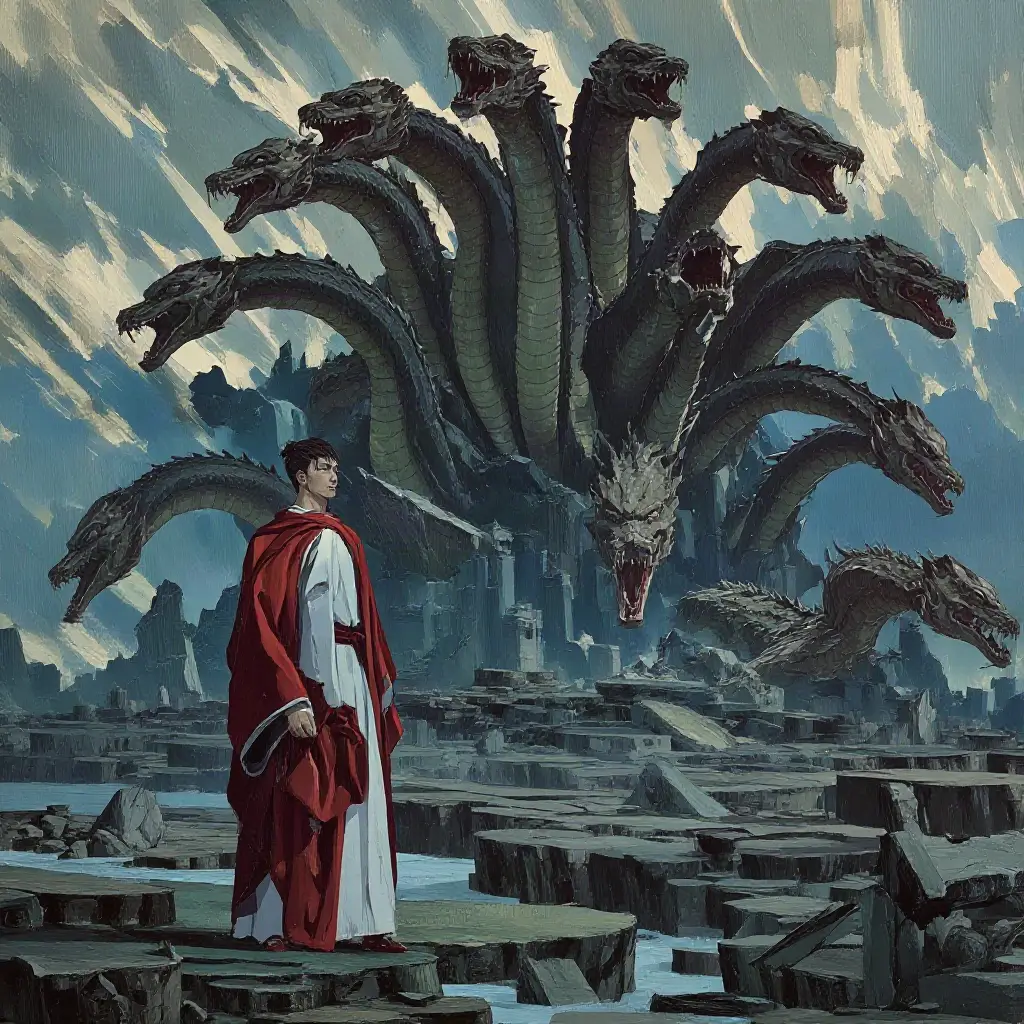
Susanoo and the Eight-Headed Serpent
The exiled storm god Susanoo battles an eight-headed serpent, finding a divine sword in its tail that became one of Japan's Imperial Regalia.
Chapter 1
A God Cast Out
0:52
Frequently Asked Questions
Who was Susanoo?
Susanoo-no-Mikoto was the Japanese storm god in Shinto mythology. He was born from the nose of the creator god Izanagi and was the brother of the sun goddess Amaterasu. He was known for his destructive rampages before becoming a hero in Izumo.
What was the Yamata no Orochi?
The Yamata no Orochi was a monstrous serpent with eight heads and eight tails, described in the ancient text, the Kojiki. Its body was large enough to span eight hills and valleys, with eyes as red as winter cherries. It is often interpreted as a metaphor for a flooding river.
What is the Kusanagi-no-Tsurugi?
The Kusanagi-no-Tsurugi, or 'Grass-Cutting Sword,' is the blade Susanoo found in the serpent's tail. It is one of the Three Imperial Regalia of Japan, symbolizing the virtue of valor. The sword is housed at the Atsuta Shrine and is part of the emperor's enthronement ceremony.
Learn more
To continue the story, download the Chunks Microlearning app
Or get it straight away:
 Download on iOS
 Download on Android