
In the age of sail, a disease haunted the seas that was more deadly than any battle. It was called scurvy. Caused by a simple lack of Vitamin C, it triggered a horrifying breakdown of the body. Without this key nutrient, the body cannot produce collagen, the biological glue that holds human tissue together. Sailors’ gums would turn black and spongy, their teeth falling from their sockets. Most shockingly, old, long-healed wounds would physically unzip, reopening into fresh gashes as if the injury had just occurred. Even decades-old bone fractures could spontaneously re-break. Between the 15th and 18th centuries, scurvy killed an estimated two million sailors, more than all naval combat, shipwrecks, and storms combined. Finding a cure was not just a medical challenge; it was a matter of national survival.
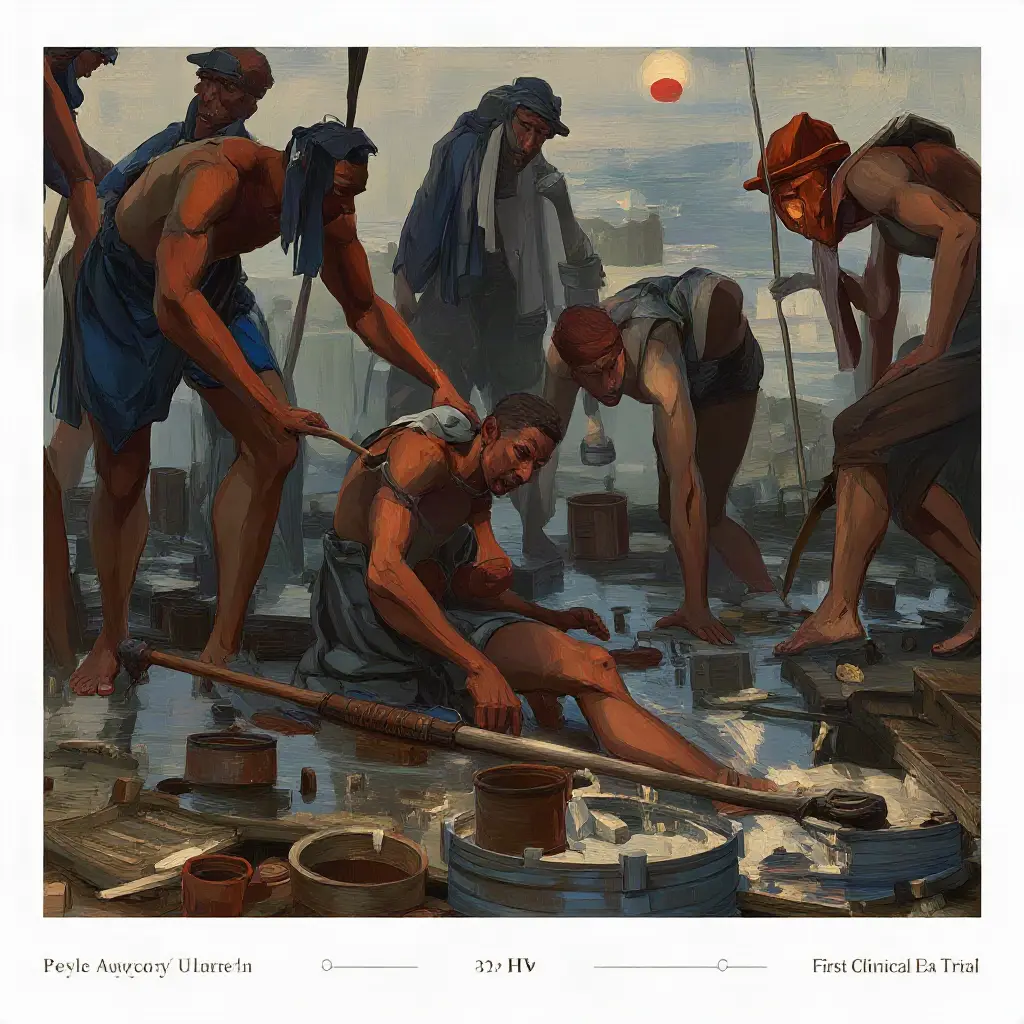
Scurvy and the First Clinical Trial
How James Lind's 1747 test of six scurvy remedies on twelve sailors found that citrus worked, and why the navy took fifty years to act on it.
The Sea Plague
Frequently Asked Questions
What is scurvy?
Scurvy is a disease caused by a severe lack of Vitamin C. This deficiency prevents the body from producing collagen, a protein essential for holding tissues together. Symptoms include spongy gums, tooth loss, and the reopening of old wounds.
Was James Lind the first person to suggest citrus for scurvy?
While others had anecdotally suggested fruit as a remedy, James Lind was the first to prove it using a controlled scientific experiment. His 1747 trial aboard HMS Salisbury systematically compared different treatments, providing clear, empirical evidence that citrus was the cure.
Why did it take the Royal Navy so long to adopt the cure?
Although Lind's experiment was successful, he mistakenly recommended boiling the citrus juice to preserve it. This process destroyed the Vitamin C, rendering the cure ineffective and causing naval authorities to doubt his findings for nearly 50 years until the juice was preserved with alcohol instead.
Learn more
To continue the story, download the Chunks Microlearning app
Or get it straight away:
 Download on iOS
 Download on Android