
In 1040, in Troyes, France, a boy named Shlomo Yitzchaki was born. He would become known to the world by the acronym Rashi. As a young man, he journeyed to the great Jewish academies of the Rhineland to learn. In the city of Mainz, he studied under a foremost scholar of the age, Rabbi Jacob ben Yakar. Rashi was a uniquely industrious student. He didn't just listen; he filled personal booklets with meticulous notes, capturing the lectures and logical arguments of his teachers. This habit of clarification and recording formed the foundation of his entire life's work. At about age 25, he returned to Troyes, his mind filled with the learning he had so carefully gathered.
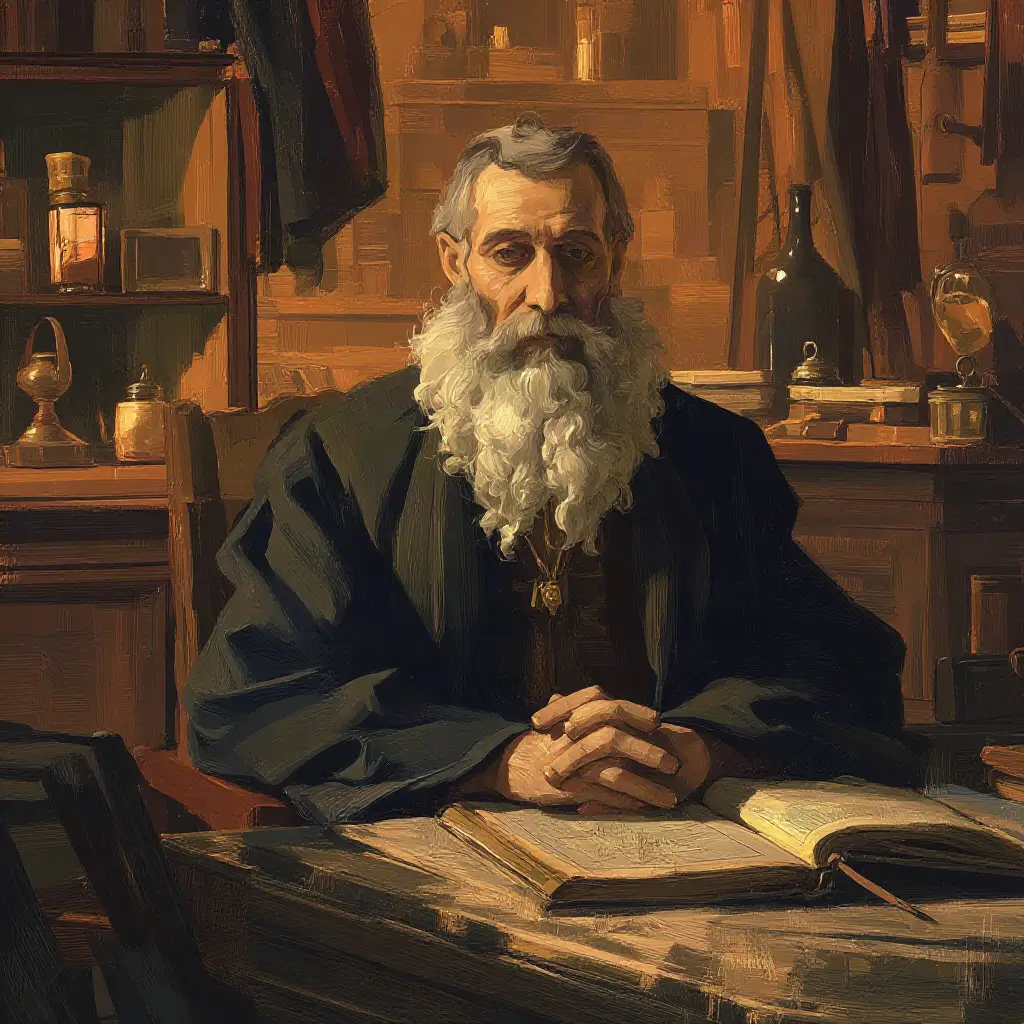
Rabbi Shlomo ben Yitzchak
The story of Rashi, the 11th-century French rabbi whose commentaries on the Bible and Talmud are still studied today.
Chapter 1
The Young Scholar
0:47
Part of
Frequently Asked Questions
What was Rashi's most important contribution?
Rashi wrote the first comprehensive commentaries on the Hebrew Bible and the Babylonian Talmud. His works focused on making the complex texts accessible through clear, simple explanations, a method that revolutionized Jewish study.
How did Rashi support himself and his family?
Rashi worked in the wine trade in Troyes, the capital of the Champagne region. His writings display a professional-level knowledge of viticulture. He taught students at his academy for free, rather than taking a salary as a rabbi.
What is 'Rashi script'?
The distinctive cursive script known as 'Rashi script' was not actually used by Rashi himself. It is a 15th-century typeface developed by early printers to distinguish Rashi's commentary from the main biblical or Talmudic text on a printed page.
Learn more
To continue the story, download the Chunks Microlearning app
Or get it straight away:
 Download on iOS
 Download on Android