
In 1868, Dmitri Mendeleev was a professor of chemistry at St. Petersburg University, tasked with writing a textbook. He faced a fundamental problem: how to organize the 63 elements known to science? They were a confusing mix of metals like iron and gases like oxygen, often grouped by simple traits, but with no unifying logic. Previous attempts to find a system, like the ‘Law of Octaves,’ had been dismissed or were incomplete. For Mendeleev, teaching chemistry without a clear structure was impossible. He needed to find a hidden pattern, a law that could bring order to the elemental chaos. His search began not in a lab, but with the pages of his unfinished book.
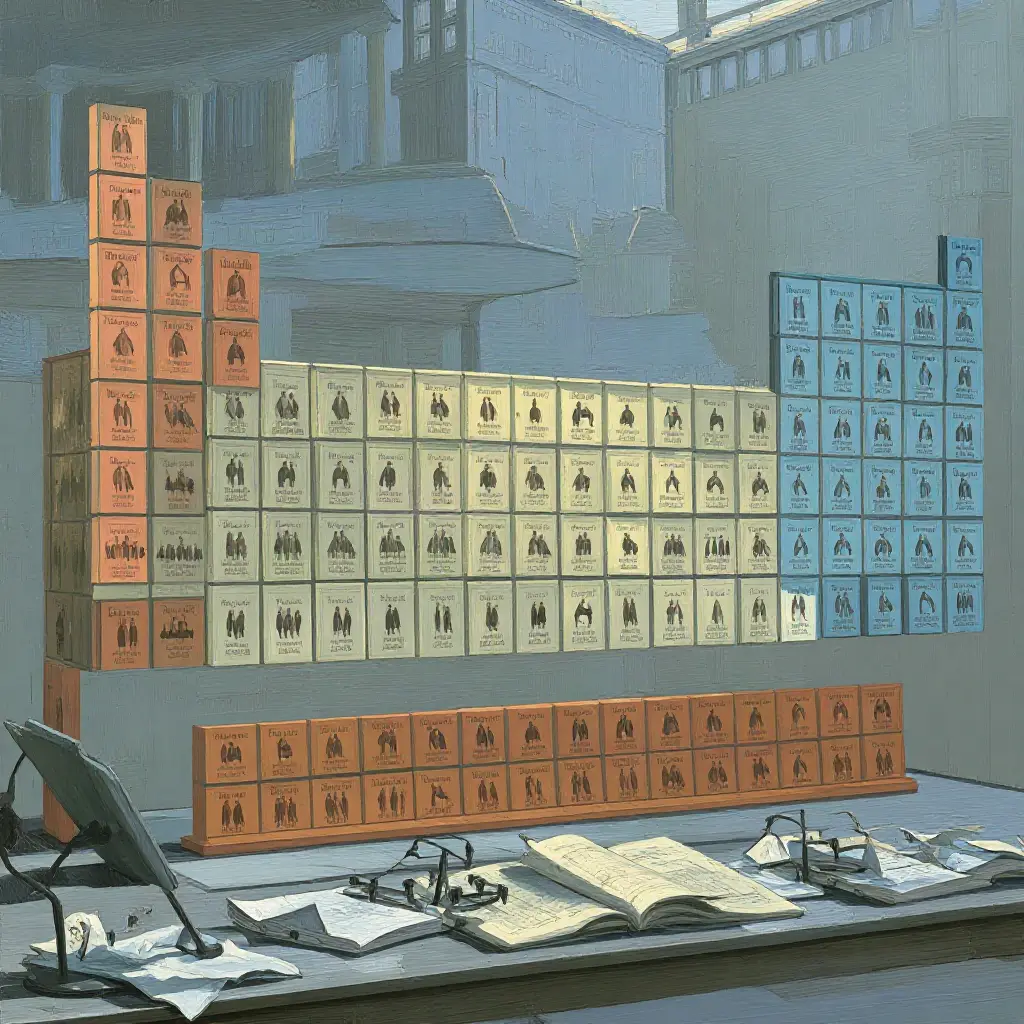
Mendeleev's Periodic Table
In 1869, Dmitri Mendeleev organized the 63 known elements, leaving gaps for new ones he predicted would one day be found.
Chapter 1
A Problem for a Professor
0:46
Part of
Frequently Asked Questions
Why did Mendeleev's periodic table succeed when others failed?
Mendeleev's table succeeded because it wasn't just a classification. By arranging elements by atomic weight, he discovered a repeating pattern, or periodic law. Crucially, he left gaps for undiscovered elements and accurately predicted their properties, a feat that stunned the scientific community when those elements were later found.
What elements did Mendeleev predict?
In 1871, he predicted the existence of three elements, which he called eka-boron, eka-aluminum, and eka-silicon. These were later discovered and named Scandium, Gallium, and Germanium, respectively. Their properties closely matched what Mendeleev had foretold.
Did Mendeleev really invent the periodic table in a dream?
Mendeleev himself later told a friend that the final arrangement came to him in a dream. However, historians suggest this story was a romanticization of what was actually years of intense, painstaking work. The dream narrative helped cement his status as a scientific folk hero.
Learn more
To continue the story, download the Chunks Microlearning app
Or get it straight away:
 Download on iOS
 Download on Android