
In 1856, Louis Pasteur was a chemist in Lille when a local distiller named Monsieur Bigo asked for help. His vats of beet juice, meant to become alcohol, were turning sour. Pasteur put samples under his microscope. In the healthy vats, he saw spherical yeast cells. But in the sour vats, he found the liquid teeming with tiny, rod-shaped organisms. He identified these as the source of the lactic acid ruining the alcohol. This was a radical idea. The leading theory insisted fermentation was a purely chemical process. His findings, published in his 1857 memoir on lactic fermentation, argued it was caused by life.
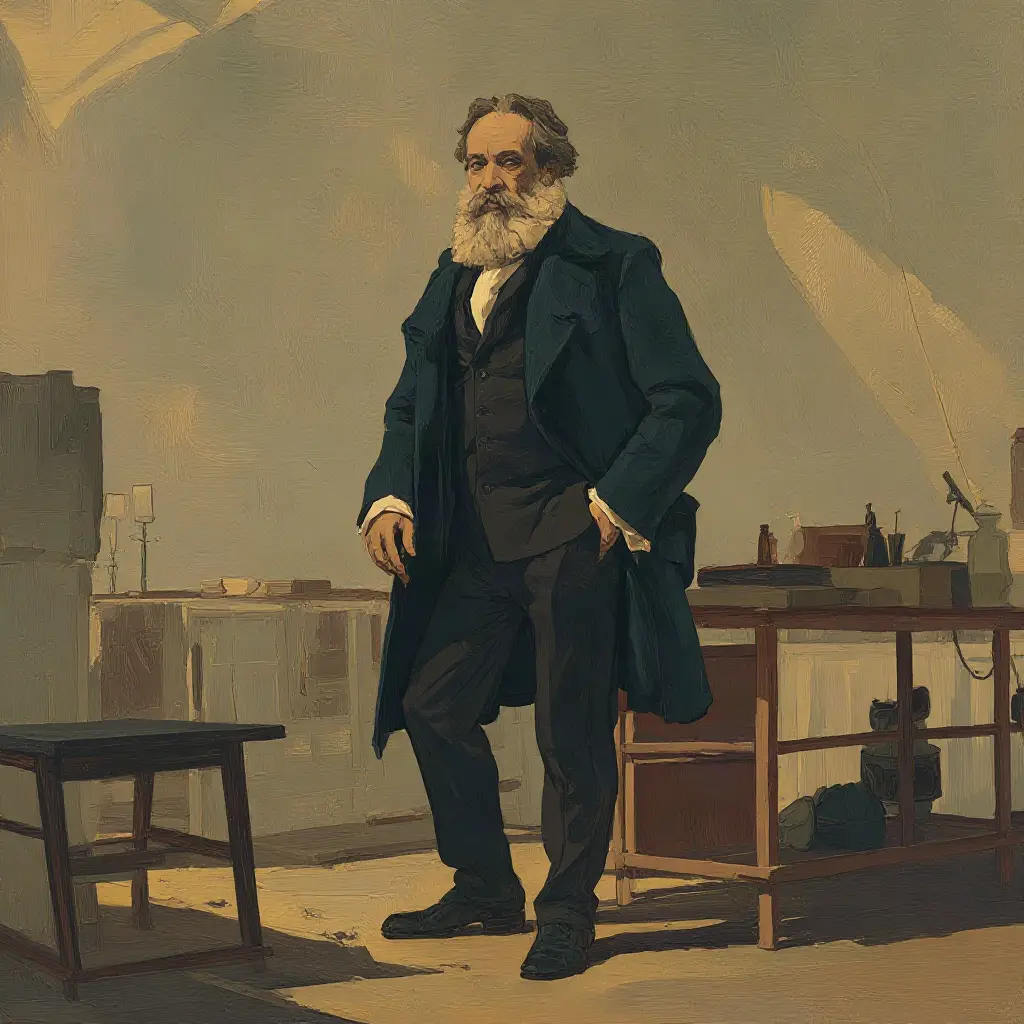
Louis Pasteur
Louis Pasteur proved germs cause disease, invented pasteurization, and created the first rabies vaccine, saving a young boy's life in 1885.
Chapter 1
The Sour Beetroot Mystery
0:42
Frequently Asked Questions
What did Pasteur discover about fermentation?
In 1856, Louis Pasteur discovered that fermentation is a biological process caused by living microorganisms. He found that healthy beet juice vats contained spherical yeast for making alcohol, while spoiled vats were full of rod-shaped bacteria producing lactic acid. This challenged the accepted theory that fermentation was purely chemical.
How did Pasteur's swan-neck flask experiment work?
Pasteur boiled broth in a flask with a long, S-shaped neck. This neck allowed air in but trapped airborne dust and microbes in its curve. The broth remained sterile indefinitely, but became cloudy with life within days if the flask was tilted to let the liquid touch the trapped dust.
Did Pasteur invent his famous anthrax vaccine?
While Pasteur publicly demonstrated a successful anthrax vaccine in 1881, his private notebooks later revealed he secretly used a chemical attenuation method pioneered by his rival, Jean-Joseph-Henri Toussaint. Publicly, Pasteur claimed he weakened the bacteria using only oxygen, but he used Toussaint's method to guarantee success at the public trial.
Learn more
To continue the story, download the Chunks Microlearning app
Or get it straight away:
 Download on iOS
 Download on Android