
In about 240 BC, the scholar Eratosthenes was the chief librarian of the Great Library of Alexandria, the ancient world's premier center of knowledge. He was a polymath, an expert in many fields, which earned him the nickname 'Pentathlos', like an athlete competing in five events. But his peers had another, less flattering name for him: 'Beta'. They considered him the second-best at everything he did. Summoned to Alexandria by the pharaoh Ptolemy III Euergetes, Eratosthenes had access to hundreds of thousands of papyrus scrolls containing reports from across the known world. It was in one of these scrolls that he found a peculiar observation, a puzzle that would lead him to his greatest achievement: measuring the world itself.
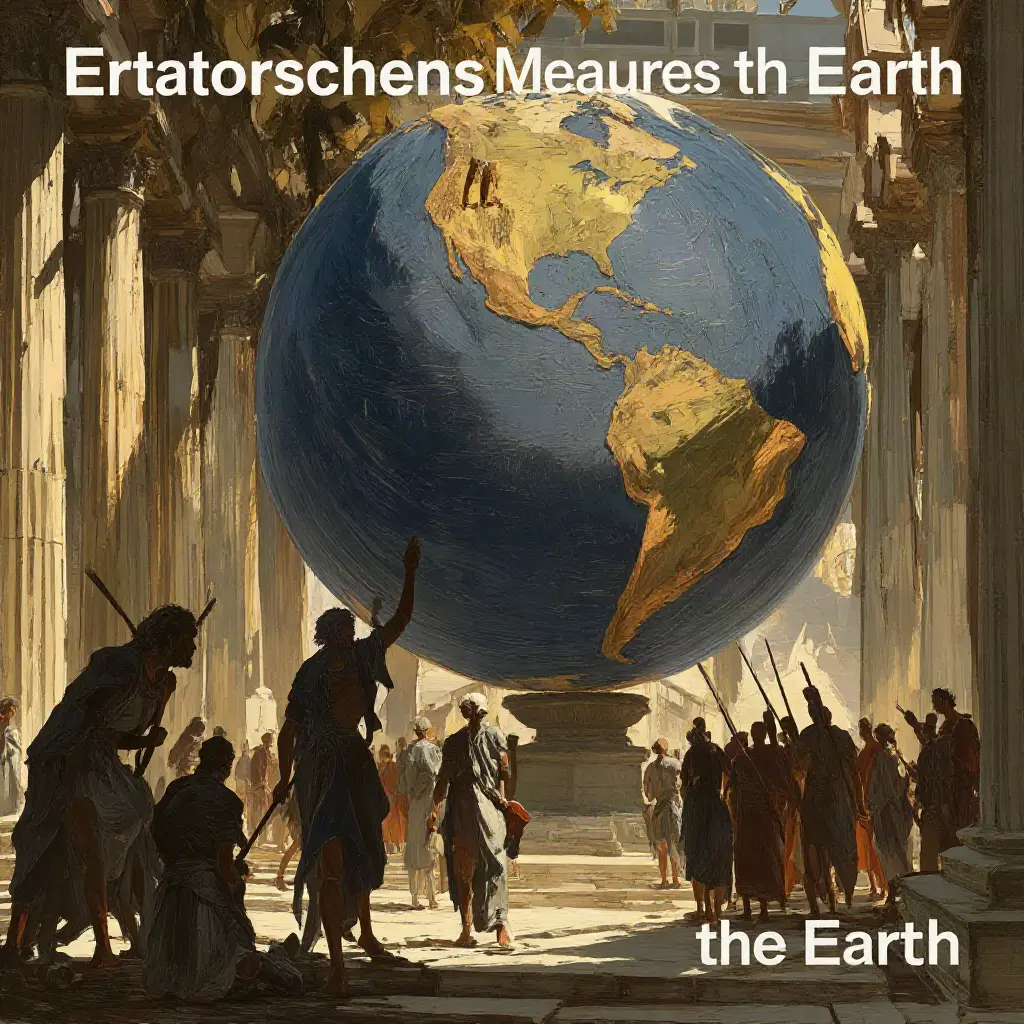
Eratosthenes Measures the Earth
Around 240 BC, a librarian in Alexandria measured the Earth's size using only a shadow, a well, and some clever geometry.
Chapter 1
The Librarian Called 'Beta'
0:48
Frequently Asked Questions
How did Eratosthenes know the Earth was round?
The idea that the Earth was a sphere was already accepted by many Greek scholars before Eratosthenes. His own experiment confirmed it: the fact that a vertical stick cast a shadow in Alexandria at the same moment one in Syene did not could only be explained by a curved surface.
What is a 'stadium' and why is it important for his measurement?
A 'stadium' was an ancient unit of length, but its exact size varied by region. The accuracy of Eratosthenes' final calculation depends entirely on which stadium he used. If he used the smaller Egyptian stadium, his measurement was incredibly accurate, but if he used the larger Greek one, his estimate was off by about 16%.
Did Eratosthenes have any other major achievements?
Yes, Eratosthenes was a versatile scholar known as a 'Pentathlos'. Besides measuring the Earth, he also accurately calculated the tilt of the Earth's axis, created a star catalog with 675 entries, and wrote on many subjects including geography, mathematics, and philosophy.
Learn more
To continue the story, download the Chunks Microlearning app
Or get it straight away:
 Download on iOS
 Download on Android