
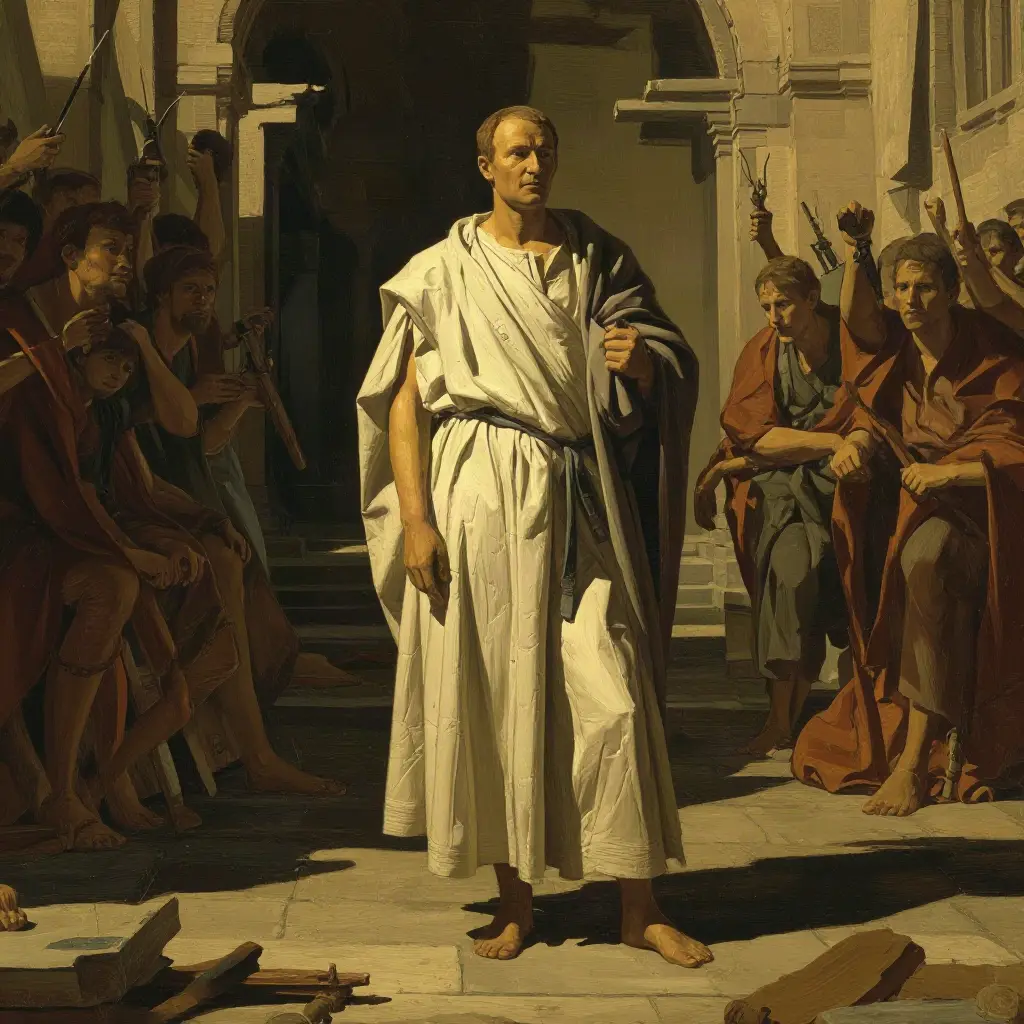
In the year 1300, on Good Friday, a 35-year-old Dante Alighieri finds himself lost and alone. He is wandering in a dark wood, a symbol for a life lost to sin, with his path to a sunlit mountain blocked by three fearsome beasts. As all hope seems lost, a figure appears before him. It is the ghost of the great Roman poet, Virgil. He explains that he has been sent from Heaven by Beatrice, Dante's long-lost love, to act as his guide. Virgil cannot lead him up the mountain directly; instead, he must guide Dante on a different path, a journey downwards through the realm of the damned. Only by confronting sin can he hope to escape it.
Dante's Inferno
Dante's Inferno, the 14th-century poem he wrote in exile: a journey down through the nine circles of Hell, where each punishment mirrors its sin.
Chapter 1
The Dark Wood
0:48
Frequently Asked Questions
Why did Dante write the Inferno in Italian instead of Latin?
Dante wrote in the Tuscan vernacular, or common Italian, for two main reasons. He wanted his work to reach a much wider audience beyond scholars, and he wanted to prove that the common language was just as capable of producing high art as the traditional Latin.
What is 'contrapasso' in Dante's Hell?
Contrapasso is the law of divine punishment in the Inferno. It means 'suffer the opposite' or 'suffer the corresponding'. Each sinner's eternal torment is a symbolic reflection of the specific sin they committed on Earth, creating a form of poetic, divine justice.
Who does Dante place at the very center of Hell?
At the center of the ninth and final circle of Hell, Dante places Satan. He is depicted as a giant, three-faced monster trapped waist-deep in a frozen lake. In his three mouths, he eternally chews on the three greatest traitors in history: Judas Iscariot, Brutus, and Cassius.
To continue the story, download the Chunks Microlearning app
Or get it straight away:
 Download on iOS
 Download on Android