
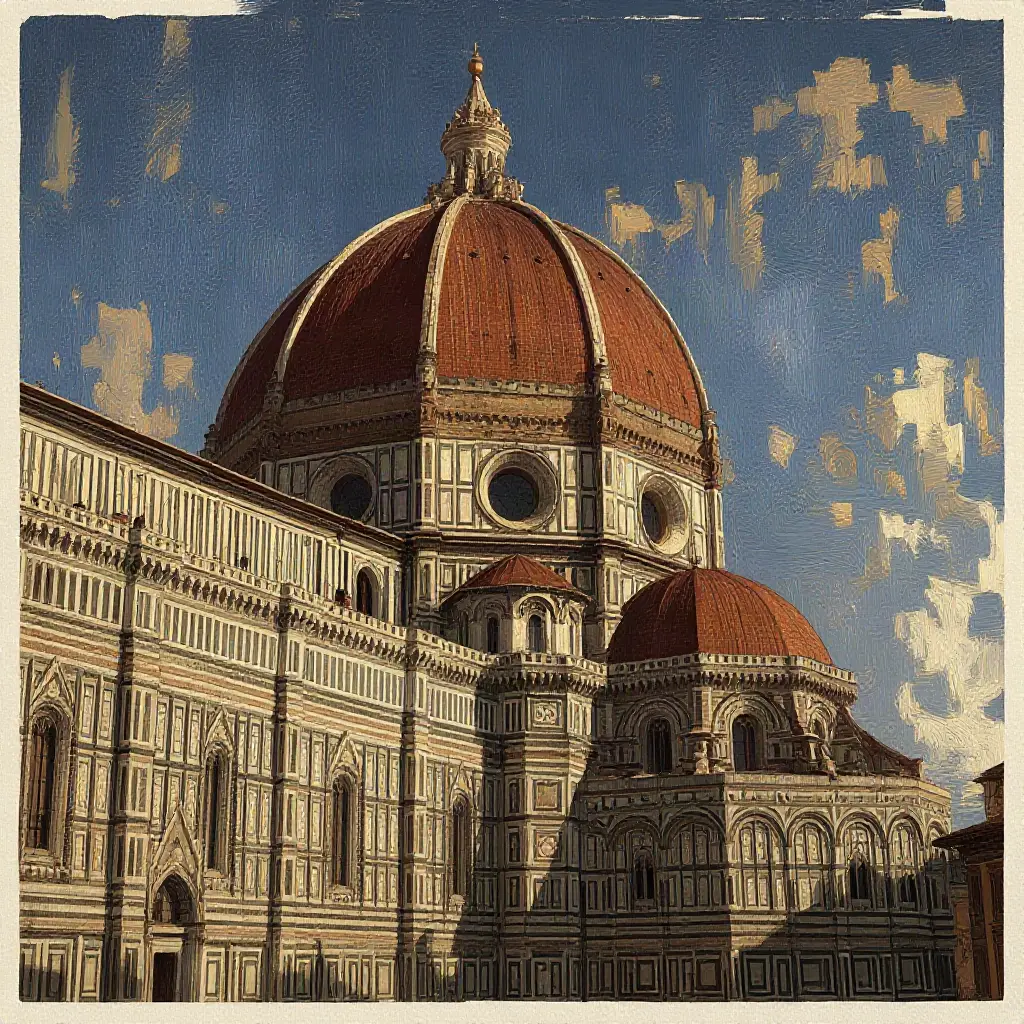
In August 1418, the city of Florence had a hole in its heart. For over fifty years, the magnificent new cathedral stood open to the sky, unfinished. At its center was a massive octagonal gap, about 43 metres across, sitting 52 metres above the ground. How could anyone possibly build a dome to cover it? Traditional wooden supports were not an option; there were no trees in Tuscany large enough. Gothic-style flying buttresses were forbidden by the city leaders, who wanted a classical Italian design. Frustrated, the Cathedral Board of Works announced a competition, offering a 200-florin prize to any architect who could design a dome and prove it wouldn’t collapse. The challenge seemed insurmountable, and for two years, no one had a convincing answer.
Brunelleschi's Dome
How Filippo Brunelleschi built Florence's iconic dome, a 43-metre-wide marvel, using a double shell and no ground-based scaffolding.
The Impossible Prize
Frequently Asked Questions
Why couldn't they use traditional wooden scaffolding to build the dome?
Building a wooden support structure, or centering, was impossible for two reasons. First, no forests in Tuscany had trees large enough to create the massive beams required. Second, the base of the dome was already 52 metres above the ground, making any floor-based scaffolding impractical and unsafe.
What was the purpose of the herringbone brick pattern?
The herringbone pattern, or 'spina pesce', was a crucial innovation. By inserting vertical bricks at intervals among the horizontal rows, masons created a self-supporting zigzag structure. This locked the curved layers of the dome together, preventing them from sliding inward and collapsing during construction.
Did Brunelleschi really win the job with an egg?
The story of the egg is a famous legend, told by the historian Giorgio Vasari over a century after the event. According to Vasari, Brunelleschi challenged his rivals to make an egg stand upright. When they failed, he tapped its base to flatten it, proving that solutions seem obvious only after someone has demonstrated them. The tale celebrates his genius, but it is not considered a factual account.
Learn more
To continue the story, download the Chunks Microlearning app
Or get it straight away:
 Download on iOS
 Download on Android