
In 6th-century Denmark, King Hrothgar built a magnificent mead-hall named Heorot. The sounds of celebration, the poet’s “Song of Creation” and the music of the harp, echoed from its walls. But this joy awoke something terrible. Deep in the moors lived Grendel, a monstrous descendant of Cain. Driven to a rage by the happy sounds, he began to terrorize the hall. On his very first raid, the "corpse-maker" snatched thirty of Hrothgar's men and dragged them back to his den to be devoured. For twelve long years, the monster attacked, night after night. No blade could harm him. Soon, the great hall of Heorot, once a symbol of joy, stood silent and empty as soon as the sun went down.
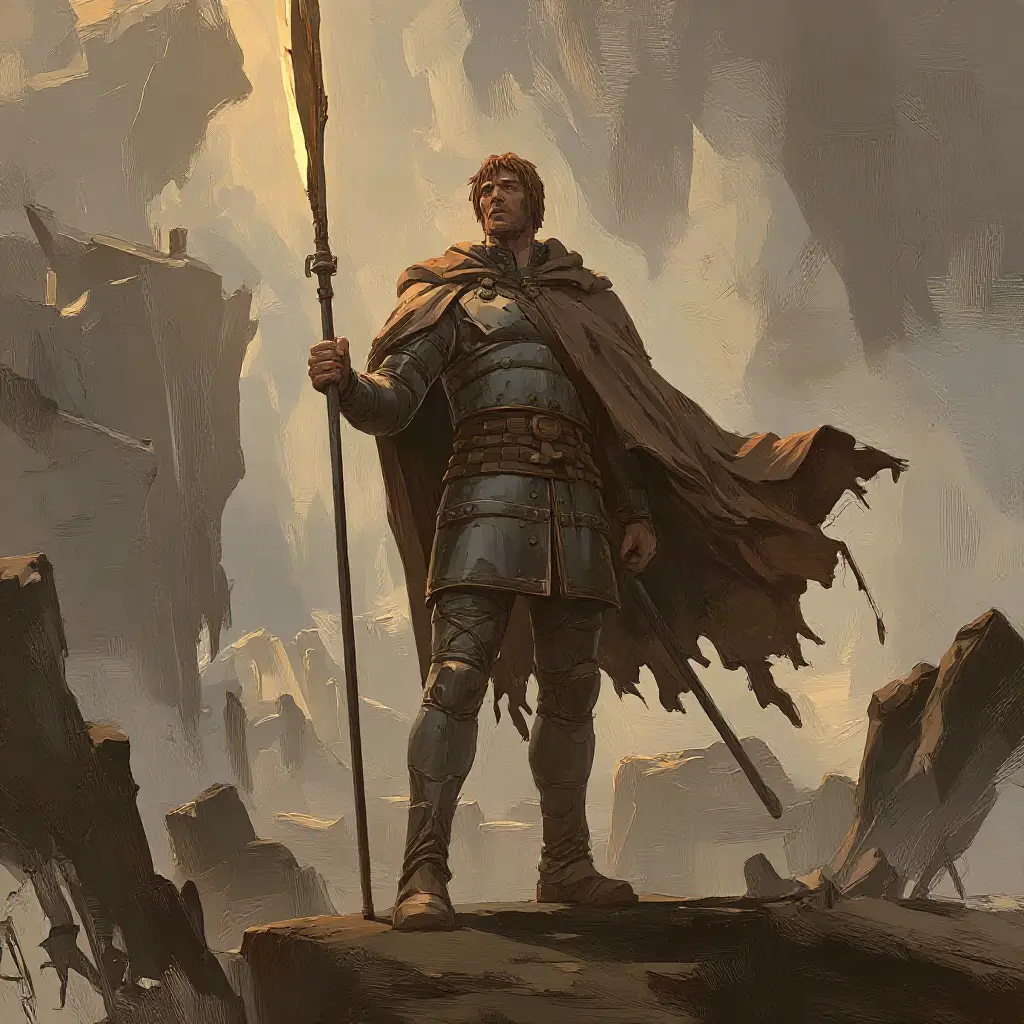
Beowulf
The epic of Beowulf was preserved only because a scholar copied the fire-damaged manuscript in 1786 before its pages crumbled away.
Chapter 1
The Terror of Heorot
0:48
Frequently Asked Questions
What is Beowulf?
Beowulf is the longest epic poem written in Old English, the earliest form of the English language. It tells the story of a great Scandinavian hero and his battles with supernatural monsters. The author is unknown.
Who are the main monsters Beowulf fights?
Beowulf fights three major monsters. First is Grendel, a beast descended from Cain who terrorizes a Danish mead-hall. Second is Grendel's Mother, who seeks revenge for her son's death. His final battle, fifty years later, is against a powerful dragon.
How did the poem Beowulf survive to the modern day?
The entire poem exists in a single manuscript copy, known as the Nowell Codex. This manuscript was damaged in a fire in 1731 but was saved from complete destruction. The text was only preserved because an Icelandic scholar made two copies of it in 1786, before its scorched edges crumbled away completely.
Learn more
To continue the story, download the Chunks Microlearning app
Or get it straight away:
 Download on iOS
 Download on Android