
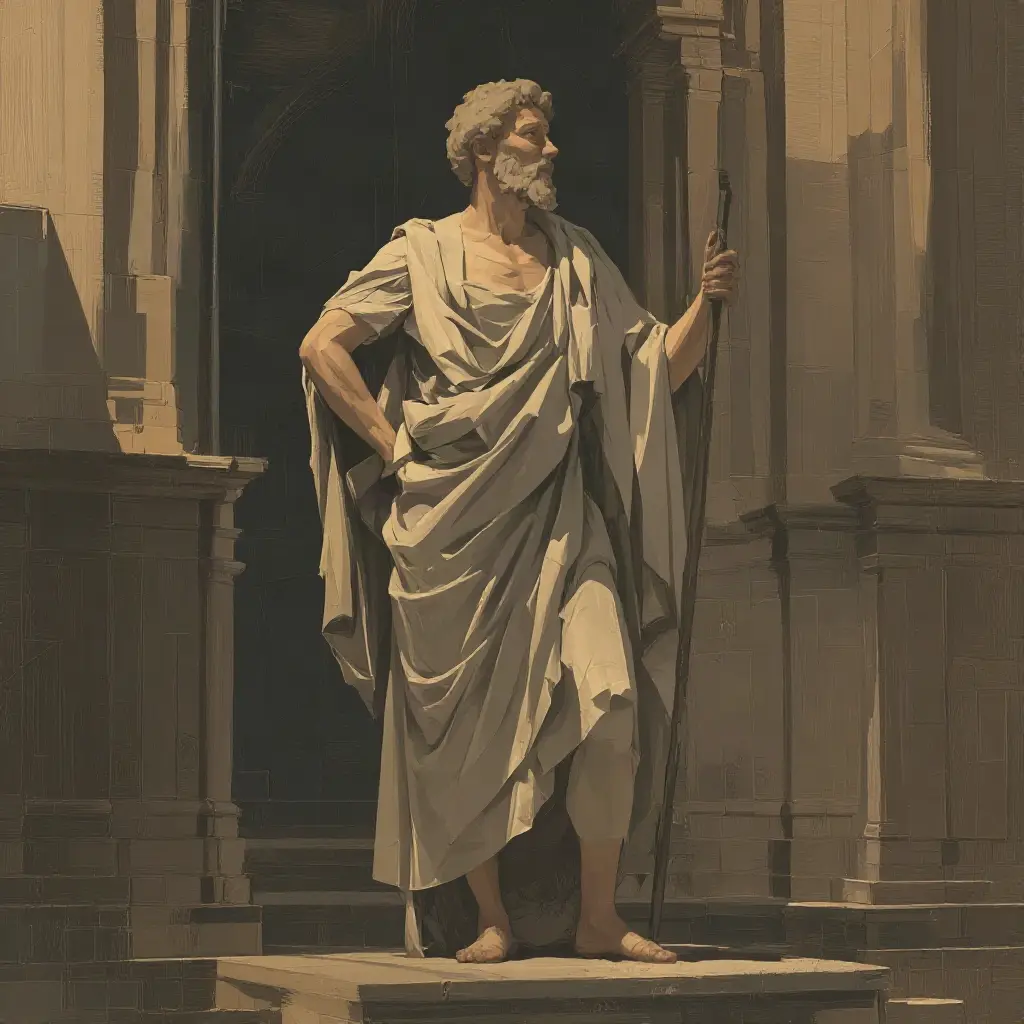
Around 250 BC in Syracuse, Archimedes boasted to King Hiero II that with a long enough lever and a place to stand, he could move the Earth. To prove the power of his mechanical theories, he set up a system of compound pulleys. While sitting at a distance, he single-handedly pulled a rope and smoothly drew the fully loaded, three-masted ship, the Syracusia, right out of the harbor. The king was so impressed he declared that from that day forward, Archimedes was to be believed in everything he said. It was one of the first successful applications of geometry to a physical, mechanical problem, proving an idea with dramatic force.
Archimedes
Discover how Archimedes moved ships with pulleys, calculated pi with 96-sided shapes, and defended Syracuse.
Chapter 1
A Place to Stand
0:44
Frequently Asked Questions
Did Archimedes really shout 'Eureka!' after discovering buoyancy in his bath?
This famous story was first told by the Roman architect Vitruvius, writing two centuries after Archimedes' death. While the scientific principle is correct, the 'Eureka' moment in the bath is considered a legend, not a historical fact.
Could Archimedes's 'burning mirrors' really set ships on fire?
The burning mirror is another legend that appeared long after the Siege of Syracuse. Modern experiments by MIT showed that while a fire could be started on a stationary target, it was impractical as a weapon against moving ships at sea. The mirrors were more likely used to dazzle and blind enemy rowers.
How did Archimedes calculate pi so accurately without computers?
He used a geometric technique called the 'method of exhaustion.' He trapped a circle between two polygons, one inside and one outside, and then increased their sides up to 96. By calculating the perimeters of these polygons, he could trap the value of pi in a very narrow and accurate range.
Learn more
To continue the story, download the Chunks Microlearning app
Or get it straight away:
 Download on iOS
 Download on Android