
In 1936, a 24-year-old Cambridge mathematician named Alan Turing published a paper that would invent the modern computer. He imagined a theoretical device he called an 'automatic machine'. It was surprisingly simple: a scanner that could read and write symbols on an infinite strip of paper tape, guided by a set of rules. The machine would move back and forth along the tape, reading a symbol, checking its rule-table, and then writing a new symbol or moving position. But Turing’s real breakthrough was the concept of a ‘Universal Machine’—a single device that could simulate any other machine imaginable, just by reading its instructions from the tape. For the first time, the software was separate from the hardware.
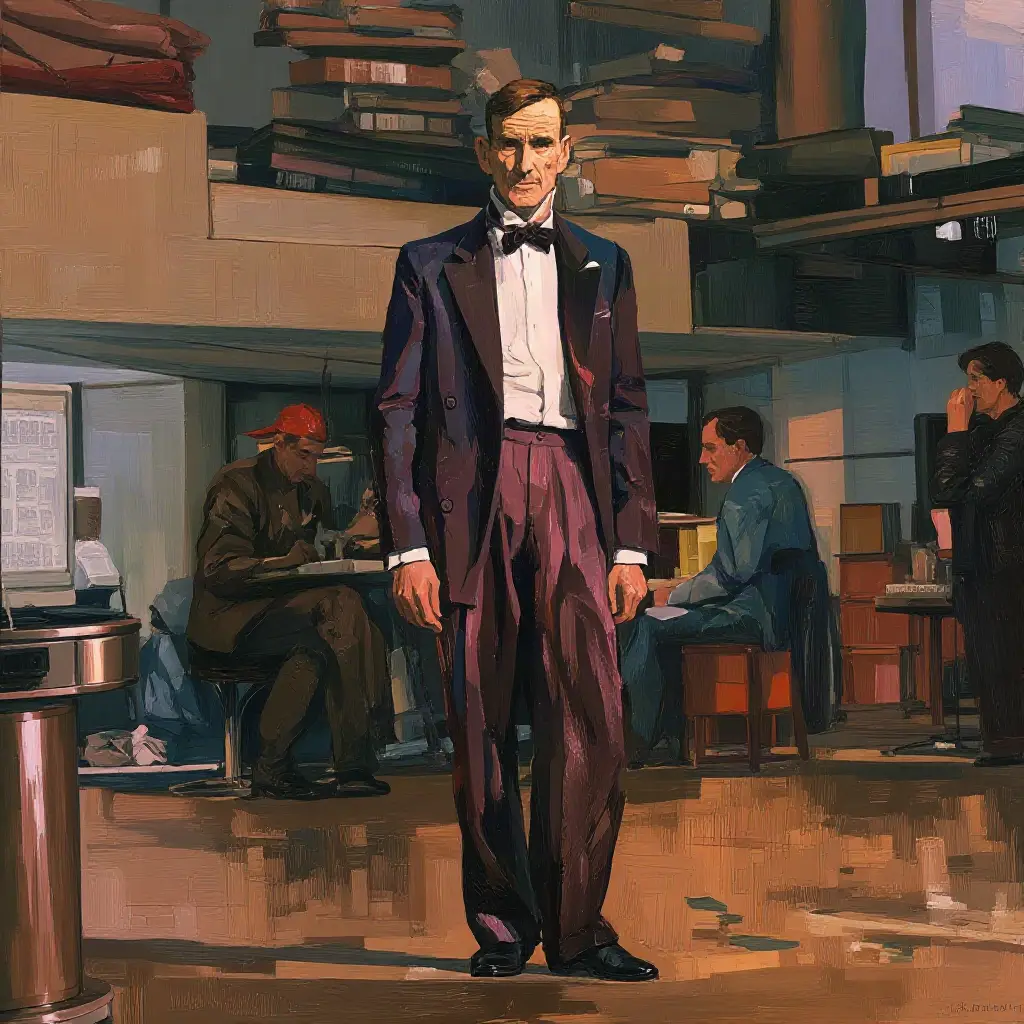
Alan Turing and the Thinking Machine
He conceived the computer and broke the Enigma code, but Alan Turing's revolutionary career was cut short by a criminal conviction.
Chapter 1
The Universal Machine
0:47
Frequently Asked Questions
What was the Universal Turing Machine?
It was a theoretical device Alan Turing proposed in 1936. It could simulate any computing algorithm by reading symbols and instructions from an infinite tape, effectively inventing the concept of a modern computer with separable hardware and software.
How did Alan Turing help in World War II?
As a lead cryptanalyst at Bletchley Park, Turing was instrumental in breaking the German Enigma code. He co-designed the 'Bombe', an electromechanical machine that dramatically sped up the process of finding Enigma's daily settings, providing crucial intelligence to the Allies.
Why was Alan Turing prosecuted?
In 1952, Turing was prosecuted for 'gross indecency' because he was in a homosexual relationship, which was a criminal offense in Britain at the time. He was convicted and chose to undergo chemical castration instead of serving a prison sentence.
To continue the story, download the Chunks Microlearning app
Or get it straight away:
 Download on iOS
 Download on Android