
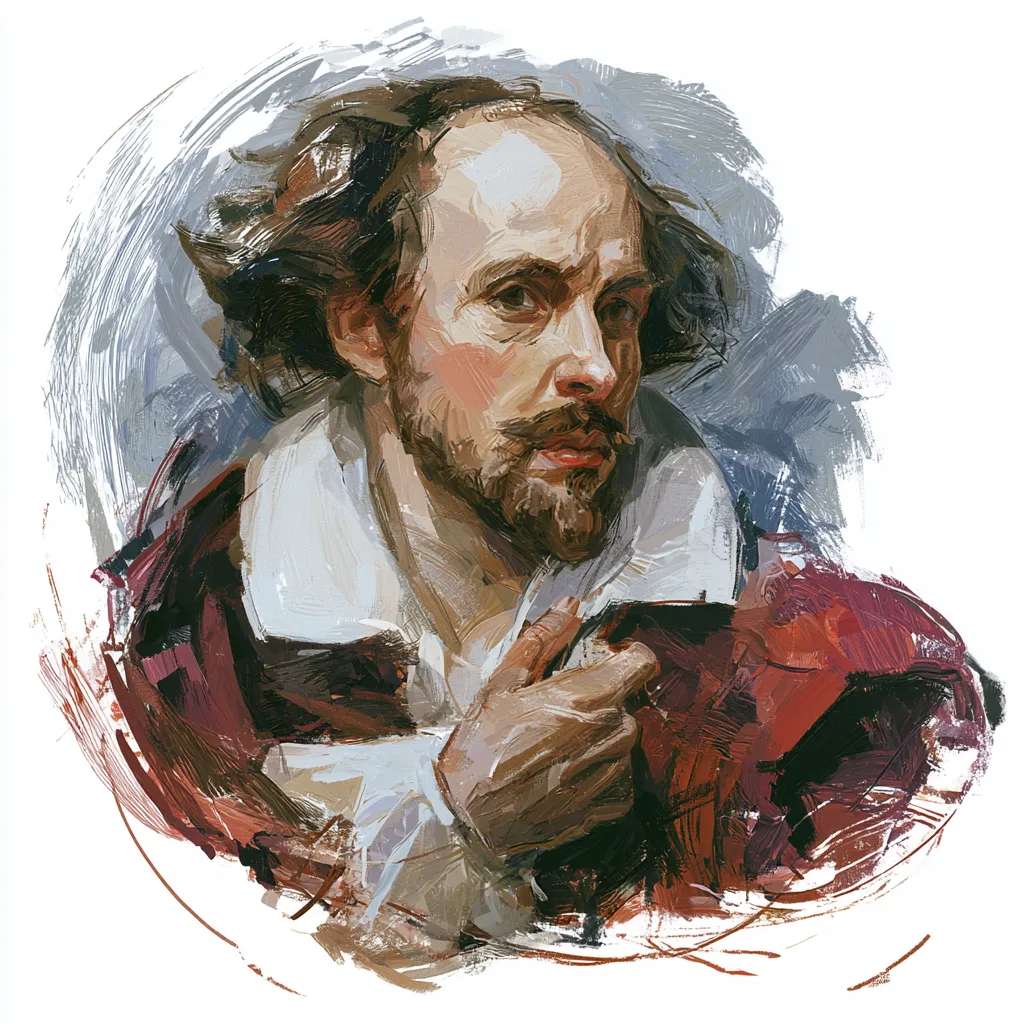
Who was William Shakespeare?
William Shakespeare (c. 23 April 1564 – 23 April 1616) was an English playwright, poet, and actor, widely regarded as the greatest writer in the English language. Born in Stratford-upon-Avon, he wrote roughly 39 plays, 154 sonnets, and several narrative poems. His tragedies, comedies, and histories remain the most performed theatrical works in the world.
A brilliant Renaissance playwright and poet from England, known for his sharp wit, deep understanding of human nature, and dramatic storytelling. He is often imagined with thoughtful eyes, a neatly trimmed beard, and elegant Elizabethan clothing, carrying himself with intelligence, curiosity, and quiet confidence.
Don't stop at the facts — continue William Shakespeare's story in free narrated chapters on Chunks.
Or get it straight away:
 Download on iOS
 Download on Android
Quick facts
- Born
- April 1564
- Birthplace
- Stratford-upon-Avon
- Died
- 23 April 1616
- Place of death
- Stratford-upon-Avon
- Nationality
- Kingdom of England
- Occupation
- Playwright, poet, stage actor
William Shakespeare: key facts
- William Shakespeare was born in Stratford-upon-Avon, Warwickshire, in April 1564, and died in the same town on 23 April 1616 at the age of 52.
- Shakespeare married Anne Hathaway in November 1582, when he was 18 and she was 26, and they had three children together: Susanna, and twins Hamnet and Judith.
- Between 1589 and 1613 Shakespeare produced most of his known works, including tragedies such as Hamlet, Othello, King Lear, and Macbeth, which are widely considered among the finest works in the English language.
- Shakespeare was a part-owner and actor in a playing company called the Lord Chamberlain's Men, which was later renamed the King's Men after King James I granted it a royal patent in 1603.
- In 1599 Shakespeare and his fellow company members built the Globe Theatre on the south bank of the River Thames in Southwark, constructing it partly from timbers salvaged from an earlier playhouse called The Theatre.
- His extant works include approximately 39 plays, 154 sonnets, and three long narrative poems, and his plays have been translated into every major living language.
- Two fellow actors, John Heminges and Henry Condell, published the First Folio in 1623, seven years after Shakespeare's death, preserving 36 of his plays in a single collected edition.
From Stratford-upon-Avon to the London Stage
William Shakespeare was born in April 1564 in Stratford-upon-Avon, Warwickshire, the son of John Shakespeare, a glove-maker and alderman, and Mary Arden, whose family were affluent landowners with strong Catholic ties. He was baptised on 26 April 1564, and tradition holds his birthday as 23 April, Saint George's Day. Though no school attendance records survive, most biographers believe he was educated at the King's New School in Stratford, where the curriculum was built around intensive Latin instruction and classical authors.
At 18, Shakespeare married Anne Hathaway, who was 26 and already pregnant. Their daughter Susanna was baptised in May 1583, followed by twins, Hamnet and Judith, in February 1585. After the birth of the twins, Shakespeare largely disappears from the historical record until he surfaces as part of the London theatre world in 1592. Biographers call this gap the 'lost years', and various stories have been attached to it — that he fled Stratford to avoid punishment for poaching, or that he worked as a schoolmaster — but none of these accounts rest on solid evidence.
Building a Career: The Lord Chamberlain's Men and the Globe
By 1592, Shakespeare was established enough in London to attract a hostile mention in print. The playwright Robert Greene mocked him as an 'upstart Crow' who presumed to compete with university-educated writers. The attack, though hostile, confirms Shakespeare was already a recognised presence on the London stage. After the plague years of 1592 to 1593, his plays were performed exclusively by a company called the Lord Chamberlain's Men, of which he was a part-owner. When King James I came to the throne in 1603, the company received a royal patent and was renamed the King's Men.
In 1599, members of the company constructed their own playhouse on the south bank of the Thames, naming it the Globe Theatre. Julius Caesar was among the first plays staged there. Shakespeare was not merely a writer for this company — he was a shareholder, an actor, and a businessman. Records of his property investments show he became genuinely wealthy: in 1597 he purchased New Place, the second-largest house in Stratford, and in 1605 he bought a share of parish tithes there.
Comedies, Histories, Tragedies: The Shape of a Career
Shakespeare produced most of his known work between 1589 and 1613. His earliest plays were histories and comedies — works like Richard III, Henry VI, The Comedy of Errors, and The Taming of the Shrew. The histories drew heavily on Raphael Holinshed's Chronicles and dramatised the consequences of weak or corrupt rule. By the mid-1590s he was writing his most celebrated comedies, including A Midsummer Night's Dream, Much Ado About Nothing, and Twelfth Night, works noted for their romantic atmosphere, wordplay, and comic invention.
From the early 1600s, Shakespeare concentrated on tragedies. Hamlet, Othello, King Lear, and Macbeth are considered the pinnacle of this phase and among the finest works in the English language. Each turns on a fatal error or flaw: Hamlet's hesitation, Othello's jealousy stoked by the scheming Iago, Lear's disastrous decision to give up his power, and Macbeth's unchecked ambition. In the final phase of his career, Shakespeare shifted toward tragicomedies — plays like The Winter's Tale and The Tempest — which are graver in tone than his earlier comedies but end with reconciliation rather than catastrophe.
The First Folio and How Shakespeare's Texts Survived
During Shakespeare's lifetime, many of his plays appeared in printed editions of varying reliability. Some of these so-called quarto editions were poorly reproduced, possibly reconstructed from memory by actors or audience members. Shakespeare left no clear indication that he approved or supervised any of these printings. The situation changed in 1623 when two of his fellow actors, John Heminges and Henry Condell, published a collected edition of his dramatic works now known as the First Folio. It contained 36 plays, 18 of which appeared in print for the first time.
The First Folio's preface included a poem by Ben Jonson, once a rival of Shakespeare's, who declared him 'not of an age, but for all time.' Two further plays — The Two Noble Kinsmen and Pericles, Prince of Tyre — were not included in the Folio but are now accepted as part of the canon. No Shakespearean poems were included, partly because the collection was assembled by theatre professionals focused on the dramatic work. The Folio stands as the single most important source for Shakespeare's plays, and without it, nearly half of them might have been lost.
Death, Reputation, and an Unmatched Global Reach
Shakespeare retired to Stratford around 1613, the same year the Globe Theatre burned to the ground during a performance of Henry VIII. He died on 23 April 1616 at the age of 52, within a month of signing his will, in which he described himself as being in 'perfect health.' No contemporary source explains the cause of death. He was buried in the chancel of Holy Trinity Church in Stratford, and a funerary monument was erected on the church wall sometime before 1623, showing him in the act of writing.
Shakespeare's reputation grew steadily after his death. Samuel Johnson quoted him more than any other author in his landmark Dictionary of the English Language. By 1800 he was firmly established as England's national poet, and his influence spread across Europe, with German writers and translators particularly active in championing his work. Sigmund Freud drew on the psychology of Hamlet when developing his theories of human nature. His plays have been translated into over 80 languages, adapted into operas by Verdi, ballets by Prokofiev, and films by directors from Laurence Olivier to Akira Kurosawa. According to Guinness World Records, his works have sold in excess of four billion copies since his death.
William Shakespeare: timeline
- c. 23 Apr 1564Born in Stratford-upon-Avon, Warwickshire, the third of eight children of glover John Shakespeare and Mary Arden.
- 1582Married Anne Hathaway, who was 26 years old, after a marriage licence was issued by the Diocese of Worcester.
- 1583His first child, daughter Susanna, was baptised in Stratford-upon-Avon.
- 1585Twins Hamnet and Judith were baptised, completing Shakespeare's family of three children.
- 1592Was sufficiently established in the London theatre scene to be attacked in print by playwright Robert Greene, the earliest surviving mention of Shakespeare's theatrical work.
- 1594His plays began performing exclusively under the Lord Chamberlain's Men, the company he co-owned, which soon became London's leading playing company.
- 1596His only son Hamnet died of unknown causes at the age of 11 and was buried in Stratford-upon-Avon.
- 1599A partnership of company members, including Shakespeare, constructed the Globe Theatre on the south bank of the Thames, opening in autumn with Julius Caesar among the first plays staged.
- 1603Following Queen Elizabeth's death, the Lord Chamberlain's Men received a royal patent from King James I and were renamed the King's Men.
- 1613Retired to Stratford-upon-Avon at around age 49, having written no plays attributed solely to him after this point.
- 23 Apr 1616Died in Stratford-upon-Avon at the age of 52, survived by his wife Anne and daughters Susanna and Judith.
- 1623Fellow actors John Heminges and Henry Condell published the First Folio, a collected edition of 36 of Shakespeare's plays, preserving 18 texts never previously printed.
Listen: stories featuring William Shakespeare
Narrated chapters from the Chunks Microlearning app. Read a preview here, or listen to the full story in the app.
Continue William Shakespeare's story
You've read the summary — hear the full story as narrated 5-minute chapters on Chunks, alongside 200+ figures and events from history, philosophy and science. Free to start on iOS and Android.