
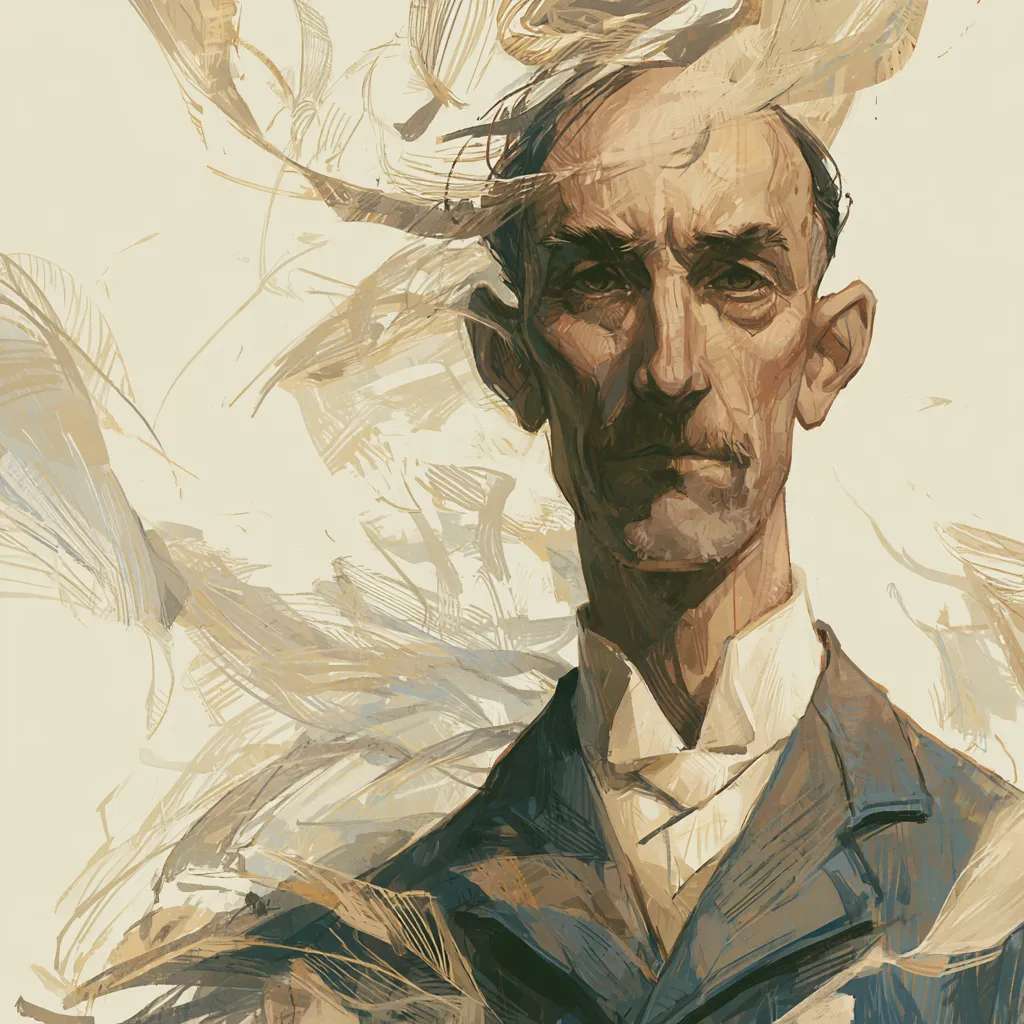
Who was Wilbur Wright?
Wilbur Wright (April 16, 1867 – May 30, 1912) was an American inventor and aviation pioneer who, alongside his brother Orville, built and flew the world's first successful powered airplane. On December 17, 1903, near Kitty Hawk, North Carolina, the brothers made the first controlled, sustained, engine-powered flight in history. Wilbur led much of the brothers' early aeronautical research and business negotiations.
American aviation pioneer who, with his brother Orville, achieved the first powered, sustained, and controlled airplane flight in 1903. Their methodical approach to solving the problems of flight made modern aviation possible.
Don't stop at the facts — continue Wilbur Wright's story in free narrated chapters on Chunks.
Or get it straight away:
 Download on iOS
 Download on Android
Quick facts
- Born
- 16 April 1867
- Birthplace
- Millville
- Died
- 30 May 1912
- Place of death
- Dayton
- Nationality
- United States
- Occupation
- Aircraft pilot, businessperson, inventor
Wilbur Wright: key facts
- Wilbur Wright was born on April 16, 1867, near Millville, Indiana, and died on May 30, 1912, in Dayton, Ohio, at age 45, after being diagnosed with typhoid fever.
- Wilbur and his brother Orville made the first controlled, sustained, engine-powered flight in history on December 17, 1903, at Kill Devil Hills, four miles south of Kitty Hawk, North Carolina.
- Wilbur took the initiative in the brothers' early aeronautical research, writing to the Smithsonian Institution in May 1899 to request information on aeronautics before Orville became deeply involved.
- On September 20, 1904, Wilbur piloted the first complete circle ever flown by a manned, engine-powered, heavier-than-air aircraft, covering 4,080 feet in about a minute and a half at Huffman Prairie near Dayton.
- Wilbur gave the first public demonstrations of the Wright Flyer in France, beginning August 8, 1908, at the Hunaudières horse racing track near Le Mans, stunning onlookers with effortless banking turns.
- On October 4, 1909, Wilbur flew over the Hudson River during the Hudson-Fulton Celebration in New York City, witnessed by approximately one million people.
- Wilbur served as president of the Wright Company, incorporated in November 1909, and spent his final years traveling extensively to manage patent lawsuits before his death in 1912.
Childhood in a Traveling Preacher's Family
Wilbur Wright was born near Millville, Indiana, in 1867, one of seven children of Milton Wright, a bishop in the Church of the United Brethren in Christ, and Susan Catherine Koerner. His father moved the family often for church business, relocating twelve times before settling permanently in Dayton, Ohio, in 1884. None of the Wright children had middle names; their father instead chose distinctive first names, naming Wilbur after a clergyman he admired, Willbur Fisk.
In 1878, while the family lived in Cedar Rapids, Iowa, Milton Wright brought home a toy helicopter for his younger sons, made of paper, bamboo, and cork with a rubber band to spin its rotor. Wilbur and Orville played with it until it broke, then built their own copies. Both brothers later pointed to this toy as the spark of their fascination with flight.
Wilbur finished four years of high school but never received a diploma, because the family's sudden move to Dayton in 1884 interrupted the process; it was awarded posthumously in 1994. Around 1885 or 1886, while ice-skating with friends, Wilbur was struck in the face with a hockey stick by Oliver Crook Haugh, a schoolmate who later became a serial killer. He lost his front teeth, and though the injury did not seem severe, he withdrew from his earlier active, athletic life and abandoned plans to attend Yale. He spent several years largely housebound, nursing his terminally ill mother, reading in his father's library, and assisting his father through disputes within the church.
From Bicycles to a New Theory of Control
In 1892 Wilbur and Orville opened a bicycle repair and sales shop in Dayton, later manufacturing their own brand, using the business to fund their growing curiosity about flight. News of Otto Lilienthal's glider flights in Germany reached them in the mid-1890s, and Lilienthal's death in a glider crash in 1896, followed by the death of British aeronaut Percy Pilcher in 1899, convinced the brothers that a reliable system of pilot control, not simply a powerful engine, was the unsolved key to flight. This set them apart from established experimenters like Ader, Maxim, and Langley, who focused on engines and assumed control could be worked out afterward.
Wilbur took the lead in this early period. Biographers note that in 1899 and 1900 he wrote of 'my' machine and 'my' plans before Orville became fully absorbed and the language shifted to 'we' and 'our'. Watching birds, Wilbur concluded they rolled their bodies by twisting the ends of their wings, and he reasoned that a flying machine could be controlled the same way, banking into turns much as a cyclist leans into one. He and Orville eventually arrived at the idea of wing-warping after Wilbur idly twisted a long inner-tube box at the bicycle shop.
In May 1899 Wilbur wrote to the Smithsonian Institution requesting aeronautical publications, and the brothers began serious mechanical experimentation that year, drawing on the work of George Cayley, Octave Chanute, Lilienthal, and Langley. Their first test came in July 1899 with a biplane kite with a five-foot wingspan, controlled by lines that twisted the wings and produced a rolling motion, confirming their basic idea before they ever built a full-size aircraft.
Gliding Trials at Kitty Hawk
Following Chanute's advice, the brothers chose the remote Outer Banks village of Kitty Hawk, North Carolina, for its steady winds and soft sand, and also because its distance from cities kept away the reporters who had swarmed Chanute's own 1896 glider tests. They made their first trip in 1900, and Wilbur alone piloted about a dozen free glides on October 20, at Kill Devil Hills, a stretch of tall dunes four miles south of Kitty Hawk. Lift proved lower than expected, but the front elevator worked well and there were no accidents.
In 1901 they returned with a much larger glider, but it produced only about a third of the calculated lift and sometimes turned opposite to the direction Wilbur intended when he used wing-warping, a flaw later called adverse yaw. Dispirited on the trip home, Wilbur told Orville he doubted man would fly within a thousand years. The failure pushed the brothers to question Lilienthal's published lift data and the standard Smeaton coefficient used in aeronautical calculations; Wilbur's own recalculations from their glider flights showed the accepted value was significantly too high.
Rather than trust secondhand figures any longer, the brothers built a six-foot wind tunnel in their shop and tested dozens of model wing shapes between October and December 1901, discovering that longer, narrower wings performed far better than the stubby ones they had been using. Applying this data, their 1902 glider flew with a flatter wing and a fixed rear rudder, but the design tended to spiral into the ground during turns. Orville proposed making the rudder movable and linking it to the wing-warping control, and by October 9, 1902, the brothers achieved true, reliable control through turns for the first time, logging over a thousand flights that season and laying the groundwork for their 1903 patent application.
Powered Flight and Years of Public Doubt
With control largely solved, the brothers turned to power, building their own wind-tunnel-tested propellers and commissioning a lightweight gasoline engine from their shop mechanic, Charlie Taylor. On December 17, 1903, at Kill Devil Hills, Orville and Wilbur alternated piloting the powered Wright Flyer into a stiff headwind, with Orville's first flight covering 120 feet in 12 seconds. Wilbur piloted the day's final and longest flight, covering 852 feet in 59 seconds before the Flyer was damaged by rough ground and, later that day, wrecked entirely by a gust of wind. The Dayton newspaper declined to report the achievement, and a garbled account leaked to a Virginia paper spread with little public excitement.
Through 1904 and 1905 the brothers refined their aircraft at Huffman Prairie near Dayton, and on September 20, 1904, Wilbur flew the first complete circle in history by a powered aircraft. Wary of competitors and still without a granted patent, the brothers avoided demonstrating their machine publicly, which left much of the world, including the American military and European press, skeptical that they had really flown. French newspapers mocked them as bluffeurs. Wilbur spent this period negotiating with the U.S. War Department and European governments, insisting on signed contracts before any public demonstration, a stance that further slowed recognition of their work.
That skepticism ended in August 1908 when Wilbur began public demonstration flights at a racetrack near Le Mans, France. His effortless banking turns and figure-eights, far beyond anything European aviators could match, stunned onlookers including Louis Blériot, and crowds flocked to see him fly. Former critics apologized publicly; the aviation promoter Ernest Archdeacon, once among the harshest doubters, admitted the brothers had been wronged. Wilbur went on to set new records for duration and altitude in France, trained French and Italian military pilots, and in October 1909 flew past Grant's Tomb over the Hudson River before a crowd estimated at a million people in New York.
The Patent War and an Early Death
Success brought a bitter legal struggle. The brothers held a U.S. patent covering their method of controlling an aircraft through wing adjustment combined with a movable rudder, and when Glenn Curtiss and others began using ailerons to achieve similar roll control, the Wrights sued for infringement. From 1910 until his death, Wilbur took the lead in this fight, traveling constantly to meet lawyers and testify, convinced it was a matter of principle. The litigation consumed time the brothers might have spent improving their designs, and by 1911 European manufacturers had overtaken them in aircraft performance.
Wilbur made his last flight in 1911 after training a German pilot in Berlin, then devoted himself to business affairs and the lawsuits, which left him worn down physically. He divided his time between New York, Washington, and Dayton, and had begun planning a large new family home, Hawthorn Hill, that he would not live to see completed. He fell ill on a business trip to Boston in April 1912, and after returning to Dayton was diagnosed with typhoid fever. He died at the family home on May 30, 1912, at age forty-five. His father wrote of him afterward as a man of unfailing intellect and quiet self-reliance who saw what was right and pursued it steadily.
Wilbur Wright: timeline
- 1867Born near Millville, Indiana, the third child of Milton Wright, a clergyman, and Susan Catherine Koerner.
- 1878His father brought home a small toy helicopter, sparking a lasting fascination with flight that Wilbur and Orville traced as the origin of their aeronautical ambitions.
- 1892Opened a bicycle repair and sales shop with Orville in Dayton, Ohio, gaining mechanical expertise that would prove essential to their later aviation work.
- 1899Wrote to the Smithsonian Institution requesting aeronautical publications, launching the brothers' systematic research into flight and control.
- 1901Delivered the first public account of the brothers' glider experiments in a lecture to the Western Society of Engineers in Chicago at Octave Chanute's invitation.
- 1904Piloted the first complete circle ever flown by a manned powered aircraft, covering roughly 4,080 feet in about a minute and a half at Huffman Prairie near Dayton.
- 1909Served as president of the newly incorporated Wright Company, overseeing a factory in Dayton and a flying school at Huffman Prairie while managing patents and business negotiations.
- 1912Died of typhoid fever at age 45 at the Wright family home in Dayton, Ohio, worn down by years of exhausting legal battles and constant travel.
Listen: stories featuring Wilbur Wright
Narrated chapters from the Chunks Microlearning app. Read a preview here, or listen to the full story in the app.

Continue Wilbur Wright's story
You've read the summary — hear the full story as narrated 5-minute chapters on Chunks, alongside 200+ figures and events from history, philosophy and science. Free to start on iOS and Android.