
Who was Philippe Pétain?
Hear Philippe Pétain's story
Chapter 1 of The Battle of Verdun · the full story is in the app
Philippe Pétain (24 April 1856 - 23 July 1951) was a French military officer and politician celebrated as the hero of Verdun during World War I, later rising to Commander-in-Chief and Marshal of France. After France's 1940 defeat, he became head of the authoritarian Vichy regime, which collaborated with Nazi Germany. Tried for treason after the war, he was sentenced to death, later commuted to life imprisonment, and died in exile on the Île d'Yeu.
French general hailed as the hero of Verdun, later head of the collaborationist Vichy regime.
Don't stop at the facts — continue Philippe Pétain's story in free narrated chapters on Chunks.
See how Chunks works → Download on iOS
 Download on Android
Quick facts
- Born
- 24 April 1856
- Birthplace
- Cauchy-à-la-Tour
- Died
- 23 July 1951
- Place of death
- Port-Joinville
- Nationality
- France
- Occupation
- Politician, diplomat, military officer
Philippe Pétain: key facts
- Philippe Pétain was born on 24 April 1856 in Cauchy-à-la-Tour in the Pas-de-Calais department of France.
- He was admitted to the Saint-Cyr Military Academy in 1876 and went on to command the French Army during the Battle of Verdun in World War I, earning the nickname the Lion of Verdun.
- After the failed Nivelle Offensive and the 1917 mutinies, Pétain was appointed Commander-in-Chief of the French Army and restored discipline and morale.
- He was made Marshal of France on 21 November 1918 following the end of World War I.
- On 16 June 1940, as France faced imminent defeat, President Albert Lebrun appointed the 84-year-old Pétain as head of government, succeeding Paul Reynaud.
- Pétain became head of state of Vichy France after a Congress of the French Parliament voted on 10 July 1940 to replace the Third Republic with the collaborationist French State.
- Tried for treason after the war, Pétain was convicted on 15 August 1945 and sentenced to death, later commuted to life imprisonment; he died on 23 July 1951 in Port-Joinville on the Île d'Yeu.
A Peasant's Son Who Climbed Slowly Through the Ranks
Philippe Pétain was born on 24 April 1856 in Cauchy-à-la-Tour, a village in the Pas-de-Calais region of northern France, into a farming family. His mother died when he was eighteen months old, and he was raised by relatives after his father remarried. He proved a strong student at a Catholic boarding school in Saint-Omer, and in 1875 he enrolled at a Dominican college to prepare for entry into the Saint-Cyr Military Academy, which admitted him the following year.
His early military career moved at a crawl. He served in garrison postings with light infantry units for over two decades, reaching captain only in 1890 and major in 1900. He was unusual among French officers of his generation in that he never served in the colonies, apart from a later campaign in Morocco. He became an instructor and then professor of infantry tactics, where he developed a view that ran against the prevailing French military doctrine: rather than championing the all-out infantry charge, he argued that firepower, not manpower, decided battles. By the spring of 1914, at 58 years old and having been told he would never make general, he had already bought a retirement villa.
Verdun and the Mutinies: Pétain Becomes a National Hero
The outbreak of war transformed Pétain's fortunes overnight. After leading a brigade at the Battle of Guise in August 1914, he was promoted to general the next day, and within weeks rose again to command an army corps. By 1915 he was leading the Second Army in major offensives and had built a reputation as one of the Western Front's more capable commanders.
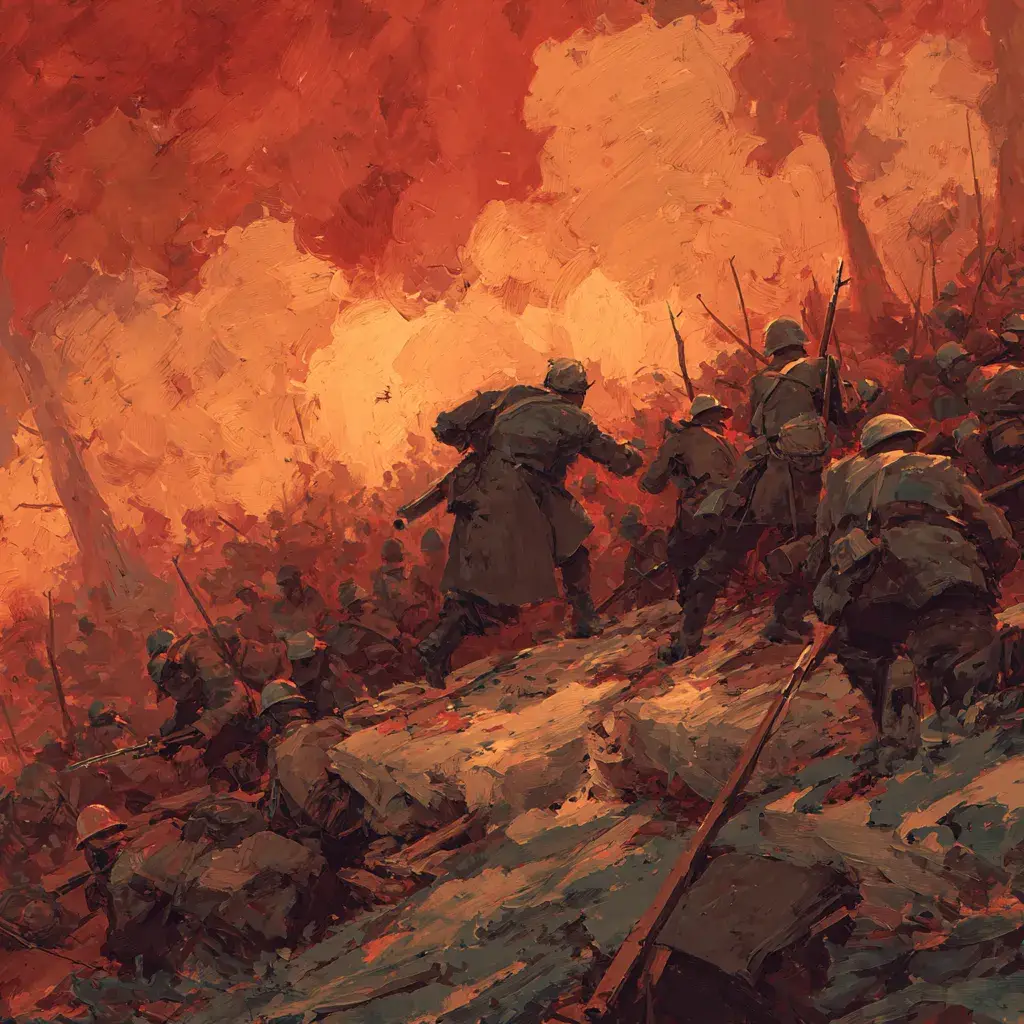
His defining moment came at the Battle of Verdun in 1916. Rather than leaving the same divisions to grind down on the battlefield for months, as the Germans did, Pétain rotated units out after only two weeks and organized continuous truck convoys along the road known as the Voie Sacrée to keep Verdun supplied with troops, artillery, and ammunition. His long-held conviction that firepower wins wars was vindicated by the millions of shells French artillery fired during the battle's opening months. The phrase most associated with Verdun's defense, 'they shall not pass,' was actually spoken by his successor there, Robert Nivelle, not by Pétain himself.
When Nivelle's own offensive collapsed in 1917 and provoked widespread mutinies across the French Army, Pétain was recalled to take command. He defused the crisis not through mass executions but by touring units personally, promising an end to futile attacks, and granting rest and home leave, while reserving the harshest punishments for only a small fraction of those court-martialed. He then held the line through 1917 and the German offensives of 1918, insisting on waiting for American troops and new French tanks before resuming major attacks, and played a key role in halting the last German pushes of the war. He was made Marshal of France in November 1918.
The Old Marshal: Decades of Influence Between the Wars
After the armistice, Pétain's prestige made him one of France's most powerful military voices even outside active command. He took the vice-chairmanship of the Supreme War Council in 1920, a post that made him commander-in-chief designate in any future war, and he held it for over a decade. He was a strong advocate for the Maginot Line, a system of frontier fortifications, having drawn on his own experience of how forts had helped at Verdun. In 1925 he commanded French forces in Morocco during the Rif War, bringing the campaign against Rif tribes to a successful conclusion within two months.
Pétain repeatedly clashed with French governments over shrinking military budgets and shortened terms of conscription, arguing that France was leaving itself dangerously unprepared, though funding cuts and reduced recruitment continued regardless. In 1934 he reluctantly accepted the post of Minister of War, where he restored previously cut officer numbers, but reports at the time still found the army poorly trained and under-resourced. He was elected to the Académie française in 1931, and by the mid-1930s had become so popular that a newspaper poll on potential dictators placed him well ahead of other political figures, despite his own lack of interest in formal politics.
In 1939 Pétain was sent to Spain as French ambassador, tasked with trying to pull the Spanish dictator Francisco Franco, whom he had once taught, away from Italian and German influence. He was still in this post when Germany invaded France the following year.
The Fall of France and the Decision to Seek Armistice
Pétain returned to government in May 1940 as Deputy Prime Minister under Paul Reynaud, brought in to bolster national morale as German forces broke through French lines. Within weeks, as the military situation collapsed, he joined commander-in-chief Maxime Weygand in arguing that continued resistance was hopeless and that an armistice, not relocation of the government abroad, was the only honorable course. When Winston Churchill urged the French to fight on, even from Paris itself, Pétain replied that turning the capital into ruins would change nothing, and noted bitterly that he no longer had the reserves he had commanded in 1918.
On 16 June 1940, with the cabinet divided and an offer of a joint Franco-British union rejected by most ministers, Reynaud resigned and recommended Pétain as his successor. President Albert Lebrun appointed him that same day. Pétain's government quickly sought terms from Germany, and France signed an armistice at Compiègne on 22 June 1940, ceding the northern and western regions, including Paris, to German occupation while leaving the remainder nominally unoccupied. The government relocated first to Clermont-Ferrand and then to the spa town of Vichy.
Head of the Vichy State and Collaboration with Germany
On 10 July 1940, the French Parliament voted overwhelmingly to grant Pétain's cabinet the power to write a new constitution, a vote that effectively dissolved the Third Republic, though its legality has been disputed ever since by French historians and governments. Pétain assumed near-total power as head of state, replacing the republican motto of liberty, equality, and fraternity with work, family, and fatherland, and presided over an authoritarian program called the National Revolution that dismantled many secular and liberal traditions of the old republic. His government dismissed civil servants, imposed censorship, and began passing antisemitic laws on its own initiative, including a 1940 law defining Jewish identity and another authorizing internment of foreign Jews, steps taken before Germany demanded them.
Vichy France initially retained a degree of nominal independence and even diplomatic recognition from countries including the United States, but it cooperated closely with Axis demands for goods and resources and ordered French colonial forces to resist Allied as well as German incursions. Pétain met Hitler at Montoire in October 1940, and a photograph of the two shaking hands caused outrage in Britain. After Allied landings in North Africa in November 1942, German forces occupied the previously free southern zone, reducing Pétain to a figurehead even as crowds still turned out to greet him on public visits as late as 1944. In 1943 his government sanctioned the creation of the Milice, a collaborationist militia that worked alongside German forces to suppress the French resistance.
As Allied forces advanced in August 1944, German officials forcibly relocated Pétain, first to Belfort and then to the Sigmaringen enclave in Germany, where remaining Vichy officials formed a government-in-exile. Pétain refused to participate in this body and later asked Hitler directly for permission to return to France, a request that went unanswered. He was eventually escorted to the Swiss border in April 1945 and crossed back into France two days later.
Trial for Treason and Final Years in Captivity
France's provisional government, led by Charles de Gaulle, put Pétain on trial for treason from 23 July to 15 August 1945. He spoke only to deny the court's authority to try him, then remained largely silent throughout the proceedings. The court convicted him on all charges and sentenced him to death and confiscation of his property, though it recommended against carrying out the execution given his advanced age. De Gaulle commuted the sentence to life imprisonment in exile, while Pétain was also stripped of all military ranks and honors apart from the title of Marshal of France.
He was imprisoned first at Fort du Portalet in the Pyrenees and then on the Île d'Yeu, an island off the Atlantic coast. Despite appeals for his release from figures including U.S. President Harry Truman and Spanish dictator Francisco Franco, successive French governments judged the move too politically risky. By the late 1940s his health deteriorated sharply, with memory loss progressing to dementia, hallucinations, and eventual loss of mobility. In June 1951 his sentence was commuted to hospital confinement, but he was too ill to be moved before his death.
Pétain died on 23 July 1951 in Port-Joinville on the Île d'Yeu at the age of 95, from dementia and heart disease. He was buried in the local cemetery, his grave deliberately positioned facing away from the sea in contrast to the island's other graves, a reflection of his conviction for national indignity. In 1973 his coffin was briefly stolen by extremists demanding his reburial among the Verdun war dead, but it was recovered and returned to its original site within days.
Philippe Pétain: timeline
- 1856Born into a peasant family in Cauchy-à-la-Tour, Pas-de-Calais, France.
- 1876Admitted to the Saint-Cyr Military Academy, beginning his career in the French Army.
- 1914Promoted to brigade general the day after leading his brigade at the Battle of Guise.
- 1916Took command of the Second Army at the start of the Battle of Verdun, later earning renown as the Lion of Verdun.
- 1917Replaced General Nivelle as Commander-in-Chief of the French Army and restored order after widespread mutinies.
- 1918Made Marshal of France after the end of World War I.
- 1925Appointed sole Commander-in-Chief of French forces in Morocco to lead the campaign against Rif tribes.
- 1934Joined the French cabinet as Minister of War under Doumergue's government of national unity.
- 1940Named head of the French government by President Lebrun after Paul Reynaud's resignation amid the imminent fall of France.
- 1940Became head of state as the French Parliament voted to replace the Third Republic with the authoritarian Vichy regime.
- 1945Convicted of treason by the High Court and sentenced to death, later commuted to life imprisonment due to his age.
- 1951Died in Port-Joinville on the Île d'Yeu, where he had been held in exile.
Listen: stories featuring Philippe Pétain
Narrated chapters from the Chunks Microlearning app. Read a preview here, or listen to the full story in the app.
Continue Philippe Pétain's story
You've read the summary — hear the full story as narrated 5-minute chapters on Chunks, alongside 200+ figures and events from history, philosophy and science. Free to start on iOS and Android.