
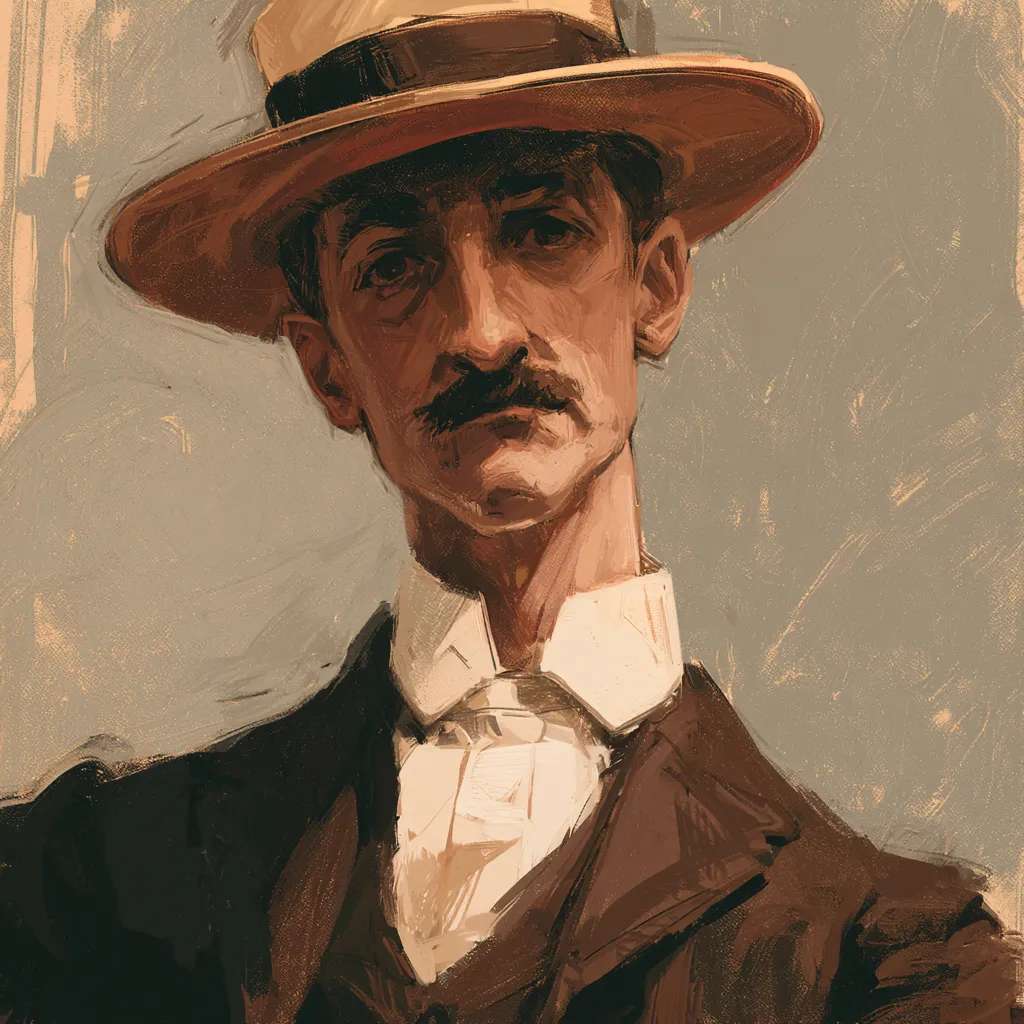
Who was Orville Wright?
Orville Wright (19 August 1871 – 30 January 1948) was an American aviation pioneer who, with his older brother Wilbur, designed and built the first successful powered airplane. On 17 December 1903, near Kitty Hawk, North Carolina, Orville piloted the first controlled, sustained flight of a powered, heavier-than-air machine — 12 seconds and about 120 feet. The brothers' real breakthrough was not the engine but control: the three-axis system they invented is still how aircraft are flown today.
American aviation pioneer who, with his brother Wilbur, achieved the first powered, sustained, and controlled airplane flight in 1903. Their invention launched the age of aviation and transformed transportation forever.
Don't stop at the facts — continue Orville Wright's story in free narrated chapters on Chunks.
Or get it straight away:
 Download on iOS
 Download on Android
Quick facts
- Born
- 19 August 1871
- Birthplace
- Dayton, Ohio, USA
- Died
- 30 January 1948 (aged 76)
- Place of death
- Dayton, Ohio, USA
- Nationality
- American
- Occupation
- Inventor, aviation pioneer, printer, bicycle manufacturer
- Known for
- Piloting the first powered airplane flight, 17 December 1903
Orville Wright: key facts
- Ran a printing business and then the Wright Cycle Company bicycle shop in Dayton with Wilbur — profits from the shop funded the flying experiments.
- Piloted the first of the four flights made on 17 December 1903 at Kill Devil Hills, near Kitty Hawk; the longest that day, Wilbur's, covered 852 feet in 59 seconds.
- The brothers' key invention was three-axis control — wing warping, rudder and elevator — worked out through glider tests and their own wind-tunnel data.
- Survived the first fatal airplane crash in 1908, a demonstration accident that killed his passenger, Lieutenant Thomas Selfridge.
- Sold the Wright Company in 1915 and spent his later years as an elder statesman of American aviation.
- Lived to see aviation progress from Kitty Hawk to the first supersonic flight in 1947.
From Dayton Bicycle Shop to the Question of Flight
Orville Wright was born on August 19, 1871, in Dayton, Ohio, the younger of the two brothers who would change the course of transportation history. His father Milton was a bishop in the Church of the United Brethren in Christ, and the family moved frequently during Orville's childhood, returning permanently to Dayton in 1884. In elementary school Orville was given to mischief and was once expelled. A toy helicopter their father brought home in 1878 — a small paper, bamboo, and cork device powered by a rubber band, based on a design by French aeronautical pioneer Alphonse Pénaud — captured both brothers' imaginations and, by their own later account, planted the seed of their interest in flight.
Orville dropped out of high school after his junior year and started a printing business in 1889, designing and building his own printing press with Wilbur's help. The brothers launched a weekly newspaper, the West Side News, with Orville as publisher and Wilbur as editor. They later moved into commercial printing, counting among their clients the poet Paul Laurence Dunbar. In December 1892, capitalizing on the national bicycle craze, they opened a repair and sales shop, and by 1896 were manufacturing their own bicycle brand. The income from this enterprise funded their growing obsession with the problem of flight.
Gliders, Wind Tunnels, and the Science of Control
The deaths of German gliding pioneer Otto Lilienthal in 1896 and British aeronaut Percy Pilcher in 1899 convinced the Wright brothers that the unsolved core of flight was not power but control. From 1900 onward they made annual trips to Kitty Hawk, North Carolina, chosen for its steady winds and soft sandy ground, to test a series of gliders. Orville's role deepened steadily; biographers note that Wilbur likely did most of the actual gliding until 1902, but Orville contributed essential analytical work throughout.
After their 1901 glider produced only about a third of the expected lift, the brothers grew suspicious of the accepted aeronautical data. They built a six-foot wind tunnel in their shop and between October and December 1901 conducted systematic tests on dozens of miniature wing shapes, using homemade balances fashioned from bicycle spokes and scrap metal to measure lift against drag. In 1902 they pressed further, running basic tests on 200 scale-model wings of varied shapes and airfoil curves, then conducting detailed measurements on 38 of them. This work revealed that longer, narrower wings — those with a higher aspect ratio — offered a far better lift-to-drag ratio, knowledge that shaped their 1902 glider.
A critical breakthrough came in October 1902, when Orville studied the problem of the glider spiraling into the ground during banked turns. He recorded in his diary on the night of October 2 that he had worked out a solution: making the rear vertical rudder movable and connecting it to the wing-warping control so that a single pilot movement managed both simultaneously. This linkage eliminated the adverse yaw that had plagued their earlier designs and gave them true three-axis control — wing-warping for roll, a forward elevator for pitch, and the movable rear rudder for yaw. On March 23, 1903, the brothers applied for their famous patent for a flying machine based on this 1902 glider.
December 17, 1903: The First Flights at Kill Devil Hills
The brothers built their powered Wright Flyer in 1903 using spruce for the frame and muslin for the surface coverings. Their shop mechanic Charles Taylor built the engine in six weeks in close collaboration with them, casting the block from aluminum to save weight. The Flyer had a wingspan of 40.3 feet, weighed 605 pounds, and was driven by a 12-horsepower engine. Rather than adapting existing propeller designs, the brothers treated an aeronautical propeller as essentially a rotating wing and used wind tunnel data to design their own, ultimately achieving an efficiency of more than 75 percent under actual flight conditions.
After weeks of delays at Kill Devil Hills caused by broken propeller shafts, Wilbur won a coin toss and made a brief, unsuccessful attempt on December 14. On December 17, 1903, with a freezing headwind gusting to 27 miles per hour, the brothers made four flights from level ground. Orville took the controls for the first, covering 120 feet in 12 seconds at a ground speed of 6.8 miles per hour — the moment captured in what became one of the most recognized photographs in history, taken by crew member John T. Daniels using Orville's pre-positioned camera. The fourth and final flight of the day, made by Wilbur, covered 852 feet in 59 seconds before the machine pitched down and struck the ground. A gust of wind then flipped the Flyer repeatedly and damaged it beyond further use that day.
Five people witnessed the flights: three members of a U.S. government coastal lifesaving crew, a local businessman, and a teenage boy from the area. The brothers telegraphed their father asking him to inform the press, but initial coverage was negligible. The Dayton Journal refused to publish the story on the grounds that the flights were too short to matter, and a telegraph operator leaked their message to a Virginia paper, which printed a wildly inaccurate account.
Public Demonstrations, Patent Wars, and a Contested Legacy
The brothers spent 1904 and 1905 refining their design at Huffman Prairie, a cow pasture eight miles northeast of Dayton. On September 20, 1904, Wilbur flew the first complete circle ever made by a powered heavier-than-air aircraft. By October 1905 their Wright Flyer III could remain airborne for nearly 40 minutes and cover more than 24 miles in a single flight, which the brothers considered the threshold of a truly practical airplane. Orville suffered a potentially fatal crash on July 14, 1905, but the rebuilt Flyer III incorporated the lessons: the elevator and rudder were enlarged and moved farther from the wings, and each of the three control axes was given its own independent mechanism.
Skepticism in Europe ran high throughout 1906 and 1907, with French newspapers openly calling the brothers bluffeurs. That changed on August 8, 1908, when Wilbur began public demonstration flights near Le Mans, France, his effortless banking turns stunning onlookers including leading French aviators. Orville simultaneously demonstrated a Flyer to the U.S. Army at Fort Myer, Virginia. On September 9, 1908, he made the first hour-long airplane flight, lasting 62 minutes and 15 seconds. Eight days later, on September 17, a propeller split mid-flight and the Flyer crashed. Army lieutenant Thomas Selfridge, riding as an official observer, suffered a fatal skull fracture — the first airplane crash fatality in history. Orville sustained a broken left leg, four broken ribs, and injuries to his hip that were not fully diagnosed until twelve years later.
The brothers' subsequent patent lawsuits, particularly against Glenn Curtiss over the use of ailerons, consumed much of the following decade and damaged their public image. Wilbur died of typhoid fever on May 30, 1912, at age 45, worn down by years of travel and legal battles. Orville inherited the company presidency, won the Collier Trophy in 1914 for his automatic stabilizer, and sold the Wright Company in 1915. He spent his later years as an elder statesman of aviation, serving on the National Advisory Committee for Aeronautics for 28 years. He received the first Daniel Guggenheim Medal in 1930 and was elected to the National Academy of Sciences in 1936. Orville died in Dayton on January 30, 1948, at age 76, having witnessed aviation grow from a 12-second hop to the threshold of supersonic flight.
Orville Wright: timeline
- 1871Born in Dayton, Ohio, to bishop Milton Wright and Susan Catherine Koerner.
- 1889Dropped out of high school to launch a printing business, designing and building his own printing press with Wilbur's help.
- 1892Opened a bicycle repair and sales shop with Wilbur in Dayton, which funded their growing interest in flight.
- 1903Made the first controlled, sustained, powered flight in history at Kill Devil Hills, North Carolina, covering 120 feet in 12 seconds aboard the Wright Flyer.
- 1904Helped develop the Wright Flyer II at Huffman Prairie near Dayton, achieving longer flights including the first complete circle by a powered aircraft.
- 1908Suffered a severe crash at Fort Myer, Virginia, when a propeller shattered mid-flight, killing passenger Thomas Selfridge and leaving Orville with a broken leg and broken ribs.
- 1909Completed U.S. Army proving flights and received a $25,000 award, cementing the Wright Flyer's status as the first military aircraft under contract.
- 1915Sold the Wright Company, departing from active business to serve as an elder statesman of aviation on committees including the NACA.
- 1930Received the first Daniel Guggenheim Medal, recognizing his contributions to aeronautics.
- 1948Died in Dayton, Ohio, at age 76 following a second heart attack, having lived to see aviation advance from the first 12-second flight to the dawn of supersonic aircraft.
Listen: stories featuring Orville Wright
Narrated chapters from the Chunks Microlearning app. Read a preview here, or listen to the full story in the app.

Continue Orville Wright's story
You've read the summary — hear the full story as narrated 5-minute chapters on Chunks, alongside 200+ figures and events from history, philosophy and science. Free to start on iOS and Android.