
.webp?v=1769011898576)
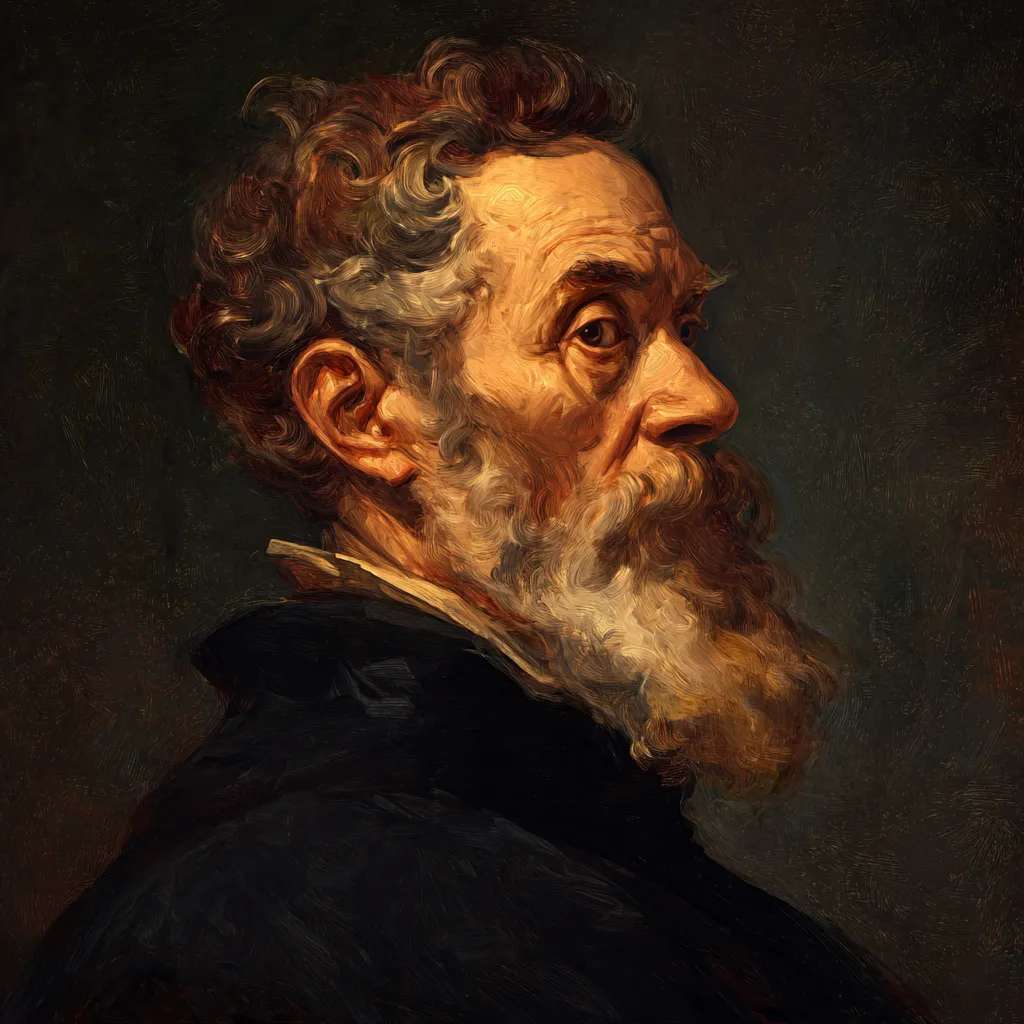
Who was Michelangelo?
Michelangelo di Lodovico Buonarroti Simoni (6 March 1475 – 18 February 1564) was a Florentine sculptor, painter, and architect of the High Renaissance, renowned for the marble statue of David, the Pietà, and the ceiling frescoes of the Sistine Chapel in Rome. Both biographers and contemporaries celebrated him as the greatest artist of his era.
Italian Renaissance sculptor, painter, and architect whose masterpieces like the Sistine Chapel ceiling and statue of David epitomize artistic genius. His intense dedication to his craft and deep faith created some of humanity's most enduring works of art.
Don't stop at the facts — continue Michelangelo's story in free narrated chapters on Chunks.
 Download on iOS
 Download on Android
Quick facts
- Born
- 6 March 1475
- Birthplace
- Caprese Michelangelo
- Died
- 18 February 1564
- Place of death
- Rome
- Nationality
- Republic of Florence
- Occupation
- Sculptor, architectural drafter, painter
Michelangelo: key facts
- Michelangelo di Lodovico Buonarroti Simoni was born on 6 March 1475 in Caprese, a small town in Tuscany now known as Caprese Michelangelo.
- The marble statue of David, completed in 1504 and originally placed in the Piazza della Signoria in Florence, established Michelangelo as a sculptor of extraordinary technical skill before he turned 30.
- Michelangelo painted the Sistine Chapel ceiling between 1508 and 1512, covering over 500 square metres with more than 300 figures depicting scenes from the Book of Genesis.
- The Pietà, carved when Michelangelo was 24 and now in St Peter's Basilica, is the only work he ever signed, with his name inscribed on the Virgin Mary's sash.
- At age 71, Michelangelo succeeded Antonio da Sangallo the Younger as architect of St Peter's Basilica in Rome, redesigning the structure and influencing the form of its famous dome.
- Giorgio Vasari published a biography of Michelangelo during the artist's own lifetime, declaring that his work transcended that of any artist living or dead across sculpture, painting, and architecture.
- Michelangelo died in Rome on 18 February 1564 at the age of 88, and his body was taken to Florence for burial at the Basilica of Santa Croce, as he had requested.
A Stonecutter's Childhood Near Arezzo
Michelangelo di Lodovico Buonarroti Simoni was born on 6 March 1475 in Caprese, a small town near Arezzo in the Republic of Florence, where his father Ludovico held a temporary post as a local administrator. The family soon returned to Florence, and after his mother Francesca fell ill and died when he was six, the young boy was sent to live with a nanny in Settignano, whose husband worked as a stonecutter. Michelangelo later said that he absorbed his love of chisel and hammer along with his nurse's milk, a line his early biographer Giorgio Vasari recorded directly from him.
Back in Florence, Michelangelo was enrolled to study grammar but showed little interest in formal schooling, preferring to copy paintings in churches and spend time around working artists. Florence at that time was one of Europe's great centers of art and Classical learning, with masters such as Ghiberti, Donatello, Giotto, and Masaccio having left work throughout the city for him to study. In 1488, at thirteen, he was apprenticed to Domenico Ghirlandaio, a leading fresco painter with the largest workshop in the city, and his father soon negotiated a rare arrangement in which the young Michelangelo was paid as an artist despite his age.
Lorenzo de' Medici, the effective ruler of Florence, asked Ghirlandaio for his two best pupils in 1489, and Michelangelo was sent to the Medici court along with fellow student Francesco Granacci. Over the next few years he studied at the Medici-sponsored Platonic Academy, absorbing ideas from humanist scholars, and carved his earliest surviving marble reliefs, Madonna of the Stairs and Battle of the Centaurs, while working alongside the sculptor Bertoldo di Giovanni. During this period a fellow pupil, Pietro Torrigiano, broke his nose in a fight, leaving the disfigurement visible in later portraits of him.
Bologna, a Forged Antique, and Roman Fame
Lorenzo de' Medici's death in 1492 ended Michelangelo's place at court, and political turmoil in Florence, including the rise of the preacher Savonarola and the expulsion of the Medici in 1494, sent him traveling to Venice and then Bologna. There he studied the relief carvings of Jacopo della Quercia and completed small commissioned figures for the Shrine of St. Dominic. Returning briefly to Florence, he carved a sleeping Cupid that was sold in Rome disguised as an ancient sculpture; when the buyer, Cardinal Raffaele Riario, discovered the deception he was impressed enough by the workmanship to invite Michelangelo to Rome, where he arrived in 1496 at the age of twenty-one.
In Rome he carved a statue of Bacchus for Cardinal Riario, which the cardinal ultimately rejected, and then, in 1497, received a commission from a French cardinal for a Pietà depicting the Virgin Mary grieving over the body of Christ. Completed when Michelangelo was twenty-four, the sculpture was immediately recognized as extraordinary, with Vasari calling it a near miracle that shapeless stone could be reduced to such perfection. It remains the only work Michelangelo ever signed, his name carved into the sash across Mary's chest, and it now stands in St Peter's Basilica.
Michelangelo returned to Florence in 1499 as the political climate shifted again following Savonarola's execution. The Guild of Wool commissioned him to finish a colossal marble figure of David that had sat unfinished for forty years, and by 1504 he had produced the statue that made his reputation as a sculptor of unmatched technical skill. A panel of the city's leading artists, including Leonardo da Vinci and Botticelli, was convened to decide where it should stand, ultimately choosing the Piazza della Signoria in front of the Palazzo Vecchio.
Painting Against His Own Preference: The Sistine Ceiling
In 1505 Pope Julius II summoned Michelangelo to Rome to build an enormous papal tomb featuring forty statues, a project meant to take five years but which dragged on for four decades amid constant interruptions and, eventually, disputes between the two strong-willed men. The tomb was never finished as originally planned; it now stands in the Church of San Pietro in Vincoli, notable chiefly for the finished figure of Moses, completed in 1516, along with two unfinished slave figures now housed in the Louvre.
According to his biographer Condivi, the architect Bramante, resentful of Michelangelo's standing, urged Julius to assign him a medium in which he had little experience, hoping he would fail. The result was the ceiling of the Sistine Chapel, painted between 1508 and 1512, covering more than 500 square meters with over 300 figures. Rather than the twelve apostles originally requested, Michelangelo persuaded the pope to let him design a far more ambitious scheme depicting scenes from Genesis, including the widely reproduced Creation of Adam, framed by prophets and sibyls who foretold the coming of Christ.
Decades later, Pope Clement VII commissioned a second major fresco from Michelangelo, The Last Judgment, painted on the altar wall of the same chapel between 1534 and 1541 under Clement's successor, Paul III. The work depicted Christ and the souls of the dead with a physical, muscular intensity that struck many contemporaries as scandalous for its nudity; church authorities later ordered the figures partially covered, a task carried out after Michelangelo's death by his former apprentice Daniele da Volterra.
Florence, the Medici, and the Architecture of Old Age
Between his Roman commissions, Michelangelo remained tied to Florence and its ruling Medici family. He designed the Medici Chapel at the Basilica of San Lorenzo, housing tombs adorned with allegorical figures of Night, Day, Dusk, and Dawn, and later designed the Laurentian Library, whose dramatic staircase and inventive use of columns anticipated the Baroque style. When Florentine citizens expelled the Medici and restored the republic in 1527, Michelangelo helped fortify the city, and after its fall to a siege in 1530 he was briefly condemned to death by the Medici pope Clement VII before being pardoned and allowed to keep working.
In his final decades Michelangelo settled permanently in Rome, where in 1546 he was appointed architect of St. Peter's Basilica, succeeding a line of architects who had struggled to advance the project for fifty years. He revived and strengthened Bramante's original centralized plan and designed the basilica's dome, which was not completed until after his death but became renowned as one of the defining achievements of Renaissance architecture. Alongside this he designed the Capitoline Hill piazza, the upper floor of the Palazzo Farnese, and several churches, including Santa Maria degli Angeli.
Michelangelo was a devout Catholic whose religious devotion deepened with age, and he wrote several hundred sonnets and madrigals, some addressed to the Roman nobleman Tommaso dei Cavalieri and others to the poet Vittoria Colonna, with whom he shared a close friendship until her death in 1547. He continued working almost until the end, carving the unfinished Rondanini Pietà only days before he died in Rome on 18 February 1564, at the age of eighty-eight. Honoring his wish to be buried in Florence, his body was later interred at the Basilica of Santa Croce beneath a tomb commissioned from Vasari and funded partly by Cosimo I de' Medici.
Michelangelo: timeline
- 1475Born in Caprese, a small town in Tuscany, to a family of small-scale Florentine bankers; the family returned to Florence within months of his birth.
- 1488Apprenticed at age 13 to Domenico Ghirlandaio, the most prominent fresco painter in Florence, marking the formal start of his artistic training.
- 1490–1492Entered the Medici court under Lorenzo de' Medici, studying at the Platonic Academy and producing his earliest known marble reliefs, the Madonna of the Stairs and Battle of the Centaurs.
- 1496Arrived in Rome at age 21 and received his first major Roman commission, a larger-than-life statue of Bacchus for Cardinal Riario.
- 1498–1499Carved the Pietà for Cardinal Jean de Bilhères-Lagraulas; completed before he turned 25, it was immediately recognised as one of the greatest sculptures ever made.
- 1504Completed the colossal marble statue of David in Florence, definitively establishing his reputation as a sculptor of extraordinary technical skill and symbolic imagination.
- 1508–1512Painted the ceiling of the Sistine Chapel in Rome, covering over 500 square metres with more than 300 figures, including the celebrated Creation of Adam.
- 1534–1541Painted The Last Judgment on the altar wall of the Sistine Chapel, depicting the Second Coming of Christ on an unprecedented scale and generating fierce controversy over its nudity.
- 1546Appointed architect of St. Peter's Basilica in Rome at age 71, redesigning the structure around Bramante's centrally planned concept and designing the great dome.
- 1564Died in Rome at age 88; his body was transported to Florence for burial at the Basilica of Santa Croce, in accordance with his final wishes.
Listen: stories featuring Michelangelo
Narrated chapters from the Chunks Microlearning app. Read a preview here, or listen to the full story in the app.
Continue Michelangelo's story
You've read the summary — hear the full story as narrated 5-minute chapters on Chunks, alongside 200+ figures and events from history, philosophy and science. Free to start on iOS and Android.