

Who was Josephine Baker?
Josephine Baker (June 3, 1906 – April 12, 1975) was an American-born French dancer, singer, and spy who became one of Europe's most celebrated entertainers. Born in St. Louis, she rose to fame at the Folies Bergère in Paris and later aided the French Resistance during World War II, earning the Croix de Guerre and the Legion of Honour.
American-born French entertainer, dancer, and World War II spy who became an international icon while secretly working for the French Resistance.
Don't stop at the facts — continue Josephine Baker's story in free narrated chapters on Chunks.
Or get it straight away:
 Download on iOS
 Download on Android
Quick facts
- Born
- 3 June 1906
- Birthplace
- St. Louis
- Died
- 12 April 1975
- Place of death
- Paris
- Nationality
- United States, France
- Occupation
- Singer, vedette, film actor
Josephine Baker: key facts
- Josephine Baker was born Freda Josephine McDonald on June 3, 1906, in St. Louis, Missouri, and later became a French citizen after marrying French industrialist Jean Lion in 1937.
- Baker became the first Black woman to star in a major motion picture when she appeared in the 1927 French silent film Siren of the Tropics, directed by Mario Nalpas and Henri Étiévant.
- Her performance in the 1927 Folies Bergère revue Un vent de folie, in which she wore a skirt made of artificial bananas, became an iconic image of the Jazz Age and the Roaring Twenties.
- During World War II, Baker worked as a spy for the French Resistance, the British Secret Intelligence Service, and the United States Office of Strategic Services, smuggling intelligence written in invisible ink on her sheet music across borders.
- After World War II, General Charles de Gaulle named Baker a Knight of the Legion of Honour, and she also received the Resistance Medal and the Croix de Guerre for her wartime service.
- Baker was the only official female speaker at the 1963 March on Washington, where she appeared wearing her Free French uniform and her Légion d'honneur medal.
- On November 30, 2021, Baker became the first Black woman inducted into the Panthéon in Paris, with a symbolic casket containing soil from locations where she had lived, as her remains stayed in Monaco Cemetery.
From St. Louis Poverty to the Paris Stage
Freda Josephine McDonald was born on June 3, 1906, in St. Louis, Missouri, to Carrie McDonald, a laundress of African American and Native American heritage, and a father whose identity remains uncertain. The name Eddie Carson, a vaudeville drummer, was long offered as her biological father, but research by her foster son Jean-Claude Baker raised serious doubts. The birth certificate listed only 'Edw' as the father, and the circumstances — Carrie being admitted to an exclusively white hospital — led Jean-Claude Baker and others to believe the father was a white man who used his influence to secure her admission.
Baker's childhood on Targee Street in St. Louis's Chestnut Valley neighborhood was defined by hunger and instability. By age eight she was working as a live-in domestic for white families; one employer burned her hands as punishment for using too much soap. She dropped out of school by twelve, worked as a waitress at thirteen, and briefly married a man named Willie Wells before finding work with a street performance group. Her mother opposed her ambitions as an entertainer, but Baker's determination was fixed. She secured a role in the touring production of the Broadway revue Shuffle Along in 1921, initially placed at the end of the chorus line, where she turned her marginal position into an advantage by adding comic improvisation that made audiences notice her above everyone else.
Sensation at the Folies Bergère and the Making of an Icon
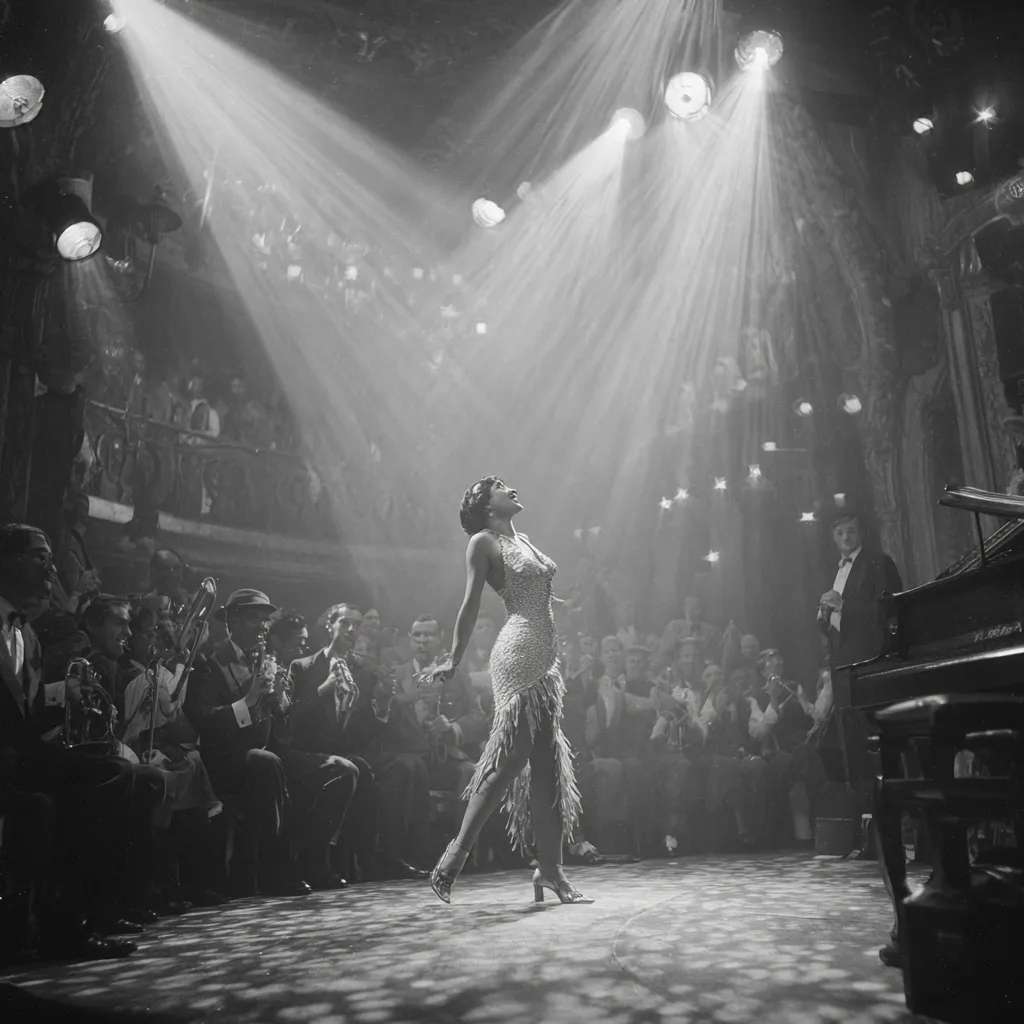
Baker sailed to Paris in 1925 and opened on October 2 at the Théâtre des Champs-Élysées in La Revue nègre, performing the Danse Sauvage barely clothed. The response was immediate. She broke her contract with the touring show and returned to France in 1926 to headline at the Folies Bergère, where her performance in the 1927 revue Un vent de folie — wearing only a short skirt of artificial bananas and a beaded necklace — became one of the defining images of the Jazz Age. Artists and intellectuals competed to celebrate her: Ernest Hemingway called her the most sensational woman anyone ever saw, Picasso painted her, and Jean Cocteau became a close friend.
Her fame extended well beyond the stage. She endorsed products, starred in films, and in 1931 recorded J'ai deux amours, a song expressing love for both her homeland and Paris that became permanently associated with her public persona. She was the first Black woman to star in a major motion picture, the 1927 French silent film Siren of the Tropics. In 1934 she took the lead role in a revival of Jacques Offenbach's opera La créole after months of vocal training, a transformation that her friend and admirer Shirley Bassey later described as a journey from petite danseuse sauvage to la grande diva magnifique. Despite this European triumph, her 1936 star turn in the Ziegfeld Follies on Broadway was coolly received, and she returned to France permanently, becoming a French citizen after marrying industrialist Jean Lion in 1937.
Spy and Resistance Fighter in World War II
When France declared war on Germany in September 1939, Baker was recruited by the Deuxième Bureau, the French military intelligence agency, as an honorable correspondent. Working with Jacques Abtey, the head of French counterintelligence in Paris, she used her celebrity access to socialize at embassies and ministries, drawing information from high-ranking Japanese, Italian, and Vichy officials without raising suspicion. She collected intelligence on German troop movements and the locations of airfields and harbors, transporting sensitive notes written in invisible ink on her sheet music, pinned inside her clothing, or written on her hands and arms.
After the German invasion of France in 1940, Baker withdrew to her Château des Milandes estate in the Dordogne, which became a center of Resistance activity — sheltering fighters and Jewish refugees, housing a radio transmitter, and storing weapons. She also held a pilot's license and flew missions during the Phoney War. Later operating from Morocco, she toured Spain gathering further intelligence, carrying notes hidden inside her underwear. A miscarriage in North Africa was followed by a severe infection requiring a hysterectomy, but after recovering she toured North Africa entertaining British, French, and American troops. After the war, she was awarded the Resistance Medal, the Croix de Guerre, and was named a Knight of the Legion of Honour by General Charles de Gaulle.
Civil Rights Activism in America and the March on Washington
Although Baker had made France her permanent home, she remained deeply engaged with racial inequality in the United States. She refused to perform for segregated audiences, an insistence that helped integrate live entertainment in the Las Vegas Valley. A 1951 incident at the Stork Club in Manhattan, where she was refused service, became a flashpoint: she publicly criticized the journalist Walter Winchell, who had been seated nearby and said nothing, and Winchell retaliated by labeling her a communist sympathizer. The backlash cost her bookings across the country, but it did not silence her. The NAACP had already declared May 20, 1951 'Josephine Baker Day' and presented her with life membership.
In 1963, Baker spoke at the March on Washington as the only official female speaker. Wearing her Free French uniform emblazoned with her Legion of Honour medal, she introduced the 'Negro Women for Civil Rights,' acknowledging Rosa Parks and Daisy Bates among others. After the assassination of Martin Luther King Jr., his widow Coretta Scott King approached Baker in the Netherlands to ask whether she would assume leadership of the Civil Rights Movement. Baker declined, citing concern for the welfare of her children.
The Rainbow Tribe, Late Career, and Death in Paris
Baker adopted twelve children of different nationalities and religions, whom she called the Rainbow Tribe, intending them as a living demonstration that children of different ethnicities could be raised as brothers and sisters. She raised two daughters — French-born Marianne and Moroccan-born Stellina — and ten sons from Japan, Colombia, Finland, France, Algeria, Ivory Coast, and Venezuela. For a period she lived with the children at Château des Milandes, which she opened to the public as a kind of living exhibit. Financial mismanagement and mounting debts eventually cost her the estate in 1968, after which Princess Grace of Monaco offered her an apartment near Monaco and later financial assistance.
Baker continued performing well into her final years. In 1973 she appeared at Carnegie Hall to a standing ovation, and in 1974 she performed at a Royal Variety Performance at the London Palladium. On April 8, 1975, she opened a retrospective revue at the Bobino in Paris celebrating her fifty years in show business, with financing from Prince Rainier, Princess Grace, and Jacqueline Kennedy Onassis. The opening-night audience included Sophia Loren, Mick Jagger, Shirley Bassey, Diana Ross, and Liza Minnelli. Four days later, Baker was found in a coma after suffering a cerebral hemorrhage and died on April 12, 1975, aged 68, at Pitié-Salpêtrière Hospital. On November 30, 2021, she was inducted into the Panthéon in Paris, becoming the first Black woman to receive that honor, with a symbolic casket interred there while her body remained in Monaco.
Josephine Baker: timeline
- 1906Born Freda Josephine McDonald in St. Louis, Missouri, into poverty in the Chestnut Valley neighborhood.
- 1921Secured a role in the touring production of the Broadway revue Shuffle Along, launching her professional performance career.
- 1925Sailed to Paris and opened in La Revue nègre at the Théâtre des Champs-Élysées, becoming an instant sensation for her erotic dancing.
- 1927Her performance in the Folies Bergère revue Un vent de folie, wearing only a skirt of artificial bananas and a beaded necklace, made her an iconic figure of the Jazz Age.
- 1927Became the first Black woman to star in a major motion picture, the French silent film Siren of the Tropics.
- 1937Married French industrialist Jean Lion in Crèvecœur-le-Grand, acquiring French citizenship and renouncing her American nationality.
- 1939Recruited by the French military intelligence agency the Deuxième Bureau as an honorable correspondent, beginning her work as a spy against Nazi Germany.
- 1951Named NAACP Woman of the Year after winning a public battle to desegregate a Miami nightclub audience and completing a successful national tour.
- 1963Spoke at the March on Washington alongside Martin Luther King Jr., serving as the only official female speaker and introducing Negro Women for Civil Rights.
- 1975Starred in a retrospective revue at the Bobino in Paris celebrating 50 years in show business, financed by Prince Rainier, Princess Grace, and Jacqueline Kennedy Onassis.
- 1975Died in Paris aged 68 after suffering a cerebral hemorrhage, and was later interred at the Cimetière de Monaco.
- 2021Inducted into the Panthéon in Paris with a symbolic casket, becoming the first Black woman to receive this honor in France.
Listen: stories featuring Josephine Baker
Narrated chapters from the Chunks Microlearning app. Read a preview here, or listen to the full story in the app.
Continue Josephine Baker's story
You've read the summary — hear the full story as narrated 5-minute chapters on Chunks, alongside 200+ figures and events from history, philosophy and science. Free to start on iOS and Android.