
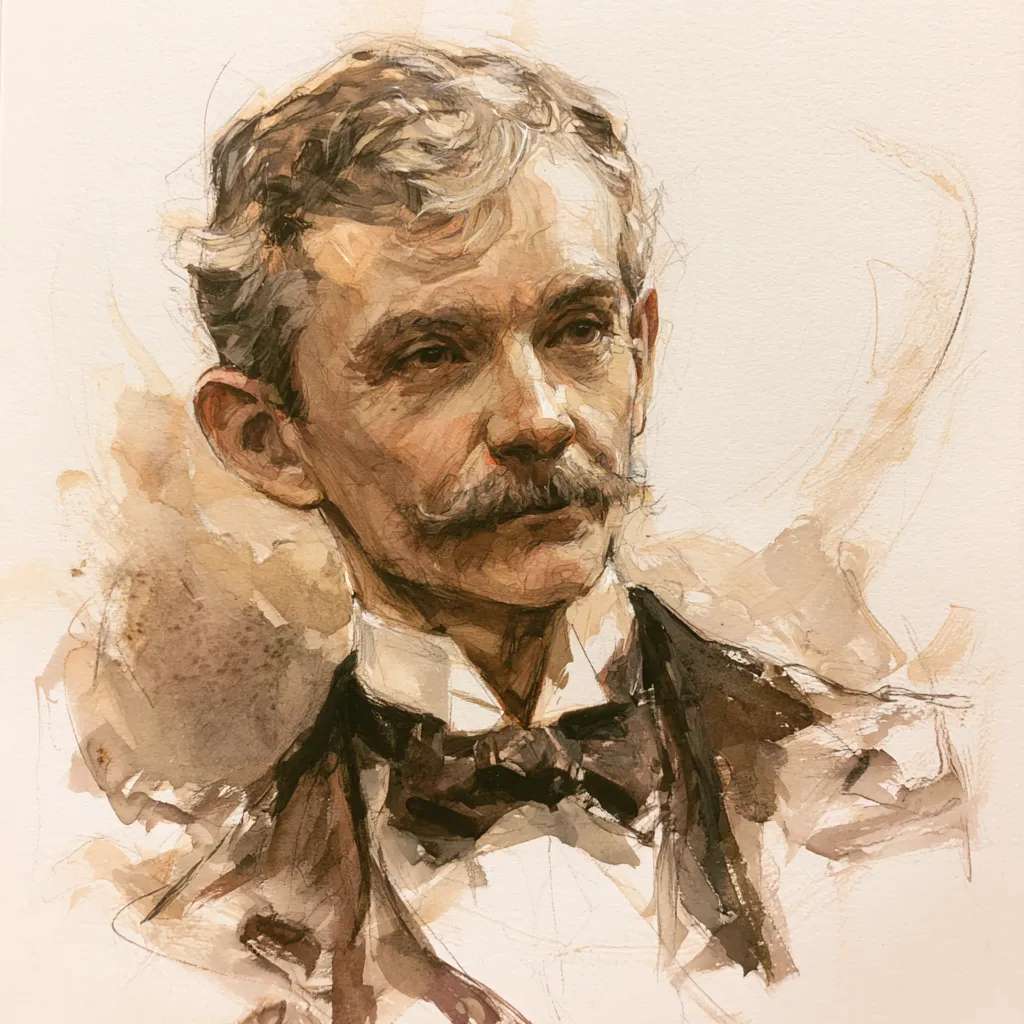
Who was John Watson?
John Broadus Watson (January 9, 1878 – September 25, 1958) was an American psychologist who founded behaviorism as a psychological school, arguing that behavior rather than consciousness should be the focus of psychology. He is best known for the 1920 Little Albert experiment, in which he conditioned a child to fear a white rat using classical conditioning principles, and for his 1913 address Psychology as the Behaviorist Views It.
American psychologist who conducted the controversial Little Albert experiment, demonstrating classical conditioning in humans and founding behaviorism.
Don't stop at the facts — continue John Watson's story in free narrated chapters on Chunks.
Or get it straight away:
 Download on iOS
 Download on Android
Quick facts
- Born
- 9 January 1878
- Birthplace
- Greenville
- Died
- 25 September 1958
- Place of death
- New York City
- Nationality
- United States
- Occupation
- Psychologist, politician
John Watson: key facts
- John Broadus Watson was born on January 9, 1878, and died on September 25, 1958, at Columbia-Presbyterian Medical Center in Upper Manhattan, New York City, at the age of 80.
- Watson founded behaviorism as a psychological school, arguing that psychology should study observable behavior rather than consciousness or the mind, and outlined this position in his 1913 article 'Psychology as the Behaviorist Views It.'
- In 1920, Watson and his assistant Rosalie Rayner conducted the Little Albert experiment, conditioning a 9-month-old boy to fear a white rat by pairing its appearance with a loud clanging noise.
- Watson earned his PhD from the University of Chicago in 1903, with a dissertation titled 'Animal Education' that examined the relationship between brain myelination and learning ability in rats.
- After being asked to resign from Johns Hopkins University in 1920 following a publicized affair with student Rosalie Rayner, Watson joined advertising agency J. Walter Thompson and rose to a vice-presidency within two years.
- Watson's 1928 book 'Psychological Care of Infant and Child,' co-written with Rosalie Rayner, sold 100,000 copies within months and argued that parents shape a child's development entirely through environmental influences.
- A 2002 survey published in Review of General Psychology ranked Watson as the 17th most cited psychologist of the 20th century.
From Rural South Carolina to the University of Chicago
John Broadus Watson was born on January 9, 1878, in Travelers Rest, South Carolina. His childhood was shaped by two sharply contrasting parental influences. His father, Pickens Butler Watson, was an alcoholic who abandoned the family when John was 13, leaving to live with two other women. His mother, Emma Kesiah Watson, was deeply religious, named her son after a Baptist minister, and subjected him to strict religious discipline. Watson developed a lifelong hostility toward religion that he carried into adulthood.
In an effort to escape poverty, Watson's mother sold the family farm and relocated to Greenville, South Carolina, a town of around 8,000 people. The move proved formative. Watson gained admission to Furman University at age 16, relying on his mother's social connections despite poor grades and two arrests during high school — one for fighting and one for discharging a firearm within city limits. He left Furman with a master's degree at 21, then spent a year running a one-room school before successfully petitioning to enter the University of Chicago.
At Chicago, Watson studied philosophy under John Dewey before gravitating toward the scientific study of animal behavior. The combined influence of James Rowland Angell, Henry Herbert Donaldson, and Jacques Loeb pushed him toward a rigorously objective approach to psychology. He earned his PhD in 1903 with a dissertation examining the relationship between brain myelination and learning ability in rats, then spent five more years at Chicago researching how sensory input shapes behavior in maze-running animals.
The Behaviorist Manifesto and a New School of Psychology
In 1908, Watson joined Johns Hopkins University as chair of the psychology department. Five years later, in 1913, he published what became known as the Behaviorist Manifesto, formally titled Psychology as the Behaviorist Views It. The opening paragraph set out his position plainly: psychology should be a purely objective experimental science whose goal is the prediction and control of behavior, with no reliance on introspection or concepts of consciousness.
Watson's central argument was that introspection — the method of examining one's own mental states — was unreliable and had held psychology back. He insisted that only observable behavior could form the basis of a genuine science. He rejected Edward Thorndike's law of effect for what he considered its subjective elements, and it was not until 1916 that he fully recognized the broader significance of Ivan Pavlov's work on conditioned reflexes, which he then incorporated into his own framework.
Watson placed the emphasis on how external situations produce behavioral reactions, rather than on any inner mental life. This approach, combined with commitments to determinism and empiricism, gave rise to what is sometimes called Methodological Behaviorism. Watson served as president of the Southern Society for Philosophy and Psychology in 1915, and edited Psychological Review from 1910 to 1915, cementing his institutional influence over the discipline during its most formative years.
The Little Albert Experiment and the Conditioning of Fear
The experiment Watson conducted with his assistant Rosalie Rayner in 1920 became one of the most discussed and controversial studies in the history of psychology. Their subject, known as Little Albert, was a nine-month-old boy. Watson and Rayner first established that the child showed no fear of a white rat, then repeatedly paired the rat's appearance with the loud clang of an iron rod struck nearby. After several such pairings, the boy cried at the sight of the rat alone. The conditioned fear also transferred to a rabbit, a dog, and a fur coat.
The study was designed to demonstrate that emotional responses, specifically fear, could be produced through classical conditioning — that they were not innate reactions to specific objects but learned associations. Watson and Rayner did not decondition the child before he was taken out of town, which raised serious ethical concerns. Later analysis of Watson's film footage suggested that Little Albert may have had developmental disabilities, and a 2009 investigation identified him as Douglas Merritte, a child who died from congenital hydrocephalus at age six. Subsequent scholarship complicated those findings, and the journals that initially published the identification later ran articles questioning it.
Watson did develop a deconditioning method in separate work with colleague Mary Cover Jones, who worked with a boy named Peter to eliminate his fear of rabbits. By gradually bringing a caged rabbit closer to the child during pleasant mealtimes, and retreating whenever the child showed distress, Jones eventually got Peter to the point where he could sit calmly beside the rabbit and even play with it. This technique is recognized today as an early form of systematic desensitization.
Child-Rearing Theories and the 1928 Handbook
Watson's forced resignation from Johns Hopkins in October 1920 — the result of a widely publicized affair with Rayner, whom he married in 1921 — redirected his public attention toward child psychology. In 1928, he published Psychological Care of Infant and Child, co-written with Rayner. The book argued that children should be treated with a businesslike respect rather than overt emotional warmth, warning that excessive maternal affection produced dependent, psychologically weakened adults. The book sold 100,000 copies within months of publication.
Watson's position rested on the same logic as his laboratory work: since love is a conditioned response rather than an innate bond, parents who constantly comfort children are simply training dependency. He argued that nothing in human development is instinctual, and that parents bear full responsibility for the environment in which a child is formed. His slogan captured this view directly — not more babies but better brought up babies — and he proposed that society should pause and accumulate data before continuing to raise children under poorly understood conditions.
The book attracted significant criticism. Analysts noted that Watson's own difficult upbringing on a poor South Carolina farm, his father's abandonment, and his complicated emotional life may have shaped these prescriptions more than objective research did. Watson himself later admitted he had not known enough to write on the subject well. His granddaughter, the actor Mariette Hartley, publicly attributed psychological difficulties in her own life to being raised according to his theories, and both sons he had with Rayner later attempted suicide, with one, William, dying by suicide in 1954.
Advertising, Later Life, and Contested Legacy
After leaving academic life in 1920, Watson entered the advertising industry through contacts provided by his colleague E. B. Titchener. He joined the agency J. Walter Thompson, starting at ground level — including a period selling shoes in a department store — before rising to a vice-presidency within two years. His salary in advertising far exceeded anything he had earned in academia. He led campaigns for products including Ponds cold cream and Maxwell House coffee, and is credited with popularizing the idea of a coffee break through the Maxwell House campaign.
Watson stopped writing for popular audiences in 1936 and retired from advertising around age 65. He had burned his personal letters and papers before his death, depriving historians of primary sources for the early history of behaviorism. In 1957, the American Psychological Association awarded him a Gold Medal for his contributions to psychology. He died on September 25, 1958, at Columbia-Presbyterian Medical Center in Upper Manhattan, at the age of 80, and was buried at Willowbrook Cemetery in Westport, Connecticut.
A 2002 survey published in the Review of General Psychology ranked Watson as the 17th most cited psychologist of the 20th century. His influence cut across animal research, human emotional conditioning, child development, and commercial persuasion — an unusually wide range for a single career. The Little Albert study alone reshaped how psychologists understood the origins of fear, even as ongoing disputes about Albert's identity and condition have complicated any straightforward reading of what the experiment actually proved.
John Watson: timeline
- 1878Born in Travelers Rest, South Carolina, to a religious mother and an alcoholic father who would later abandon the family.
- 1903Earned his PhD from the University of Chicago with a dissertation on brain myelination and learning ability in rats at different ages.
- 1908Accepted a faculty position at Johns Hopkins University and was immediately promoted to chair of the psychology department.
- 1913Delivered the address 'Psychology as the Behaviorist Views It' at Columbia University, outlining behaviorism's core argument that behavior, not consciousness, should be psychology's subject matter.
- 1920Conducted the Little Albert experiment with Rosalie Rayner, conditioning a young child to fear a white rat by pairing it with a loud clanging noise.
- 1920Asked to resign from Johns Hopkins University after his affair with research assistant Rosalie Rayner became public and front-page news in Baltimore.
- 1921Married Rosalie Rayner following the finalization of his divorce, and began a career in advertising at J. Walter Thompson, rising to vice-president within two years.
- 1928Published Psychological Care of Infant and Child with Rosalie Rayner, a widely read book arguing that child-rearing should be approached with emotional detachment and behaviorist principles.
- 1957Received a Gold Medal from the American Psychological Association shortly before his death, recognizing his contributions to psychology.
- 1958Died at age 80 at Columbia-Presbyterian Medical Center in Upper Manhattan and was buried at Willowbrook Cemetery in Westport, Connecticut.
Listen: stories featuring John Watson
Narrated chapters from the Chunks Microlearning app. Read a preview here, or listen to the full story in the app.

Continue John Watson's story
You've read the summary — hear the full story as narrated 5-minute chapters on Chunks, alongside 200+ figures and events from history, philosophy and science. Free to start on iOS and Android.