
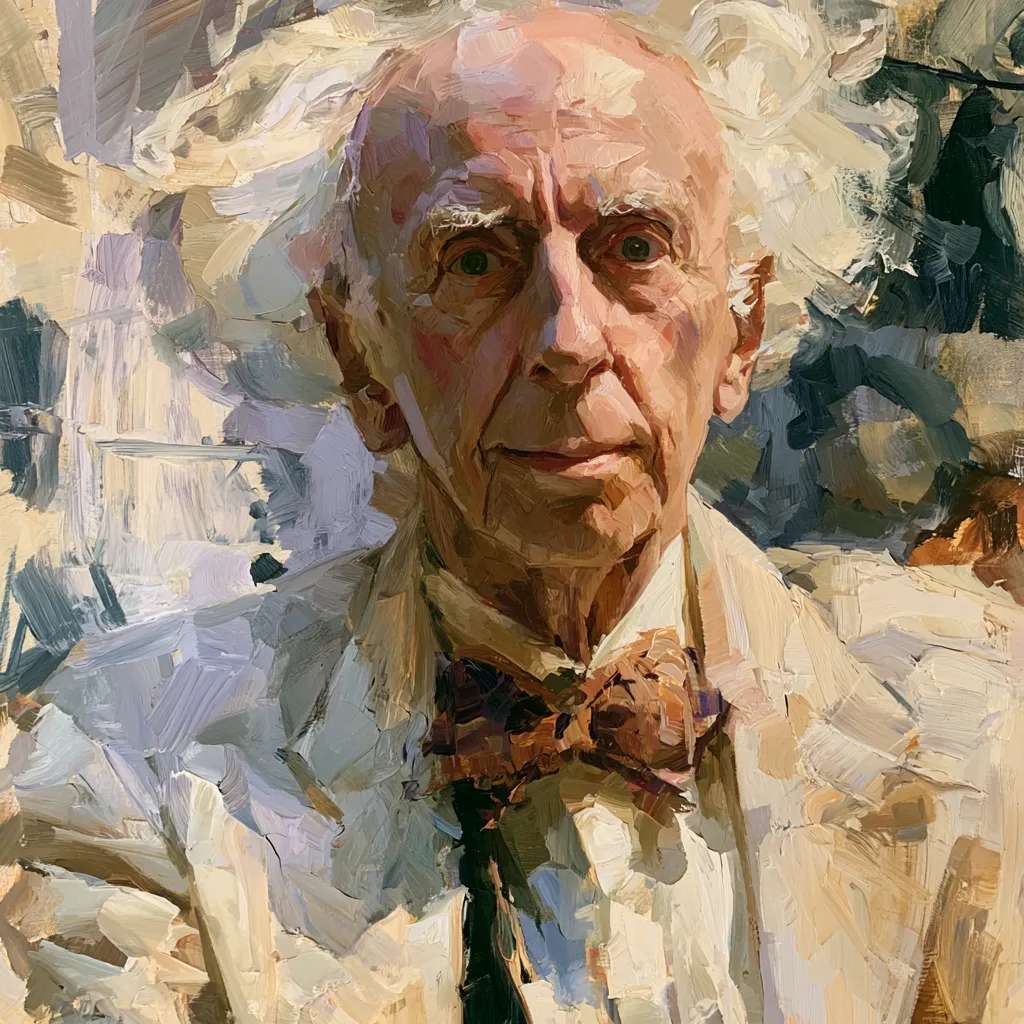
Who was James Watson?
James Dewey Watson (April 6, 1928 – November 6, 2025) was an American molecular biologist who, alongside Francis Crick, proposed the double helix structure of DNA in 1953, a discovery built significantly on X-ray diffraction data gathered by Rosalind Franklin. Watson shared the 1962 Nobel Prize in Physiology or Medicine with Crick and Maurice Wilkins for this work.
American molecular biologist who, with Francis Crick, discovered the double helix structure of DNA, revolutionizing our understanding of genetics and heredity.
Don't stop at the facts — continue James Watson's story in free narrated chapters on Chunks.
Or get it straight away:
 Download on iOS
 Download on Android
Quick facts
- Born
- 6 April 1928
- Birthplace
- Chicago
- Died
- 6 November 2025
- Place of death
- East Northport
- Nationality
- United States
- Occupation
- Biologist, geneticist, zoologist
James Watson: key facts
- James Watson was born in Chicago on April 6, 1928, and died in East Northport, New York, on November 6, 2025, at the age of 97.
- In April 1953, Watson and Francis Crick published a landmark paper in Nature proposing the double helix structure of DNA, building on X-ray diffraction data collected by Rosalind Franklin and Raymond Gosling.
- Watson, Crick, and Maurice Wilkins were awarded the Nobel Prize in Physiology or Medicine in 1962 for their discoveries concerning the molecular structure of nucleic acids.
- Watson earned a Bachelor of Science in zoology from the University of Chicago in 1947 and a doctorate from Indiana University Bloomington in 1950, with Salvador Luria as his doctoral advisor.
- From 1968, Watson served as director of Cold Spring Harbor Laboratory in Laurel Hollow, New York, transforming it into a world-leading center for molecular biology and cancer research.
- Between 1988 and 1992, Watson was associated with the National Institutes of Health and helped establish the Human Genome Project, which completed the mapping of the human genome in 2003.
- Watson wrote the bestselling memoir The Double Helix in 1968, ranked seventh on the Modern Library list of 100 Best Nonfiction books, detailing the discovery of the DNA structure and the personalities involved.
From Chicago Birdwatcher to DNA Pioneer
James Dewey Watson was born in Chicago on April 6, 1928, and grew up on the city's South Side with an early passion for bird watching, a hobby he shared with his father. He was bright enough to appear on Quiz Kids, a popular radio programme that tested young contestants, and enrolled at the University of Chicago on a tuition scholarship at just 15 years old. Reading Erwin Schrödinger's book What Is Life? in 1946 redirected his ambitions entirely, pulling him away from ornithology and toward the molecular basis of heredity.
Watson earned his zoology degree from Chicago in 1947 and moved to Indiana University, where he was drawn by the presence of Nobel laureate Hermann Joseph Muller. Under the supervision of Salvador Luria, Watson completed his doctorate in 1950. Luria was part of the Phage Group, a network of researchers using viruses that infect bacteria to study the nature of genes, and Watson absorbed that group's conviction that the physical structure of the genetic molecule was the central unsolved problem in biology.
Cambridge, the Cavendish, and the Race for the Double Helix
After a postdoctoral year in Copenhagen that failed to satisfy his growing interest in DNA structure, Watson arrived at the Cavendish Laboratory in Cambridge, England, in 1951. There he met Francis Crick, and the two quickly aligned around the goal of determining DNA's molecular architecture. Their approach combined X-ray crystallography data, molecular model building, and close attention to results being generated by other laboratories, particularly King's College London.
The critical data came largely from Rosalind Franklin and her student Raymond Gosling at King's College. Franklin's high-quality X-ray diffraction images revealed the water content of DNA crystals and indicated that the sugar-phosphate backbones of the molecule belonged on the outside. She also determined the space group of DNA crystals, which told Crick that the two strands ran in opposite directions. Watson and Crick had access to her unpublished results through her 1951 seminar, through conversations with Maurice Wilkins, and through a Medical Research Council progress report. Franklin was not informed that her data was being used.
In mid-March 1953, Watson and Crick completed their model of the double helix. Their paper, 'Molecular Structure of Nucleic Acids: A Structure for Deoxyribose Nucleic Acid,' appeared in the journal Nature on April 25, 1953. Franklin and Gosling published their own supporting paper in the same issue. In 1962, Watson, Crick, and Wilkins received the Nobel Prize in Physiology or Medicine for the discovery. Franklin had died in 1958 and was therefore ineligible for nomination.
Building Institutions: Harvard and Cold Spring Harbor Laboratory
Watson joined the biology faculty at Harvard University in 1956, where he focused on RNA and its role in transferring genetic information. He remained on the Harvard faculty until 1976, though his attention increasingly shifted elsewhere. In 1968, the same year he published his memoir The Double Helix, he was appointed director of the Cold Spring Harbor Laboratory in Laurel Hollow, New York, a small facility he would transform into one of the world's leading centres for molecular biology and cancer research.
At Cold Spring Harbor, Watson redirected the laboratory's emphasis toward understanding the genetic basis of cancer and dramatically expanded both its funding and its research programs. He served as director, then president from 1994, and later chancellor. Between 1988 and 1992, he also helped establish the Human Genome Project at the National Institutes of Health, advocating that the human genome should belong to the world rather than to private patent holders. He resigned from the Genome Project in 1992 after conflicts with NIH Director Bernadine Healy over the patenting of gene sequences. Francis Collins took over the project, which completed the mapping of the human genome in 2003.
The Double Helix and the Question of Credit
Watson's 1968 book The Double Helix presented a personal, candid account of the discovery and quickly became a bestseller, ranked seventh on the Modern Library's list of the 100 best nonfiction books. The book generated immediate controversy. Francis Crick and Maurice Wilkins objected strongly enough that Harvard University Press dropped the project, and it was published commercially instead. Crick reportedly described the book as a contemptible account of events.
Watson's portrayal of Rosalind Franklin drew particular criticism. He referred to her dismissively throughout, gave the impression she was Wilkins' assistant rather than an independent scientist, and suggested she was unable to interpret her own data. The accusation was especially difficult to defend given that Franklin had correctly told Watson and Crick that the helical backbones had to be on the outside of the molecule. Watson himself acknowledged in the book that Franklin had not given her data directly to him and that no one at King's College had known it was in their possession. In a 1954 paper, Watson and Crick had written that without Franklin's data the formulation of their structure would have been most unlikely, if not impossible.
Controversy, Disgrace, and a Long Reckoning
Throughout his career, Watson made a series of public statements that proved deeply damaging to his reputation. He repeatedly asserted that differences in average measured IQ between Black and white populations were genetic in origin, and made similar claims linking skin colour to libido and ethnicity to specific cognitive traits. In October 2007, following an interview in which he discussed his views on African intelligence, Cold Spring Harbor Laboratory suspended his administrative responsibilities. Watson retired shortly afterward, and the laboratory described his nearly 40 years of service as distinguished even as it distanced itself from his remarks.
In January 2019, after a television documentary in which Watson again repeated his views on race and genetics, Cold Spring Harbor Laboratory revoked all honorary titles it had awarded him and severed all remaining ties. Watson did not publicly respond. In 2014, he had auctioned his Nobel Prize medal at Christie's for 4.1 million US dollars, citing his sense of having been made an outcast following the earlier controversy. The buyer, Alisher Usmanov, later returned the medal to Watson.
Watson died in East Northport, New York, on November 6, 2025, at the age of 97. The New York Times called him one of the most important scientists of the twentieth century while acknowledging the deep controversy surrounding his racial views. The BBC noted that his work on DNA opened the door to understanding how DNA replicates and carries genetic information and set the stage for rapid advances in molecular biology.
James Watson: timeline
- 1928Born in Chicago, Illinois, the only son of Jean and James D. Watson.
- 1947Earned a Bachelor of Science degree in zoology from the University of Chicago after enrolling on a scholarship at age 15.
- 1950Received his doctorate from Indiana University Bloomington under the supervision of Salvador Luria.
- 1951Began working at the University of Cambridge's Cavendish Laboratory, where he met Francis Crick and began their collaboration on the structure of DNA.
- 1953Co-authored a paper with Crick in Nature proposing the double helix structure of DNA, building critically on X-ray diffraction data gathered by Rosalind Franklin and Raymond Gosling.
- 1956Joined the faculty of Harvard University's biology department, where he focused research on RNA and its role in genetic information transfer.
- 1962Shared the Nobel Prize in Physiology or Medicine with Francis Crick and Maurice Wilkins for discoveries concerning the molecular structure of nucleic acids.
- 1968Appointed director of Cold Spring Harbor Laboratory and published The Double Helix, his bestselling personal account of the discovery of the DNA structure.
- 1990Appointed head of the Human Genome Project at the National Institutes of Health, a position he held until 1992.
- 2007Resigned as chancellor of Cold Spring Harbor Laboratory after making controversial public remarks claiming a genetic link between race and intelligence.
- 2019Cold Spring Harbor Laboratory revoked all honorary titles and severed all ties with Watson after he reiterated his views on race and genetics in a television documentary.
- 2025Died in East Northport, New York, at age 97, following treatment for an infection.
Listen: stories featuring James Watson
Narrated chapters from the Chunks Microlearning app. Read a preview here, or listen to the full story in the app.
Continue James Watson's story
You've read the summary — hear the full story as narrated 5-minute chapters on Chunks, alongside 200+ figures and events from history, philosophy and science. Free to start on iOS and Android.