
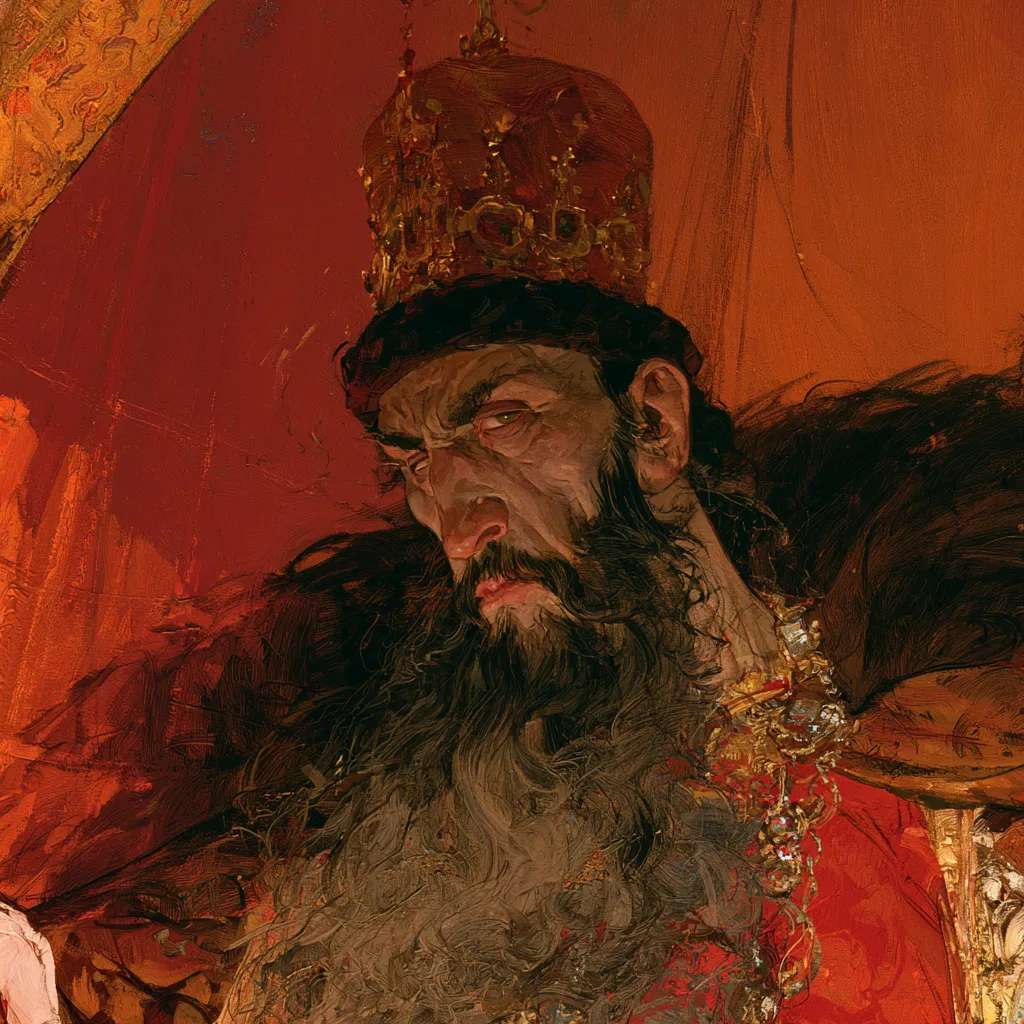
Who was Ivan the Terrible?
Ivan IV Vasilyevich (25 August 1530 - 18 March 1584), known as Ivan the Terrible, was Grand Prince of Moscow from 1533 and became the first Tsar of Russia in 1547, ruling until his death. He conquered the khanates of Kazan and Astrakhan, expanding Russian territory, but his later reign was marked by the violent oprichnina purges, the massacre of Novgorod, and increasing instability and paranoia.
Ivan IV, known as Ivan the Terrible, was the first Tsar of Russia, ruling from 1547 to 1584. He expanded Russian territory dramatically but is also remembered for his brutal purges and erratic later reign.
Don't stop at the facts — continue Ivan the Terrible's story in free narrated chapters on Chunks.
Or get it straight away:
 Download on iOS
 Download on Android
Quick facts
- Born
- 25 August 1530
- Birthplace
- Kolomenskoye
- Died
- 18 March 1584
- Place of death
- Moscow
- Nationality
- Grand Principality of Moscow, Tsardom of Russia
- Occupation
- Politician, raspevschik
Ivan the Terrible: key facts
- Ivan IV was born on 25 August 1530 and became Grand Prince of Moscow in 1533 at just three years old after his father Vasili III died.
- On 16 January 1547, at age sixteen, Ivan was crowned in the Cathedral of the Dormition in the Moscow Kremlin, becoming the first Russian ruler to hold the title of Tsar.
- During the 1550s Ivan conquered the Khanate of Kazan in 1552 and the Khanate of Astrakhan by 1556, bringing the entire Volga River under Russian control.
- In 1565 Ivan created the oprichnina, a separate territory ruled directly by him and enforced by his personal guard, the oprichniki, to crush boyar opposition.
- In 1570 the oprichniki sacked the city of Novgorod amid suspicions of treason, killing thousands of its inhabitants.
- Ivan launched the Livonian War in 1558 to gain access to the Baltic Sea, a 24-year conflict that ended in 1583 with Russia losing ground to Sweden and the Polish-Lithuanian Commonwealth.
- Ivan died of a stroke on 18 March 1584 while playing chess in Moscow, and was succeeded by his son Feodor I.
A Childhood Marked by Neglect and Boyar Rivalry
Ivan Vasilyevich was born on 25 August 1530 at Kolomenskoye, the first son of Grand Prince Vasili III and his second wife, Elena Glinskaya. His mother's family claimed descent from Orthodox Hungarian nobles and the Mongol ruler Mamai, while his grandmother Sophia Palaiologina had been a Byzantine princess. Ivan was only three years old when his father died from blood poisoning caused by an abscess on his leg, leaving the toddler as Grand Prince of Moscow with his mother acting as regent.
Elena Glinskaya died in 1538, when Ivan was eight, and many at the time believed she had been poisoned. With no strong regent left, power passed between feuding boyar families, particularly the Shuisky and Belsky clans, who fought bitterly for control of the young ruler. Ivan later wrote to his former adviser Andrey Kurbsky that he and his younger brother Yuri had been raised like paupers, lacking food and clothing despite their royal status, though some historians have questioned the reliability of this account.
Crowning as Tsar and a Decade of Reform
On 16 January 1547, at age sixteen, Ivan was crowned in the Cathedral of the Dormition in the Moscow Kremlin, becoming the first Russian ruler to take the title of tsar rather than grand prince. The new title deliberately echoed the authority of the former Byzantine emperors and the Tatar khans, elevating Ivan's status both at home and among foreign monarchs. Two weeks later he married Anastasia Romanovna, who became the first Russian tsaritsa and bore him several children, though only two sons survived into adulthood.
In the years following his coronation, Ivan governed alongside a group of advisers known as the Chosen Council. Together they issued a revised legal code, the Sudebnik of 1550, created Russia's first standing army, the streltsy, and convened the Zemsky Sobor, an assembly of feudal estates considered Russia's first parliament. Ivan also strengthened the Orthodox Church through the Council of the Hundred Chapters in 1551 and brought the first printing press to Russia in 1553, though the new technology provoked opposition from traditional scribes and the original print shop was eventually destroyed by arson.
Seizing the Volga: Kazan and Astrakhan
Since Ivan's childhood, the Khanate of Kazan had repeatedly raided northeastern Russia, and the Crimean Khanate had allied with Kazan to counter Moscow's growing strength. After earlier campaigns failed to secure lasting control, Ivan personally led a large army to Kazan in the summer of 1552. Russian forces, using battering rams, a siege tower, and around 150 cannons, cut off the city's water supply and breached its walls, and Kazan fell on 2 October 1552 after fierce fighting. Ivan commemorated the victory with several new churches in Moscow, most famously Saint Basil's Cathedral on Red Square.
Following the fall of Kazan, resistance continued among the Mari and other peoples of the middle Volga in what became known as the Cheremis Wars, which were not fully suppressed until 1557. Russian troops went on to conquer the Astrakhan Khanate in campaigns during 1554 and 1556, bringing the entire length of the Volga River under Russian control and transforming Muscovy from a regional principality into a multi-ethnic empire with access to major trade routes.
The Oprichnina and the Destruction of Novgorod
The 1560s brought famine, military setbacks, and a naval blockade that isolated Russia from Baltic trade. The death of Anastasia in 1560, which some contemporaries blamed on poisoning, appears to have worsened Ivan's temperament, and the defection of his adviser Andrey Kurbsky to Lithuania deepened his suspicion of the nobility. In December 1564 Ivan abruptly left Moscow and threatened to abdicate, accusing the boyars and clergy of treason. When a delegation begged him to return, he agreed only on condition of being granted unchecked power to punish traitors, leading to the creation of the oprichnina, a separate territory under his direct personal rule enforced by a corps of agents called the oprichniki.
The oprichniki targeted princely families, executed or exiled prominent boyars including Metropolitan Philip, and seized peasant property so aggressively that grain prices rose roughly tenfold, driving many peasants to flee their land. In 1570, suspecting that Novgorod's nobles intended to defect to Lithuania, Ivan sent the oprichniki to sack the city. Thousands of residents were tortured, drowned in the Volkhov River, or killed outright over several weeks, and Novgorod never recovered its former importance. After the oprichniki performed poorly against Tatar and Ottoman forces in the early 1570s, Ivan formally abolished the institution in 1572.
War, a Fatal Blow to His Son, and Death
In 1558 Ivan launched the Livonian War to gain access to the Baltic Sea, a conflict that dragged on for twenty-four years and drew in Sweden, Lithuania, Poland, and the Teutonic Knights. The war drained Russia's economy, and by the late 1570s Ivan faced a skilled new adversary in Stephen Bathory of the Polish-Lithuanian Commonwealth, who captured Polotsk, Velikiye Luki, and besieged Pskov. The war ended in 1583 with truces that stripped Russia of its Baltic ambitions. Compounding these losses, Crimean Tatars burned much of Moscow in 1571, though a Russian army under Prince Mikhail Vorotynsky decisively defeated a renewed Tatar invasion at Molodi the following year.
In November 1581, Ivan struck his eldest son and heir, Ivan Ivanovich, during a quarrel over the younger man's pregnant wife, delivering a fatal blow with his staff; the shock also caused her to miscarry. This left Ivan's younger, politically weak son Feodor as heir. Ivan himself died of a stroke on 18 March 1584 in Moscow while playing chess, and was buried at the Cathedral of the Archangel. Feodor's childless death in 1598 ended the Rurik dynasty and opened the way to the Time of Troubles.
Ivan the Terrible: timeline
- 1530Born at Kolomenskoye as the eldest son of Vasili III and Elena Glinskaya.
- 1533Became Grand Prince of Moscow at age three following his father's death, with his mother acting as regent.
- 1547Crowned at the Cathedral of the Dormition, becoming the first ruler to be titled Tsar of all Russia.
- 1547Married Anastasia Romanovna two weeks after his coronation, making her the first Russian tsaritsa.
- 1552Led the Russian army in the successful siege and capture of Kazan, ending the Kazan Khanate.
- 1554-56Russian forces conquered the Astrakhan Khanate, bringing the whole length of the Volga River under Russian control.
- 1558Launched the Livonian War in an attempt to win access to the Baltic Sea, beginning a conflict that would last 24 years.
- 1560His first wife, Anastasia, died, a loss widely believed to have worsened his temperament and mental state.
- 1564Left Moscow for Aleksandrova Sloboda and threatened abdication, then returned demanding absolute power, leading to the creation of the oprichnina.
- 1570Ordered the oprichniki to sack Novgorod on suspicion of treason, resulting in a massacre of thousands of its inhabitants.
- 1571Crimean Tatar forces under Devlet I Giray burned much of Moscow after Russian defenses, weakened by the Livonian War, failed to stop the raid.
- 1581Fatally struck his eldest son and heir, Ivan Ivanovich, in a fit of rage during an argument, also causing his daughter-in-law's miscarriage.
- 1584Died of a stroke while playing chess in Moscow, leaving the throne to his ineffectual younger son Feodor.
Listen: stories featuring Ivan the Terrible
Narrated chapters from the Chunks Microlearning app. Read a preview here, or listen to the full story in the app.
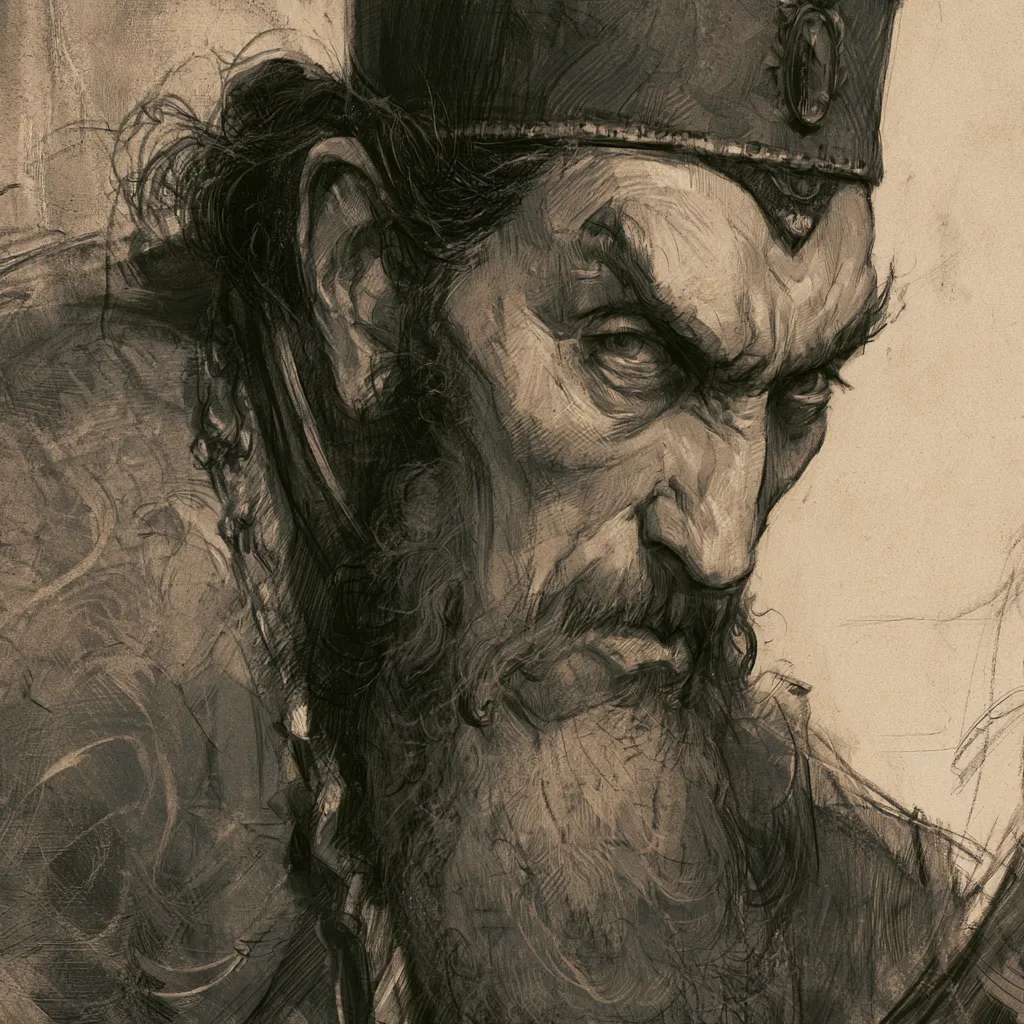
Frequently asked questions about Ivan the Terrible
Who was Ivan the Terrible?
Ivan the Terrible, born Ivan IV, was the first Tsar of Russia, reigning from 1547 to 1584. He centralized Russian power and greatly expanded the territory of the Russian state.
Why is Ivan the Terrible remembered as brutal?
Ivan the Terrible earned his fearsome reputation through violent purges of the nobility, known as the Oprichnina, which involved mass executions and terror tactics. His later reign was marked by paranoia and increasingly erratic, violent behavior.
What did Ivan the Terrible accomplish as ruler?
Ivan the Terrible transformed Russia by taking the title of Tsar and significantly expanding its territory through military conquests, including the capture of Kazan and Astrakhan. He also reformed legal codes and centralized government administration.
Continue Ivan the Terrible's story
You've read the summary — hear the full story as narrated 5-minute chapters on Chunks, alongside 200+ figures and events from history, philosophy and science. Free to start on iOS and Android.