
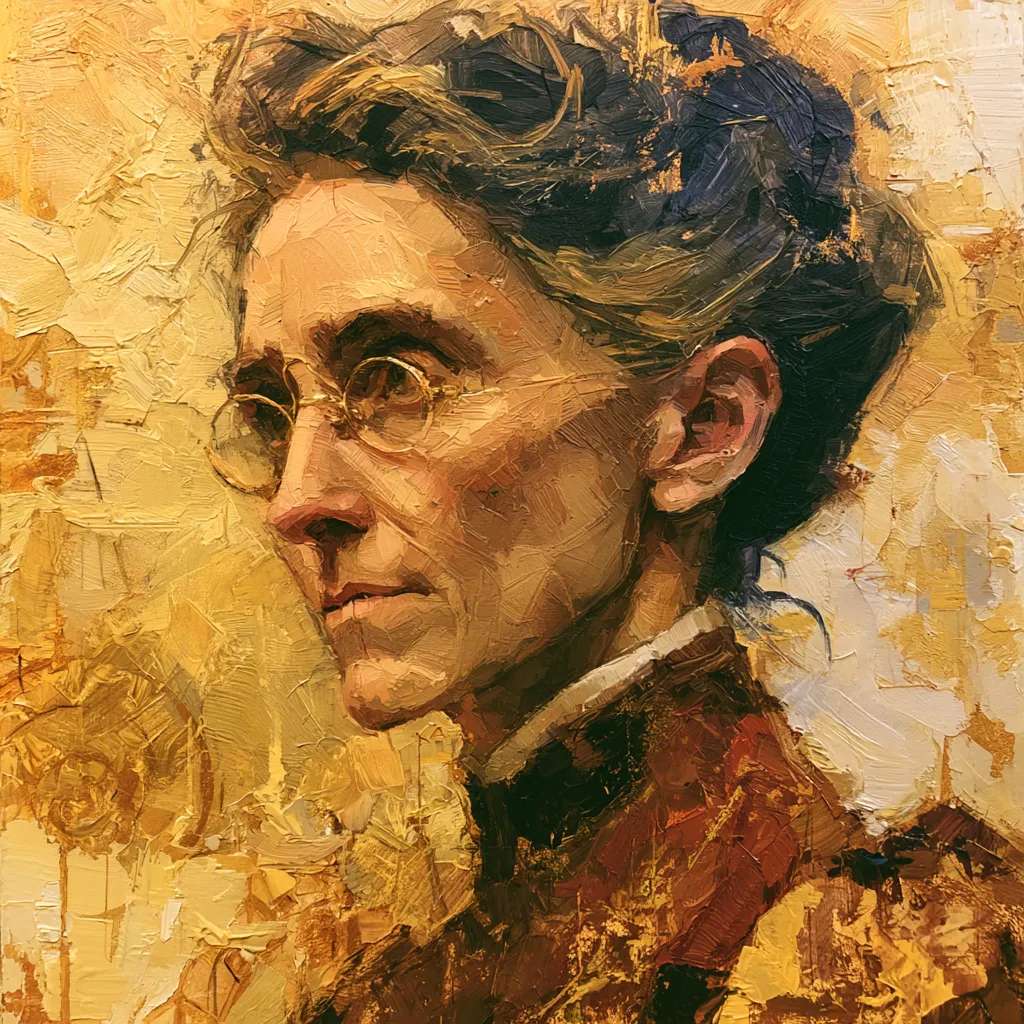
Who was Henrietta Leavitt?
Henrietta Swan Leavitt (July 4, 1868 – December 12, 1921) was an American astronomer who discovered that Cepheid variable stars follow a precise relationship between their period and luminosity, giving astronomers their first reliable method for measuring vast cosmic distances. Working at the Harvard College Observatory, her finding enabled Edwin Hubble to prove that galaxies exist beyond the Milky Way.
Harvard astronomer who discovered the period-luminosity relationship of Cepheid variable stars, providing astronomers with the first reliable 'cosmic yardstick' to measure distances in the universe.
Don't stop at the facts — continue Henrietta Leavitt's story in free narrated chapters on Chunks.
Or get it straight away:
 Download on iOS
 Download on Android
Quick facts
- Born
- 4 July 1868
- Birthplace
- Lancaster
- Died
- 12 December 1921
- Place of death
- Cambridge
- Nationality
- United States
- Occupation
- Astronomer
Henrietta Leavitt: key facts
- Henrietta Swan Leavitt was born on July 4, 1868, in Lancaster, Massachusetts, and died on December 12, 1921, at age 53 from stomach cancer.
- Leavitt worked at the Harvard College Observatory as a human computer, hired in 1902 by director Edward Charles Pickering to measure and catalog the brightness of stars on photographic plates.
- In a 1912 paper, Leavitt analyzed 25 Cepheid variable stars in the Small Magellanic Cloud and established that a straight-line relationship exists between a star's period and its brightness, a finding now called Leavitt's Law.
- Leavitt's key insight was that all stars in the Small Magellanic Cloud lie at roughly the same distance from Earth, meaning differences in their apparent brightness reflected true differences in intrinsic luminosity.
- Edwin Hubble used Leavitt's Law in 1923–24 to calculate that Cepheids detected in the Andromeda Nebula were far too distant to be part of the Milky Way, confirming that separate galaxies exist beyond our own.
- Leavitt developed the Harvard Standard for photographic measurements, a logarithmic scale ordering stars by brightness greater than 17 magnitudes, which was accepted by the International Committee of Photographic Magnitudes in 1913.
- Mathematician Gösta Mittag-Leffler attempted to nominate Leavitt for the Nobel Prize in 1924, but learned she had already died three years earlier, and the Nobel Prize cannot be awarded posthumously.
From Lancaster to Harvard: Education and Early Career
Henrietta Swan Leavitt was born on July 4, 1868, in Lancaster, Massachusetts, the daughter of a Congregational minister. She attended Oberlin College for two years before transferring to Harvard University's Society for the Collegiate Instruction of Women, later known as Radcliffe College, where she earned a bachelor's degree in 1892. Her studies ranged widely, covering classical Greek, fine arts, philosophy, analytic geometry, and calculus. Astronomy came to her attention only in her fourth year, when she took a single course in the subject and earned an A− grade.
After graduating, Leavitt began volunteering as a human computer at the Harvard College Observatory, performing the painstaking work of measuring photographic plates to catalog star positions and brightness. She left for a period that included trips to Europe and a stint as an art assistant at Beloit College in Wisconsin, during which she contracted an illness that caused progressive hearing loss, eventually leaving her deaf. She returned to the observatory permanently in 1903, and in 1902 director Edward Charles Pickering had formally hired her at thirty cents an hour — work that demanded precision but offered little pay and no access to the telescopes, which women at the observatory were barred from operating.
Studying the Magellanic Clouds: The Discovery That Changed Astronomy
Pickering assigned Leavitt to study variable stars in the Small and Large Magellanic Clouds, using photographic plates taken with the Bruce Astrograph at the Harvard Observatory's station in Arequipa, Peru. She identified 1,777 variable stars across those two bodies and published initial findings in 1908, noting that the brighter variables among them tended to have longer periods — the time they take to complete one cycle of brightening and dimming.
In a 1912 paper, Leavitt focused on 25 Cepheid variable stars in the Small Magellanic Cloud and plotted their brightness against the logarithm of their period. The result was a straight line, establishing what she described as a simple, direct relationship between a Cepheid's brightness and its period. The key insight was that because all the stars in the Small Magellanic Cloud are roughly the same distance from Earth, differences in their apparent brightness on photographic plates genuinely reflected differences in their intrinsic luminosity. The paper was signed by Pickering but explicitly noted as prepared by Leavitt.
Leavitt observed that a five-day Cepheid variable in the Small Magellanic Cloud was about one ten-thousandth as bright as Delta Cephei, a nearby five-day Cepheid. Applying the inverse-square law, she calculated that the Small Magellanic Cloud was about 100 times farther away than Delta Cephei. Once other astronomers measured the distances to nearby Cepheids through stellar parallax — something Leavitt herself had anticipated would be necessary — her period-luminosity scale became a fully calibrated measuring tool, capable of yielding distances far beyond the reach of any previous technique.
The Cosmic Yardstick: How Leavitt's Law Reshaped the Universe
Before Leavitt's discovery, the only reliable method for measuring stellar distances was stellar parallax, a technique limited to stars within a few hundred light-years of Earth. Leavitt's period-luminosity relationship — now called Leavitt's Law — extended the astronomer's reach to distances measured in millions of light-years. One year after her results appeared, Ejnar Hertzsprung used Milky Way Cepheids to calibrate the scale, allowing any Cepheid's distance to be calculated from its period alone.
Edwin Hubble put Leavitt's Law to decisive use in the early 1920s when he detected Cepheid variables in the Andromeda Nebula and several other nebulae. The distances he calculated placed them far outside the Milky Way, confirming they were separate galaxies entirely. This resolved astronomy's Great Debate over the scale of the universe. Hubble later combined Leavitt's distance measurements with observations of galactic redshifts to establish that the universe is expanding — a finding that defined cosmology for the twentieth century and beyond. Cepheid variables, as a result of Leavitt's work, allow astronomers to measure distances out to roughly 60 million light-years.
Other Contributions: The Harvard Standard and Further Discoveries
Leavitt's work extended beyond Cepheids. She developed the Harvard Standard for photographic measurements, a logarithmic scale ordering stars by brightness across more than 17 magnitudes. Constructing it required analyzing 299 photographic plates taken through 13 different telescopes. The International Committee of Photographic Magnitudes accepted the scale in 1913, making it a standard reference for astronomers worldwide.
In 1913, Leavitt also identified T Pyxidis, a recurrent nova in the constellation Pyxis. It is among the most frequently erupting recurrent novae known, with outbursts observed in 1890, 1902, 1920, 1944, 1967, and 2011. In 1921, when Harlow Shapley became director of the Harvard College Observatory, he appointed Leavitt head of stellar photometry, a recognition of her standing within the institution.
Death, Recognition, and a Missed Nobel Prize
Leavitt died on December 12, 1921, at the age of 53, from stomach cancer. Her colleagues mourned not only the loss of her scientific contributions but the person herself. Fellow Harvard astronomer Solon I. Bailey wrote that she possessed a nature so full of sunshine that all of life became beautiful and full of meaning to her. She was buried in the Leavitt family plot at Cambridge Cemetery in Cambridge, Massachusetts, where a tall hexagonal monument marks the site.
Hubble reportedly said that Leavitt deserved the Nobel Prize for her discovery. In 1924, the Swedish mathematician Gösta Mittag-Leffler attempted to nominate her for the prize, only to learn she had been dead for three years. The Nobel Prize is not awarded posthumously, so the nomination could not proceed. The asteroid 5383 Leavitt and a crater on the Moon both bear her name, honors designated to recognize deaf men and women who have contributed to astronomy — a fitting tribute given that Leavitt herself had worked through progressive deafness for much of her career.
Henrietta Leavitt: timeline
- 1868Born in Lancaster, Massachusetts, the daughter of Congregational minister George Roswell Leavitt.
- 1892Received a bachelor's degree from the Society for the Collegiate Instruction of Women (later Radcliffe College) after studying classics, fine arts, philosophy, and mathematics.
- 1898Became a formal member of the Harvard College Observatory staff after earlier volunteer work as a human computer.
- 1903Returned to the Harvard College Observatory after travels to Europe and a stint as an art assistant at Beloit College, during which she developed progressive hearing loss.
- 1908Published findings in the Annals of the Astronomical Observatory of Harvard College identifying 1,777 variable stars in the Magellanic Clouds and noting that brighter variables had longer periods.
- 1913Developed the Harvard Standard for photographic measurements, a brightness scale spanning more than 17 magnitudes, accepted by the International Committee of Photographic Magnitudes.
- 1921Appointed head of stellar photometry when Harlow Shapley became observatory director, then died of cancer later that year.
- 1921Died at the age of 53; her period-luminosity law would go on to enable Hubble's proof that galaxies exist beyond the Milky Way.
Listen: stories featuring Henrietta Leavitt
Narrated chapters from the Chunks Microlearning app. Read a preview here, or listen to the full story in the app.
Continue Henrietta Leavitt's story
You've read the summary — hear the full story as narrated 5-minute chapters on Chunks, alongside 200+ figures and events from history, philosophy and science. Free to start on iOS and Android.