
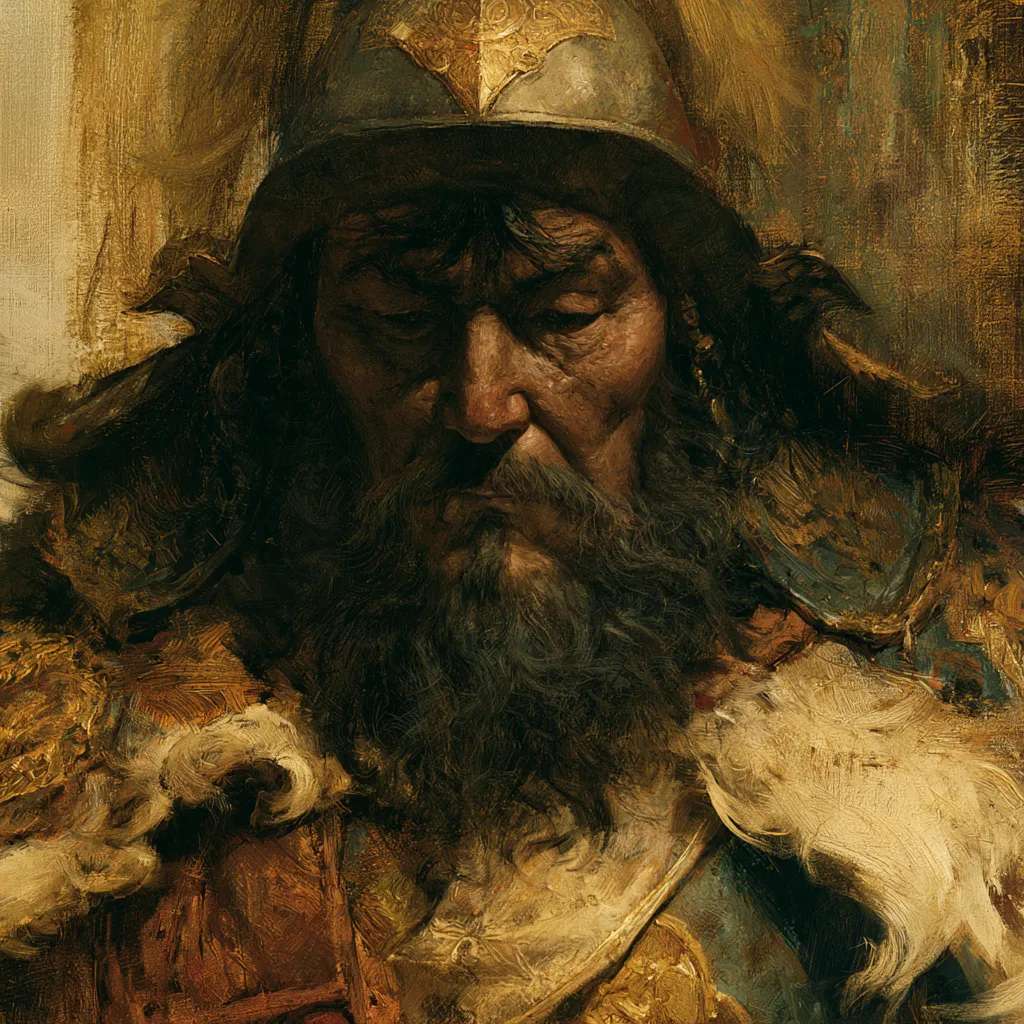
Who was Genghis Khan?
Genghis Khan (born Temüjin, c. 1162 – 18 or 25 August 1227) was a Mongol ruler who founded and led the Mongol Empire, the largest contiguous land empire in history. After uniting the Mongol tribes, he conquered large parts of China and Central Asia. His campaigns were brutal, yet his empire enabled unprecedented trade and cultural exchange across Eurasia.
Mongol emperor who created the largest contiguous land empire in history, connecting East and West through conquest, trade, and cultural exchange.
Don't stop at the facts — continue Genghis Khan's story in free narrated chapters on Chunks.
Or get it straight away:
 Download on iOS
 Download on Android
Quick facts
- Born
- 31 May 1162
- Birthplace
- Delüün Boldog
- Died
- 25 August 1227
- Place of death
- Yinchuan
- Nationality
- Mongol Empire
- Occupation
- Military leader, traditional leader or chief, monarch
Genghis Khan: key facts
- Temüjin was born around 1162 near the Onon River at Delüün Boldog and took the title Genghis Khan at a formal assembly called a kurultai held at the source of the Onon in 1206.
- After Mongol merchants travelling to the Khwarazmian Empire were massacred on the orders of the governor of Otrar, Genghis Khan launched a full invasion of the Khwarazmian Empire in 1219, toppling the state and devastating Transoxiana and Khorasan.
- Genghis Khan captured the Jin dynasty capital Zhongdu, present-day Beijing, in 1215 after a campaign against the Jin that began in 1211.
- Genghis died on either 18 or 25 August 1227 while subduing the rebellious Western Xia, and his death was kept secret until the Xia capital Zhongxing fell the following month.
- The Mongol army was reorganised into a decimal system of units of tens, hundreds, and thousands, with commanders appointed by merit and loyalty rather than tribal birth.
- Genghis Khan's third son Ögedei was chosen as his successor and acceded to the throne in 1229 following a two-year interregnum after Genghis's death.
- Genghis Khan was posthumously given the temple name Taizu, meaning Supreme Progenitor, when his grandson Kublai Khan established the Yuan dynasty in 1271.
From Abandoned Child to Ruler of the Steppe
Temüjin, who would become Genghis Khan, was born at Delüün Boldog on the Onon River, most likely around 1162, though historians have also proposed 1155 and 1167 as possibilities. He was the eldest son of Yesügei, a chieftain of the Borjigin clan, and his wife Hö'elün. When Temüjin was around eight years old, his father died after being poisoned by Tatar enemies, and the clan promptly abandoned the family, leaving them to survive by hunting, fishing, and foraging. In this precarious state, tensions over leadership and resources led Temüjin and his brother Qasar to kill their older half-brother Behter — an act the Secret History of the Mongols records with evident disapproval.
From this low point, Temüjin demonstrated a remarkable ability to attract loyal followers. A boy named Bo'orchu helped him recover stolen horses and became his first personal companion. Temüjin also forged a blood-brotherhood with Jamukha, a fellow aristocrat, and later sought the protection of Toghrul, the powerful khan of the Kerait tribe, by gifting him a sable cloak. When Merkits raided his camp and abducted his new wife Börte, Temüjin called on both Toghrul and Jamukha, who each fielded armies of 20,000 warriors. The campaign succeeded and Börte was recovered, though the son she soon bore, Jochi, carried a cloud of doubt over his paternity for the rest of his life.
Civil War, Defeat, and the Road to Sole Power
As Temüjin's reputation grew, his alliance with Jamukha collapsed into open warfare. Around 1187, the two clashed at Dalan Baljut and Temüjin suffered a clear defeat. Modern historians believe he may then have spent years in the service of the Jurchen Jin dynasty in northern China — the Song diplomat Zhao Hong recorded that he served as a slave of the Jin, and the absence of any other convincing explanation for his activities during this period lends the claim credibility. Because such vassalage would have been an embarrassment to Mongol pride, no Mongol source mentions it.
When Temüjin reemerged around 1196 he moved quickly. He fought alongside the Jin against the Tatars, absorbed disaffected tribal followers, and steadily reduced the power of his rivals. By 1202 he had destroyed the Tatars, and the following year his old patron Toghrul turned against him. Temüjin was badly defeated at the Battle of Qalaqaljid Sands and retreated to a place called Baljuna, where he swore a famous oath of loyalty with a small, mixed group of followers from nine different tribes. This Baljuna Covenant became a founding symbol of his later empire. He regrouped, ambushed and defeated the Kereit, and in 1204 crushed the Naiman tribe. Jamukha, betrayed by his own companions, was executed — according to the Secret History, at his own request, so that he might die honourably.
The 1206 Kurultai and the Reinvention of Mongol Society
In 1206, Temüjin convened a great assembly at the source of the Onon River and formally adopted the title Genghis Khan, the precise meaning of which remains debated. Proposed interpretations range from connotations of strength and firmness to a connection with the Turkic word for ocean, implying a claim to universal rulership. Whatever the title meant, what followed was a sweeping transformation of Mongol society. Genghis dismantled the old tribal structure and reorganised every male between fifteen and seventy into military units of tens, hundreds, and thousands. Warriors from defeated tribes were dispersed across different units to prevent them from rebelling as a cohesive group, replacing old clan loyalties with loyalty to the state and to commanders chosen on merit.
The reforms extended to Genghis's personal bodyguard, the keshig, which was expanded from around a thousand men to ten thousand. It functioned simultaneously as a household staff, a military academy, and the centre of government administration. Commanders including Subutai began their careers within it. Genghis also moved against a powerful shaman named Kokechu, who had been using spiritual influence to divide the imperial family and humiliate Genghis's brothers. After allowing his youngest brother Temüge to arrange Kokechu's death, Genghis assumed the shaman's role as the Mongols' highest spiritual authority, reinforcing his claim that the supreme deity Tengri had destined him for greatness.
Conquest from China to Central Asia
Genghis began his external campaigns with raids on the Western Xia, a Tangut-led kingdom to the south. After a full-scale invasion in 1209, including a failed attempt to flood the capital by diverting the Yellow River, the Xia submitted and paid tribute. Genghis then turned to the much larger Jin dynasty in northern China. A four-year campaign ended in 1215 with the capture and sacking of the Jin capital Zhongdu, modern-day Beijing. His general Jebe annexed the Central Asian state of Qara Khitai in 1218, completing Mongol control of the eastern Silk Road.
The invasion of the Khwarazmian Empire, which controlled much of Central Asia, Persia, and Afghanistan, began in 1219 after the Khwarazmian governor of Otrar massacred a Mongol trade caravan and the Khwarazmian ruler Muhammad II executed a Mongol ambassador. Genghis responded with one of the most devastating campaigns in recorded history. Cities including Bukhara and Samarkand fell in quick succession. Tolui, Genghis's youngest son, conducted a brutal campaign through Khorasan in which Nishapur, Merv, and Herat were all destroyed. Meanwhile, the generals Jebe and Subutai pursued Muhammad II until he died in flight, then led a 7,500-kilometre expedition around the Caspian Sea that brought Mongol forces into contact with Georgia and Kievan Rus' for the first time.
Death, Burial, and a Disputed Memory
Genghis spent his final campaign returning to punish the Western Xia, who had refused to provide troops for the Khwarazmian invasion. The campaign began in 1226 and proceeded systematically along the Gansu Corridor. He fell from his horse while hunting during the winter of 1226 to 1227 and grew steadily weaker over the following months. He died on either 18 or 25 August 1227, while the siege of the Xia capital Zhongxing was still underway. His death was kept secret; the city fell shortly afterward and its population was subjected to extreme violence. The exact cause of death has never been settled — Rashid al-Din and the History of Yuan point to illness, possibly malaria, typhus, or bubonic plague; Marco Polo claimed he was shot by an arrow during a siege; and Carpini reported he was struck by lightning.
Genghis was buried near the sacred Burkhan Khaldun peak in the Khentii Mountains. The mountain was declared a prohibited zone, guarded by the Uriankhai, and the specific details of the burial were never made public. His third son Ögedei was recognised as his heir and acceded to the throne in 1229 following a two-year regency under Tolui. The empire Genghis left behind was the largest contiguous land empire in world history, but its founder had built no reliable mechanism for keeping it unified. Within decades it began fracturing into the Golden Horde, the Chagatai Khanate, the Ilkhanate, and the Yuan dynasty. His reputation has been shaped by geography ever since — mourned as a destroyer in the Arab world and Russia, celebrated as a founding father in Mongolia, and viewed with growing complexity in modern Western scholarship.
Genghis Khan: timeline
- c. 1162Born Temüjin into the Borjigin clan on the Onon River, the eldest child of the chieftain Yesügei and his wife Hö'elün.
- c. 1178Married Börte, daughter of the Onggirat chieftain Dei Sechen, upon reaching the age of majority.
- c. 1187Suffered a decisive defeat against his former ally Jamukha at the Battle of Dalan Baljut, after which he likely spent years in service to the Jin dynasty.
- 1196Reemerged on the steppe, joined a joint campaign with the Jin against the Tatars, and was restored to effective equality with his patron Toghrul of the Kereit.
- 1203Toghrul launched a surprise attack on Temüjin; after regrouping, Temüjin overpowered him and absorbed the Kereit tribe into his own following.
- 1209–1210Led a full-scale invasion of the Western Xia, forcing Emperor Xiangzong to submit, pay tribute, and hand over a princess in exchange for Mongol withdrawal.
- 1211–1215Launched a sustained campaign against the Jin dynasty, culminating in the capture and sacking of the Jin capital Zhongdu in 1215.
- 1219–1221Invaded the Khwarazmian Empire after its ruler executed Mongol envoys and merchants, toppling the state and devastating Transoxiana and Khorasan.
- 1226–1227Led a final punitive campaign against the rebellious Western Xia, dying on 18 or 25 August 1227 before Zhongxing surrendered.
Listen: stories featuring Genghis Khan
Narrated chapters from the Chunks Microlearning app. Read a preview here, or listen to the full story in the app.
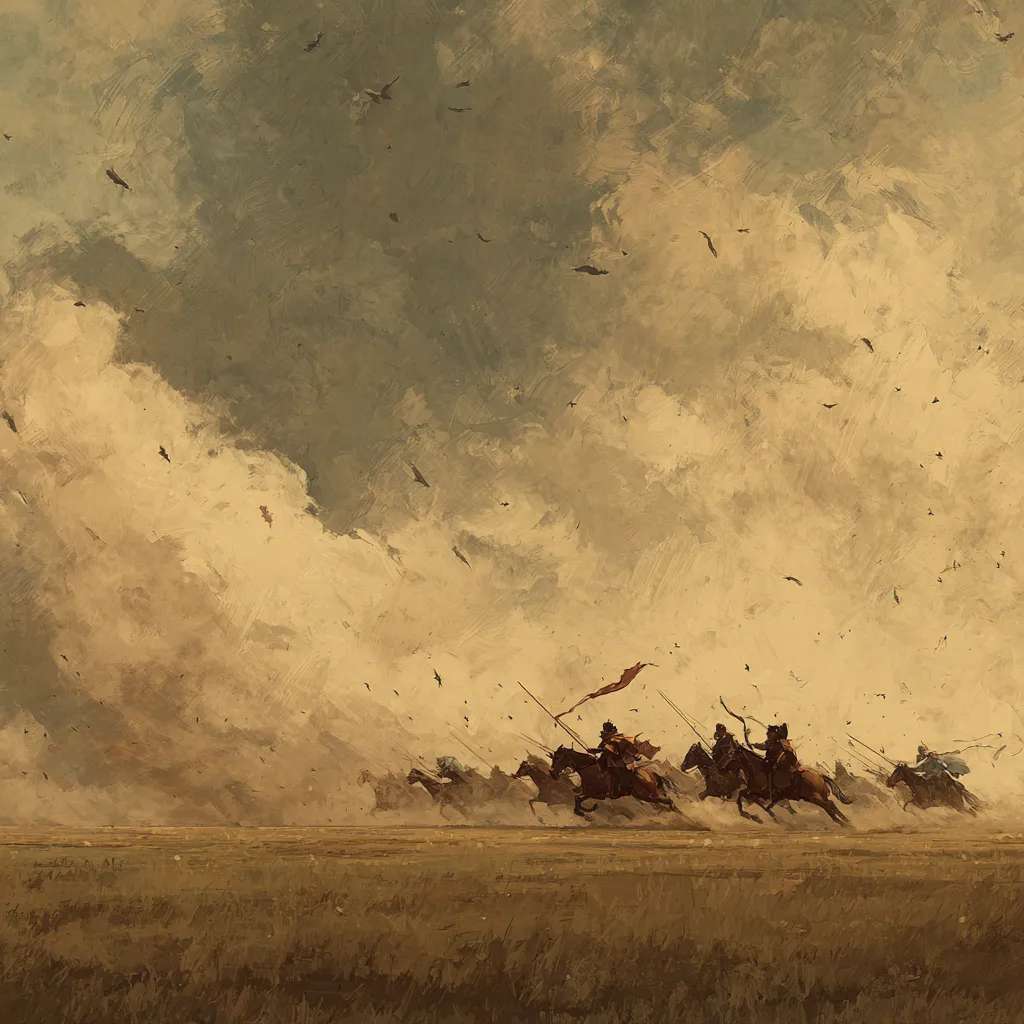
Continue Genghis Khan's story
You've read the summary — hear the full story as narrated 5-minute chapters on Chunks, alongside 200+ figures and events from history, philosophy and science. Free to start on iOS and Android.