
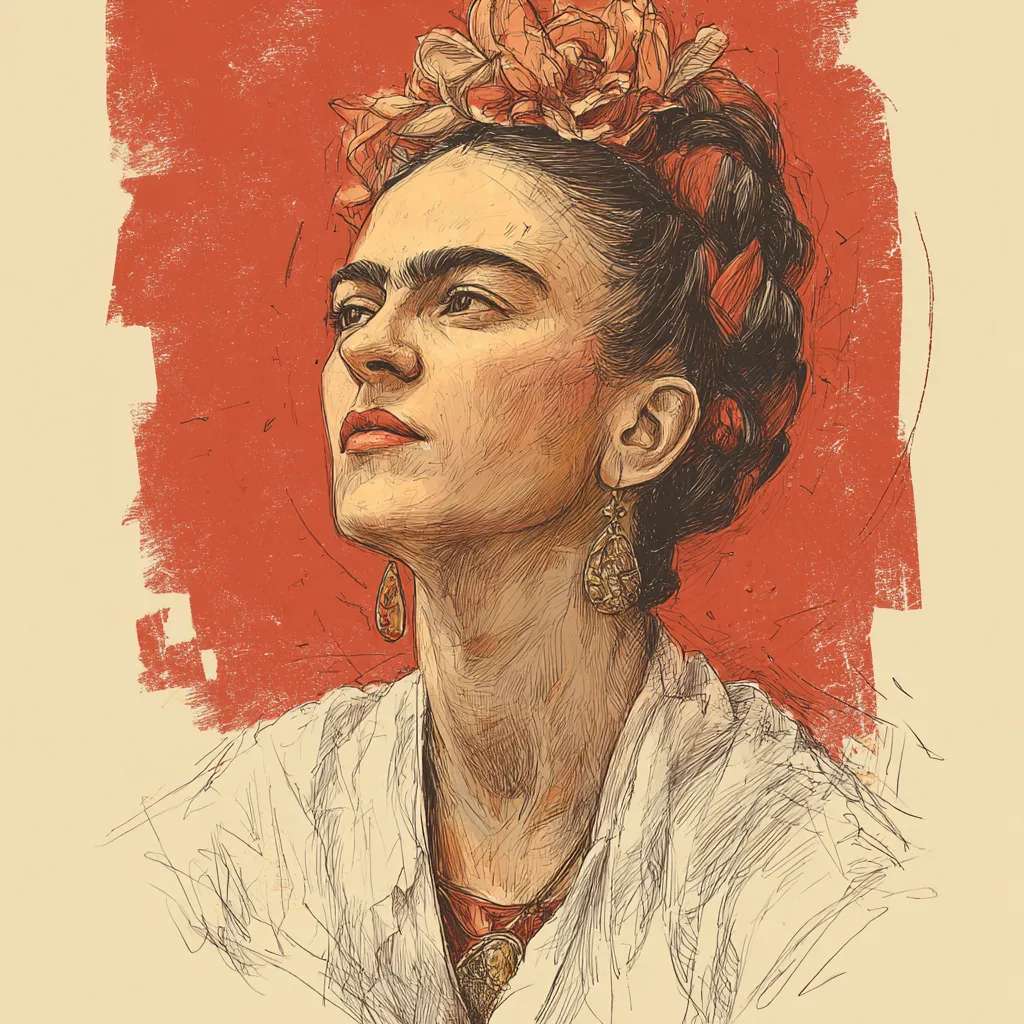
Who was Frida Kahlo?
Frida Kahlo (6 July 1907 – 13 July 1954) was a Mexican painter known for self-portraits and works inspired by Mexican folk culture, exploring identity, gender, and chronic pain. After a severe bus accident at 18 left her disabled, she turned to painting during recovery. She became an icon for feminist, Chicano, and LGBTQ+ communities, and remains one of Mexico's most celebrated artists.
Mexican artist whose intensely personal paintings explored themes of identity, pain, and Mexican culture with raw emotional power. Her bold self-portraits and surrealist-influenced works made her an icon of artistic expression and feminist strength.
Don't stop at the facts — continue Frida Kahlo's story in free narrated chapters on Chunks.
 Download on iOS
 Download on Android
Quick facts
- Born
- 6 July 1907
- Birthplace
- Coyoacán
- Died
- 13 July 1954
- Place of death
- Coyoacán
- Nationality
- Mexico
- Occupation
- Painter
Frida Kahlo: key facts
- Frida Kahlo was born on 6 July 1907 in Coyoacán, a village on the outskirts of Mexico City, and died there on 13 July 1954 at the age of 47.
- A severe bus accident at age 18 fractured Kahlo's pelvis, broke her spine in three places, and shattered her right leg in eleven places, causing her lifelong pain and launching her serious pursuit of painting during her recovery.
- Kahlo's 1940 painting The Dream (The Bed) sold at auction in 2025 for $54.7 million, setting the record for the highest auction price ever achieved by a female artist.
- The Louvre purchased Kahlo's painting The Frame following her 1939 Paris exhibition, making her the first Mexican artist to have a work enter the museum's collection.
- Kahlo painted mostly small, intensely autobiographical self-portraits that drew on Mexican folk art traditions, pre-Columbian mythology, and Catholic imagery rather than the large public murals dominant in Mexican art of her era.
- Although Surrealist André Breton championed Kahlo's work and arranged her first solo exhibition at the Julien Levy Gallery in New York in 1938, Kahlo herself rejected Surrealism, calling it bourgeois art that was not true art for the people.
- Kahlo's family home in Coyoacán, La Casa Azul, opened as the Frida Kahlo Museum in 1958 and now draws approximately 25,000 visitors per month.
A Childhood Shaped by Illness and Ambition
Frida Kahlo was born on 6 July 1907 in Coyoacán, then a village on the outskirts of Mexico City. Her father, Guillermo Kahlo, was a German immigrant who worked as a photographer; her mother, Matilde Calderón y González, was born in Oaxaca to an Indigenous father and a mother of Spanish descent. Kahlo grew up in the family home known as La Casa Azul, the Blue House, which later became a museum in her memory.
When Kahlo was six years old she contracted polio, which left her right leg shorter and thinner than the left. The illness forced months of isolation from her peers and drew her closer to her father, with whom she shared the experience of living with disability. Guillermo encouraged her to play sports, taught her photography, and introduced her to literature and philosophy — an unconventional education for a girl of that era. By 1922, Kahlo had earned a place at the elite National Preparatory School in Mexico City, one of only about 35 girls among 2,000 students, where she planned to study medicine.
The Bus Accident That Redirected Her Life
On 17 September 1925, the bus Kahlo was riding home from school was struck by an electric streetcar. Several passengers were killed. Kahlo suffered catastrophic injuries: her pelvis was fractured, her spine was broken in three places, her right leg broken in eleven places, her right foot crushed and dislocated, and an iron handrail pierced her abdomen and uterus. She spent a month in hospital and months more confined to bed, wearing a plaster corset for the better part of three months.
During this long recovery, Kahlo's mother arranged a specially made easel so she could paint lying down, and her father lent her his oil paints. A mirror was fixed above the easel so she could use herself as a model. Painting began as a way to occupy painful, isolated days, but it quickly became the central work of her life. She later explained her focus on self-portraiture simply: she was often alone and was the subject she knew best. The accident ended her plans to become a physician and caused her chronic pain for the rest of her life.
Building a Style from Mexican Folk Roots
Kahlo's early paintings drew on Renaissance masters and European avant-garde movements, but after she moved to Cuernavaca with her husband, muralist Diego Rivera, in 1929 her style shifted decisively toward Mexican folk traditions. She became absorbed by retablos — small religious paintings on metal sheets made by amateur artists to give thanks to saints after surviving calamity. The format suited the kind of intimate, narrative painting she wanted to make, and she eventually collected around 2,000 of them. Works she produced in this manner while in Detroit, including Henry Ford Hospital and My Birth, both from 1932, placed graphic personal experience — miscarriage, pain, the female body — at the centre of her art.
Kahlo and Rivera married in 1929 and spent time in San Francisco, Detroit, and New York during the early 1930s. Despite her growing output, she was still publicly described primarily as Rivera's wife. That changed when French Surrealist André Breton visited Mexico in 1938, declared her work extraordinary, and arranged her first solo exhibition at the Julien Levy Gallery in New York later that year. Half of the 25 paintings on show sold despite the Great Depression. In 1939, the Louvre purchased her painting The Frame, making her the first Mexican artist to enter their collection. Though Breton claimed her as a Surrealist, Kahlo rejected the label, calling Surrealism bourgeois and not true art; she insisted her imagery came from Mexican and Aztec culture, not European intellectual movements.
Pain, Politics, and Recognition in Her Final Years
Throughout the 1940s Kahlo taught at the Escuela Nacional de Pintura, Escultura y Grabado in Mexico City and became a founding member of the Seminario de Cultura Mexicana, a government-backed group of artists working to spread public knowledge of Mexican culture. Her own health deteriorated steadily. She wore a succession of supportive corsets — at least twenty-eight between 1940 and 1954 — and in June 1945 traveled to New York for a spinal operation that fused a bone graft and steel support to her spine. The operation failed. Her paintings from the mid-1940s, among them Broken Column and The Wounded Deer, reflect this physical suffering with unflinching directness.
In August 1953 her right leg was amputated at the knee due to gangrene. She fell into severe depression and her reliance on painkillers increased. Despite being prescribed bed rest, she attended her first solo exhibition in Mexico, staged at the Galería Arte Contemporaneo in April 1953, arriving by ambulance and spending the evening lying in her four-poster bed, which had been moved into the gallery. Her last public appearance was a political demonstration on 2 July 1954. She died on 13 July 1954 at the age of 47. The official cause of death was pulmonary embolism, though biographer Hayden Herrera has argued she took a deliberate overdose of painkillers.
Rediscovery and the Making of a Global Icon
During her lifetime Kahlo was far better known as Diego Rivera's wife than as an artist in her own right. Her reputation began to recover in the late 1970s when feminist art historians challenged the exclusion of women and non-Western artists from the historical canon, and the Chicano movement embraced her as an icon. The first books dedicated to her work appeared in Mexico in 1976 and 1977, and the first major retrospectives were held in 1978. Hayden Herrera's biography, published in 1983, brought her life to a wide international audience.
By 1984 the Mexican government declared her paintings part of the national cultural heritage and prohibited their export, which is why comprehensive retrospectives remain rare outside Mexico. Even so, her work has broken successive auction records: in 1990 she became the first Latin American artist to sell a painting for more than one million dollars, and her 1940 self-portrait The Dream (The Bed) sold in 2025 for 54.7 million dollars, setting a record for the highest auction price ever achieved by a female artist. La Casa Azul, her home in Coyoacán, opened as the Frida Kahlo Museum in 1958 and draws approximately 25,000 visitors each month.
Frida Kahlo: timeline
- 1907Born in Coyoacán, on the outskirts of Mexico City, to German-born photographer Guillermo Kahlo and his mestiza wife Matilde Calderón y González.
- 1913Contracted polio at age six, leaving her right leg shorter and thinner than the left and forcing months of isolation from her peers.
- 1922Enrolled at the elite National Preparatory School in Mexico City, one of only 35 girls among 2,000 students, intending to pursue a career in medicine.
- 1926During her bedridden recovery, began painting seriously using a specially made easel and a mirror, producing portraits of herself, her sisters, and school friends.
- 1929Married muralist Diego Rivera in a civil ceremony in Coyoacán; the couple moved to Cuernavaca, where Kahlo shifted from European influences toward Mexican folk art.
- 1938Held her first solo exhibition at the Julien Levy Gallery in New York, selling half of the 25 paintings on show and attracting major collectors and press attention.
- 1939The Louvre purchased her painting The Frame, making her the first Mexican artist to enter the museum's collection, following a Surrealist exhibition in Paris.
- 1939Divorced Rivera in November after years of mutual infidelities; the separation drove a highly productive period in which she painted some of her most celebrated works, including The Two Fridas.
- 1940Remarried Rivera in a simple civil ceremony in San Francisco, where she had traveled for medical treatment for chronic back pain.
- 1954Died in Coyoacán at age 47; the official cause was pulmonary embolism, though biographer Hayden Herrera has argued she died of a deliberate overdose.
Listen: stories featuring Frida Kahlo
Narrated chapters from the Chunks Microlearning app. Read a preview here, or listen to the full story in the app.

Continue Frida Kahlo's story
You've read the summary — hear the full story as narrated 5-minute chapters on Chunks, alongside 200+ figures and events from history, philosophy and science. Free to start on iOS and Android.