
Who was Ewen Montagu?
Hear Ewen Montagu's story
Chapter 1 of Operation Mincemeat · the full story is in the app
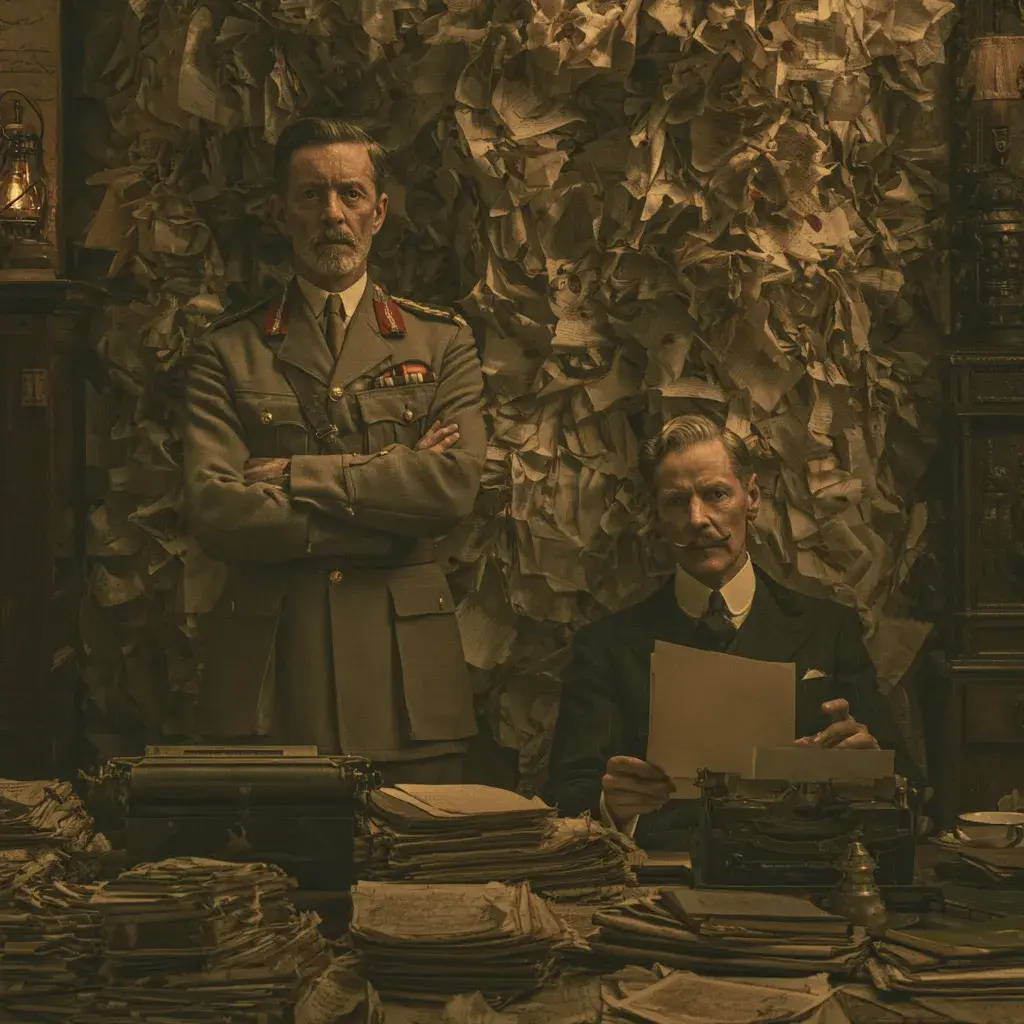
Ewen Montagu (19 March 1901 - 19 July 1985) was a British barrister and Naval intelligence officer best known for devising Operation Mincemeat, a deception that planted false invasion plans on a corpse to mislead German forces away from the Allied invasion of Sicily. He later served as Judge Advocate of the Fleet and wrote The Man Who Never Was, recounting the operation's success.
British naval intelligence officer who devised Operation Mincemeat's deception of Hitler.
Don't stop at the facts — continue Ewen Montagu's story in free narrated chapters on Chunks.
See how Chunks works → Download on iOS
 Download on Android
Quick facts
- Born
- 19 March 1901
- Birthplace
- London
- Died
- 19 July 1985
- Place of death
- London
- Nationality
- United Kingdom
- Occupation
- Intelligence officer, author, screenwriter
Ewen Montagu: key facts
- Ewen Montagu was born on 19 March 1901 in London and died on 19 July 1985 in London.
- He co-devised Operation Mincemeat with Squadron Leader Charles Cholmondeley, planting fake invasion papers on a corpse to mislead German forces away from Sicily in 1943.
- Montagu served in the Naval Intelligence Division of the British Admiralty, reaching the rank of Lieutenant Commander RNVR and sitting as Naval Representative on the XX Committee overseeing double agents.
- He was appointed to the Military Division of the Order of the British Empire for his role in Operation Mincemeat.
- Montagu wrote The Man Who Never Was in 1953, a firsthand account of Operation Mincemeat later adapted into a 1956 film.
- He served as Judge Advocate of the Fleet from 1945 to 1973.
- Montagu was president of the United Synagogue from 1954 to 1962 and President of the Anglo-Jewish Association from December 1949.
A Lawyer's Son Enters the Bar
Ewen Edward Samuel Montagu was born on 19 March 1901 in London, the second son of Louis Montagu, 2nd Baron Swaythling, and Gladys, Baroness Swaythling. The family was Jewish, and young Ewen was sent to Westminster School. During the First World War he worked as a machine gun instructor at a United States Naval Air Station, an unusual posting for a schoolboy of his generation.
After the war he pursued a conventional path for a man of his class and intellect, studying at Trinity College, Cambridge, and then at Harvard University. He trained as a barrister, joining the Middle Temple in November 1920 and being called to the bar in May 1924. His legal career brought him real public attention in 1935, when he served as junior defence counsel for Alma Rattenbury, who stood accused of murdering her much older husband, the architect Francis Rattenbury, in a brutal mallet attack at their Bournemouth home. He took silk, becoming a King's Counsel, in 1939.
From Yachtsman to Naval Intelligence Officer
Montagu was a keen yachtsman, and in 1938, with war looming, he enlisted in the Royal Navy Volunteer Reserve. His legal training marked him out for specialized intelligence work rather than frontline naval duty. He was first posted to the Royal Navy's East Yorkshire command at Hull as an assistant staff officer in intelligence, before moving into the Naval Intelligence Division of the Admiralty itself, where he rose to the rank of Lieutenant Commander.
Within the intelligence world Montagu took on a particularly sensitive role as the Naval Representative on the XX Committee, the body responsible for overseeing Britain's network of double agents feeding false information to Germany. It was from this position, as Commanding Officer of the unit known as NID 17M, that he and Royal Air Force Squadron Leader Charles Cholmondeley began shaping the plan that would become his defining achievement.
Operation Mincemeat
Montagu's idea was audacious: plant a corpse, dressed as a British officer, so that it would wash ashore in Spain carrying fabricated documents pointing to an Allied invasion of Greece, when the real target was Sicily. Spain's officials, sympathetic to Germany, were expected to pass the papers to German intelligence. Montagu built an entire false identity for the body, that of Glyndwr Michael, naming him Acting Major William Martin and filling his pockets with a convincing scatter of personal detail, military identification, theatre ticket stubs, love letters, a photograph of a fiancée, and bills from a tailor and jeweller. To complete the illusion, Martin's death was dutifully recorded in the obituary columns of The Times on 4 June 1943, following standard wartime practice for missing or dead officers.
The deception worked completely. Captured German records later confirmed that the false papers were believed all the way up to Hitler's own headquarters, prompting German forces to be redirected toward Greece. Sicily was invaded successfully soon afterward. The historian Hugh Trevor-Roper later called it the finest deception in the history of military warfare. Montagu was appointed to the Military Division of the Order of the British Empire for his part in the operation. Decades later, in November 2021, a memorial to the operation was placed at Hackney Mortuary, where Michael's body had originally been prepared, a joint project of the Jewish American Society for Historic Preservation, the Association of Jewish Ex-Servicemen and Women, and the London Borough of Hackney.
Judge Advocate, Author, and Communal Leader
After the war Montagu returned fully to the law, serving as Judge Advocate of the Fleet from 1945 to 1973, a long tenure overseeing naval military justice. Before the Courts Act 1971 reorganised the system, he also chaired the Quarter Sessions for the Middlesex area of Greater London and served as a recorder in Hampshire, alongside an appointment as Deputy Lieutenant of the County of Southampton.
Montagu turned his wartime experience into writing, publishing The Man Who Never Was in 1953, a account of Operation Mincemeat that was made into a film three years later. He also wrote Beyond Top Secret Ultra, covering wartime intelligence and espionage methods more broadly, and The Archer-Shee Case, drawing on his legal background. Outside the courtroom and his writing desk, Montagu was deeply involved in Jewish communal life, serving as President of the Anglo-Jewish Association from December 1949 and as president of the United Synagogue from 1954 to 1962. He also served as a governor of the Peckham Experiment, a public health initiative, from 1949.
Montagu married Iris, daughter of the painter Solomon J. Solomon, on 14 June 1923. They had two children, Jeremy, who became a noted authority on musical instruments, and Jennifer, who became an art historian. His younger brother Ivor Montagu was a filmmaker and committed Communist, a striking political contrast within the same family. Montagu died in London on 19 July 1985.
Portrayals on Screen and Stage
Montagu's life has been dramatized repeatedly. In the 1956 film adaptation of The Man Who Never Was, he was played by Clifton Webb, while Montagu himself appeared in a small role as an air-vice marshal questioning the character based on him. In the 2021 film Operation Mincemeat, he was portrayed by Colin Firth. The Rattenbury murder case in which he served as junior defence counsel has also been dramatized, notably in Terence Rattigan's Cause Celebre, appearing as a radio play in 1975, a stage play in 1977, and a television film in 1987, with different actors taking the role of Montagu in each version.
More recently, Montagu became the central character of a stage musical simply titled Operation Mincemeat, where the role was originated in the West End by co-creator Natasha Hodgson, who also played the part on Broadway. Notably, every actor to take on the role in that production has been a woman, including performers such as Holly Sumpton, Geri Allen, and Emily Barber among others, a playful inversion that has become one of the production's distinguishing features.
Ewen Montagu: timeline
- 1901Born in London to Gladys and Louis Montagu, 2nd Baron Swaythling.
- 1910sEducated at Westminster School, then served as a machine gun instructor at a United States Naval Air Station during the First World War.
- 1920-24Admitted to the Middle Temple in 1920 and called to the bar in 1924 after studying at Trinity College, Cambridge, and Harvard.
- 1935Acted as junior barrister in the defence of Alma Rattenbury, accused of murdering her husband Francis Rattenbury.
- 1938Enlisted in the Royal Navy Volunteer Reserve.
- 1939Took silk, becoming a King's Counsel.
- 1943With Charles Cholmondeley devised Operation Mincemeat, planting false invasion plans on a corpse disguised as Acting Major William Martin, listed in The Times obituaries on 4 June.
- 1945-73Served as Judge Advocate of the Fleet.
- 1949Became President of the Anglo-Jewish Association.
- 1953Published The Man Who Never Was, his account of Operation Mincemeat, later adapted into a 1956 film.
- 1954-62Served as president of the United Synagogue.
- 1985Died in London.
Listen: stories featuring Ewen Montagu
Narrated chapters from the Chunks Microlearning app. Read a preview here, or listen to the full story in the app.
Continue Ewen Montagu's story
You've read the summary — hear the full story as narrated 5-minute chapters on Chunks, alongside 200+ figures and events from history, philosophy and science. Free to start on iOS and Android.