
Who was Edward Jenner?
Edward Jenner (17 May 1749 – 26 January 1823) was an English physician and scientist who created the world's first vaccine, using cowpox to protect against smallpox. Often called the father of immunology, his work is credited with saving more lives than any other individual. He was also a naturalist who made early observations on cuckoo brood parasitism and was a fellow of the Royal Society.
English physician who developed the world's first vaccine against smallpox, pioneering the field of immunology and saving millions of lives.
Don't stop at the facts — continue Edward Jenner's story in free narrated chapters on Chunks.
Or get it straight away:
 Download on iOS
 Download on Android
Quick facts
- Born
- 17 May 1749
- Birthplace
- Berkeley
- Died
- 26 January 1823
- Place of death
- Berkeley
- Nationality
- United Kingdom of Great Britain and Ireland
- Occupation
- Physician, naturalist, biologist
Edward Jenner: key facts
- Edward Jenner was born on 17 May 1749 in Berkeley, Gloucestershire, England, and died there on 26 January 1823 after suffering a stroke.
- On 14 May 1796, Jenner inoculated eight-year-old James Phipps with pus from cowpox blisters, then proved Phipps was immune to smallpox by subsequent challenges with smallpox material.
- Jenner coined the term 'Variolae vaccinae' to describe cowpox, and the words 'vaccine' and 'vaccination' are both derived from this Latin phrase meaning 'pustules of the cow'.
- Before creating his vaccine, Jenner studied the cuckoo and was among the first to document that newly hatched cuckoos — not adult birds — push host eggs and chicks from the nest, publishing his findings in Philosophical Transactions of the Royal Society in 1788.
- The British Parliament granted Jenner £10,000 in 1802 for his work on vaccination, followed by a further £20,000 in 1807 after the Royal College of Physicians confirmed vaccination's widespread efficacy.
- In 1821, Jenner was appointed physician extraordinary to King George IV and was also made mayor of Berkeley and justice of the peace.
- In 2002, Jenner was named in the BBC's list of the 100 Greatest Britons, and the World Health Organization had already declared smallpox eradicated in 1980, a milestone made possible in large part by vaccination.
A Country Doctor's Education, from Berkeley to London
Edward Jenner was born on 17 May 1749 in Berkeley, Gloucestershire, the eighth of nine children. His father was the Reverend Stephen Jenner, vicar of Berkeley, and the family's standing ensured Edward received a solid early education at schools in Wotton-under-Edge and Cirencester. As a boy he underwent variolation — deliberate inoculation with smallpox material, then the standard method of building immunity — an experience that left a lasting mark on his health.
At thirteen, Jenner began a seven-year apprenticeship with Daniel Ludlow, a surgeon in Chipping Sodbury, acquiring most of the practical skills a surgeon needed. In 1770, aged twenty-one, he moved to London to train under the eminent surgeon John Hunter at St George's Hospital. Hunter passed on a piece of advice he attributed to William Harvey: 'Don't think; try.' The empirical spirit behind those words would shape Jenner's entire career. By 1773 he had returned to Berkeley, where he built a successful practice as a family doctor and surgeon, eventually earning an MD from the University of St Andrews in 1792.
Cuckoos, Cowpox, and the Royal Society
Before Jenner became famous for vaccination, he earned his place in the scientific world through a meticulous study of the cuckoo. It was widely assumed that adult cuckoos evicted the eggs and chicks of their hosts, but Jenner demonstrated through direct observation, experiment, and dissection that it is the newly hatched cuckoo that does this work. He also identified the anatomical reason: the newborn cuckoo has a broad back with a pronounced hollow below the shoulder blades, perfectly shaped for levering eggs and nestlings over the rim of the nest. After about twelve days, this hollow fills in and disappears entirely.
Jenner published these findings in the Philosophical Transactions of the Royal Society in 1788, the same year he was elected a fellow of that body. His account was not universally accepted at first, but decades later the artist and bird observer Jemima Blackburn witnessed a blind nestling performing exactly the eviction Jenner had described, and her illustration was compelling enough to persuade Charles Darwin to revise a passage in a later edition of On the Origin of Species. Jenner's dual competence in animal biology and human medicine would prove directly relevant to his later work on vaccination, since the key insight — that a disease crossing from cattle to humans could confer protection — depended on understanding how diseases moved between species.
The Cowpox Experiment and What It Actually Proved
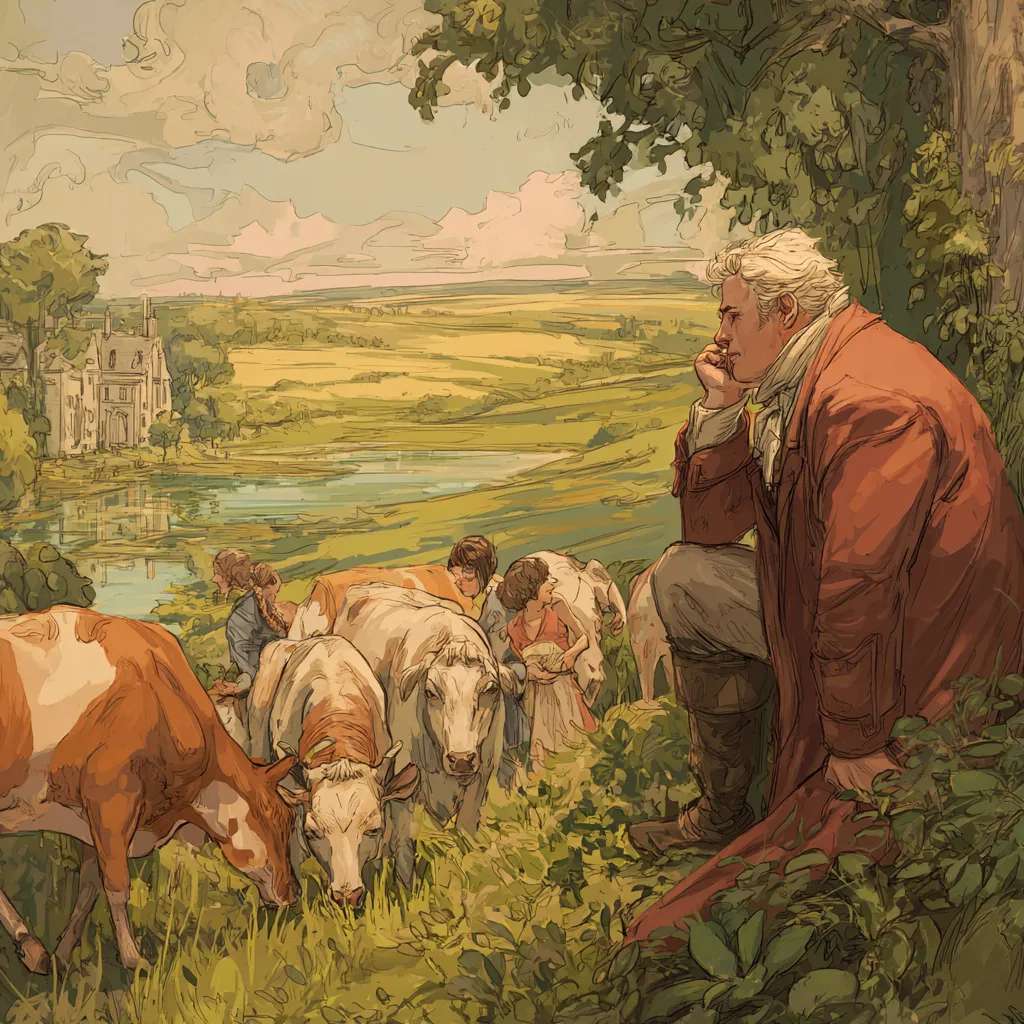
The popular story that Jenner was inspired by the clear complexions of milkmaids turns out to be a later invention by his biographer John Baron, not a documented fact. What Jenner actually did was more rigorous than a single charming observation. By 1796 he had formulated the hypothesis that the pus from cowpox blisters could protect a person from smallpox. On 14 May 1796 he tested this by taking material from blisters on the hands of a milkmaid named Sarah Nelmes, who had caught cowpox from a cow called Blossom, and inoculating it into James Phipps, the eight-year-old son of his gardener, through two small cuts in the boy's arm.
Phipps developed a mild fever but no serious illness. On 1 July 1796 Jenner then inoculated Phipps with variolous material — the standard smallpox immunisation method — and no disease followed. As the American physician Donald Hopkins later observed, Jenner's unique contribution was not simply using cowpox but proving through deliberate subsequent challenge that recipients were genuinely immune to smallpox, and showing that the protective material could be passed from person to person rather than needing to come directly from cattle each time. Jenner went on to test the procedure on twenty-three further subjects, including his own eleven-month-old son Robert, and published the full set of findings in 1798 in his Inquiry Into the Causes and Effects of the Variolae Vaccinae.
Vaccination Spreads Across Europe and Beyond
The medical establishment did not accept Jenner's findings immediately, but acceptance came. Parliament granted him ten thousand pounds in 1802 in recognition of his work, and a further twenty thousand pounds in 1807 after the Royal College of Physicians confirmed how widely effective vaccination had proved. In 1803 Jenner became president of the Jennerian Society, a body specifically created to promote vaccination and work toward eradicating smallpox. The British government eventually banned variolation outright in 1840 and provided cowpox vaccination free of charge.
The reach of the discovery extended far beyond Britain. Napoleon, despite being at war with Britain, had his entire French army vaccinated and awarded Jenner a medal. On two separate occasions Jenner personally petitioned Napoleon to release English prisoners of war, and Napoleon complied, reportedly saying he could not refuse anything to one of the greatest benefactors of mankind. Between 1803 and 1806 the Spanish Balmis Expedition carried the vaccine to the Americas, the Philippines, Macao, and China, vaccinating thousands. Jenner called it an example of philanthropy unmatched in the historical record.
Final Years in Berkeley and a Lasting Verdict
Jenner never entirely left Berkeley, and the demands of promoting vaccination increasingly consumed time that had once gone to ordinary medical practice. He continued pursuing natural history alongside medicine; in 1823, the last year of his life, he presented a paper on bird migration to the Royal Society. That same year, on 25 January 1823, he was found in a state of apoplexy with his right side paralysed. He died the following day, 26 January 1823, aged seventy-three, from what appears to have been his second stroke, and was buried in the family vault at the Church of St Mary in Berkeley.
In 1821 he had been appointed physician extraordinary to King George IV and made both mayor of Berkeley and a justice of the peace. The World Health Organization declared smallpox eradicated in 1980, the direct long-term consequence of the vaccination programme Jenner started. In 2002 a BBC poll of the British public placed him among the 100 Greatest Britons. The terms vaccine and vaccination, now applied to immunisation against dozens of diseases, both derive from Variolae vaccinae, the Latin phrase Jenner himself coined, meaning pustules of the cow.
Edward Jenner: timeline
- 1749Born in Berkeley, Gloucestershire, England, the eighth of nine children of the Reverend Stephen Jenner, vicar of Berkeley.
- 1770At age 21, began apprenticeship in surgery and anatomy under surgeon John Hunter at St George's Hospital, London.
- 1773Returned to Berkeley and established himself as a successful family doctor and surgeon, practising on dedicated premises in his hometown.
- 1788Married Catherine Kingscote and was elected a Fellow of the Royal Society, following publication of his study on the brood parasitism of the cuckoo.
- 1792Earned the degree of MD from the University of St Andrews after roughly twenty years of general practice and surgery.
- 1796Tested his cowpox hypothesis by inoculating eight-year-old James Phipps with pus from cowpox blisters, then confirmed Phipps showed no infection when exposed to smallpox material.
- 1798Published his landmark Inquiry into the Variolae vaccinae known as the Cow Pox, describing the protective effect of cowpox against smallpox across 23 documented cases.
- 1802Parliament granted him £10,000 in recognition of his work on vaccination; he was also elected a foreign honorary member of the American Academy of Arts and Sciences that year.
- 1807Awarded a further £20,000 by Parliament after the Royal College of Physicians confirmed the widespread efficacy of vaccination.
- 1821Appointed physician extraordinary to King George IV and made mayor of Berkeley and justice of the peace.
- 1823Died in Berkeley of an apparent stroke at age 73, having been found in a state of apoplexy the previous day with his right side paralysed.
Listen: stories featuring Edward Jenner
Narrated chapters from the Chunks Microlearning app. Read a preview here, or listen to the full story in the app.
Continue Edward Jenner's story
You've read the summary — hear the full story as narrated 5-minute chapters on Chunks, alongside 200+ figures and events from history, philosophy and science. Free to start on iOS and Android.